How to Go Viral on Social Media: What 176,367 Videos Show
Going viral is a hook, a format and a reason to share, not luck. Here is the 7-step method, with Revid's data on 176,367 TikToks showing which formats, moods and captions win.
On this page
To go viral on social media, post a short vertical video that hooks viewers in the first 3 seconds, triggers a strong emotion such as humor or surprise, holds attention to the end and gives people a reason to share it. Publish it on a recommendation feed (TikTok, Instagram Reels or YouTube Shorts), then repeat the format that worked.
Most creators lose before they hit record, because they choose the wrong format. In Revid's analysis of 176,367 TikToks with 1,000+ likes posted between October 2025 and October 2026, challenges had a median of 182K views and comedy 155K, while tutorials sat at 62K. Same platform, same entry bar, a far higher ceiling.
- Median views for challenge TikToks, the top format
- 182K
- Revid analysis of 176,367 TikToks
- Share of challenge TikToks that passed 1 million views
- 25.6%
- Revid analysis of 176,367 TikToks
- Share of popular TikToks (1,000+ likes) that passed 1 million views
- 11.9%
- Revid analysis of 176,367 TikToks
- U.S. adults who use TikTok, up from 21% in 2021
- 37%
- Pew Research Center, November 2025
How to go viral: the short version
- Pick one platform with a recommendation feed and learn it before adding others.
- Choose a format with a high ceiling (challenge, comedy, reaction, POV) and adapt it to your niche.
- Open with a hook that shows the payoff or the problem in the first 3 seconds.
- Show more than you say: when the visual can carry the idea, keep the talking short.
- Write a one-line caption that invites a comment, and use 3 to 4 hashtags on TikTok (Instagram caps you at 5).
- Post often and post fresh, especially when you react to news.
- After each post, read shares, saves and retention, change one variable, and repeat what wins.
The sections below explain each step.
What makes a post go viral?
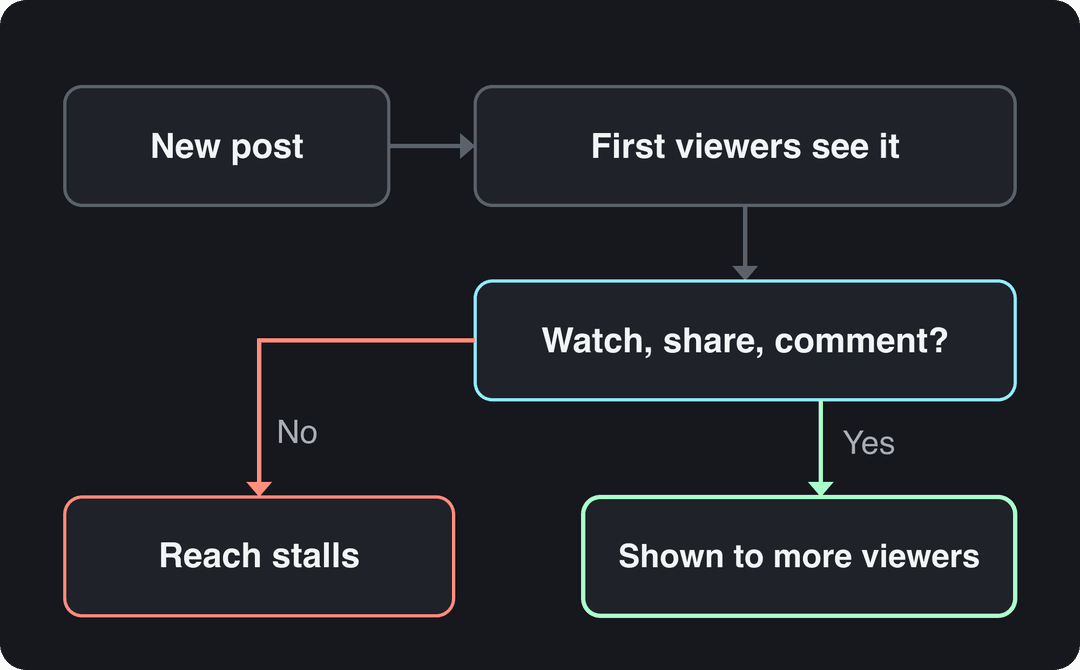
A post goes viral when people share it faster than your normal reach would carry it, so it keeps finding new viewers on its own. On short-form platforms that happens through the recommendation feed: TikTok opens on the personalized For You feed, and Instagram's trial reels are shown first to people who do not follow you. Your follower count matters less than how the first viewers react.
The feed watches what those first viewers do. If they watch to the end, rewatch, share, comment or save, the post reaches more people; if they swipe away, reach stalls. Every step in this guide is about winning that first test.
High-arousal emotions (outrage, humor, sadness) earned the most views. Calm, inspirational videos earned the least, even though they collect the most likes per view.
Source: Revid analysis of 176,367 TikToks with 1,000+ likes posted between Oct 1, 2025 and Oct 16, 2026 (61,203 creators)
Show the data
| Median views | Share that passed 1M views | |
|---|---|---|
| Outrage | 156K | 23.7% |
| Humor | 121K | 19.3% |
| Sadness | 104.4K | 16.5% |
| Excitement | 92.5K | 15.9% |
| Joy | 89.9K | 18% |
| Informative | 64.1K | 11.2% |
| Neutral | 61.2K | 11.5% |
| Inspirational | 44.6K | 11.3% |
Emotion is what gets shared
People share content that makes them feel something strongly and says something about them. Revid's AI analysis of each video's dominant mood shows how wide the gap is: TikToks driven by outrage had a 156K median and humor 121K, while inspirational videos sat at 45K. Generic motivation is the weakest emotional bet.
Outrage works, but it carries brand risk. For most accounts the practical rule is simple: make people laugh, or take a sharp, defensible position they will want to argue with or agree with in the comments.
Make it easy to share
A share is social currency: the post someone forwards is the one that lets them say "this is so you" without typing a word. Before posting, run one test: can you name a specific person a viewer would send this to? If not, sharpen the angle. Titan Blue's guide to creating shareable social media content covers more ways to package posts for sharing.
Simple formats spread furthest. A meme template anyone can apply to their job, relationship or favorite show gets copied, stitched and remixed, and every copy points back to the original.
Prompt to try
Make a 30-second faceless tutorial on how to build a monthly budget in Google Sheets. Open on the finished, color-coded spreadsheet with the text "This took me 5 minutes", then rewind and show each step as a screen-style walkthrough. Keep narration short, put key words on screen in bold captions, and end with the question "What would you track first?"
Which formats go viral most often?
Format is the choice with the biggest spread in outcomes. In Revid's study of 176,367 TikToks, challenges had a 182K median and 25.6% passed 1 million views, comedy had 155K (22%), reactions 105K (16%) and dance 84K, while storytelling (66K) and tutorials (62K) trailed. The sample only includes videos that already reached 1,000+ likes, so these figures show what top performers have in common, not what causes views; the method is in the full study on what makes a TikTok go viral.
Challenges and comedy passed 1M views about twice as often as tutorials and storytelling, which are the most common formats.
Source: Revid analysis of 176,367 TikToks with 1,000+ likes posted between Oct 1, 2025 and Oct 16, 2026 (61,203 creators)
Show the data
| Median views | Share that passed 1M views | |
|---|---|---|
| Challenge | 182.3K | 25.6% |
| Comedy | 154.8K | 22.1% |
| Reaction | 104.8K | 16% |
| Dance | 83.8K | 15.5% |
| Storytelling | 66.1K | 12.2% |
| Lip Sync | 61.7K | 12.3% |
| Tutorial | 61.9K | 12.1% |
Two more patterns from the same TikTok data are worth acting on:
- Faceless often wins. Faceless videos had a 114K median vs 67K for one person on camera, and faceless tutorials reached 156K vs 52K for on-camera tutorials. If you teach, show the hands, the screen or the result instead of your face.
- POV beats selfie. POV shots had a 107K median and screen recordings 91K, while selfie-style videos had 48K.
| If your niche is... | Try this format | Example |
|---|---|---|
| Education or how-to | Faceless tutorial, result first | A screen recording that opens on the finished spreadsheet, then rewinds |
| A product or small business | Challenge | "Can this tool survive a week of daily abuse?" |
| Lifestyle or relationships | POV comedy | "POV: you said 'one more episode' at midnight" |
| B2B or SaaS | Problem-solution skit | The old way vs your way, side by side |
| Commentary | Reaction with a strong take | Stitch a popular claim and argue with it in one line |
How do you hook viewers in the first 3 seconds?
The hook decides whether the feed's first test even starts. Open on the most interesting frame of the video, never on a greeting or background context. Patterns that work:
- Payoff first: show the finished room, the final score or the reaction, then rewind to how you got there.
- Name the mistake: "Stop rinsing your rice like this."
- Start mid-action: the first frame is already moving, with no intro.
- Make an arguable claim: "Cold brew is a scam, and here's the math."
- Open a loop: "I tried the viral hack so you don't have to. It went badly."
Revid's data suggests saying less. TikToks with under 40 characters of speech had a 123K median and 20.2% passed 1 million views, against 68K for videos with talking throughout. When the visual can carry the idea, let it, and put the key words on screen. For tested openers you can adapt, use this list of TikTok hooks that stop the scroll.
Prompt to try
Create a 20-second problem-solution video about fixing messy cables behind a desk. Hook: tangled cables with the line "This took me way too long to fix", then hands clipping a cable tray under the desk, then a clean desk reveal with "Ten minutes, no drilling". Use quick cuts, bold on-screen captions and a short flash back to the mess at the end.
Story structures that hold viewers to the end
A viral video tells a complete micro-story, so viewers feel rewarded for staying. Four structures cover most hits:
- Problem, then solution: open with a familiar annoyance and deliver the fix fast.
- Before and after: show the transformation and make viewers wait for the reveal.
- Setup and twist: start somewhere predictable, then break the expectation.
- Cliffhanger and Part 2: end on an open question and post the answer next. Comments asking for part 2 are one of the strongest signals you can get.
A problem-solution script for a short video looks like this:
| Beat | On screen | Text or voice |
|---|---|---|
| Hook | Tangled cables behind a desk | "This took me way too long to fix" |
| Build | Hands clipping a cable tray under the desk | "Two clips and one tray" |
| Payoff | Clean desk, camera pulls back | "Ten minutes, no drilling" |
| Loop | Cut back to the mess for a split second | Caption: "Which one is your desk?" |
Edit tight: cut every pause, and only let a shot linger when you are building suspense. Many people watch with the sound off, so add on-screen text or auto captions for your videos in a bold, readable font. Trending audio helps discovery, but only when you reinterpret the trend for your niche instead of copying it.
How long should a viral video be?
Length matters less than format. In Revid's 12-month TikTok study, every length from under 15 seconds to 10 minutes had a median between 58K and 76K views, with 61 to 90 seconds slightly ahead at 70K. Videos under 15 seconds had the lowest median (58K) but the most shares per view (1.41 per 100). Make the video as long as the story needs, and cut every second that does not move it forward.
Captions, hashtags and comments
The caption is where the conversation starts. TikToks with captions of 41 to 80 characters had the best median (67K views), while videos with no caption had 36K and only 7.5% passed 1 million. Write one line that adds context or asks a specific question:
- "What's the worst advice you got in your first job?"
- "Be honest: is this genius or unhinged?"
- "Part 2 if this gets weird enough."
On hashtags, 4 tags had the best median in Revid's TikTok data (77K views) and 3 tags 75K, while posts with no hashtags had 51K and posts with 9 or more fell to 16K. On Instagram the question is settled for you: posts allow up to 5 hashtags.
Replies keep a post alive. Instead of hearting a comment or writing "thanks", turn it into a new thread: answer "Great video" with "We almost used a different ending. Which part got you?" For broader numbers on how audiences interact with brands, see Talkwalker's roundup of social media statistics.
Which platform gives you the best shot at going viral?
Pick one hero platform, learn its rules, and only repurpose once you have a format that works. Each platform reaches new viewers differently:
| Platform | How new viewers find you | Rules that affect reach |
|---|---|---|
| TikTok | Personalized For You feed, open to any account | Uploads up to 60 minutes; labeling realistic AI content is required and does not reduce distribution |
| Instagram Reels | Mix of followers and recommendations; trial reels go to non-followers first | Reels over 3 minutes are not recommended to non-followers; up to 5 hashtags |
| YouTube Shorts | The Shorts feed | Square or vertical videos up to 3 minutes count as Shorts; a Short over 1 minute with a Content ID claim is blocked globally |
| Facebook Reels | Every new Facebook video is now a reel | Since March 2026, reaction-only, clip-stitched and lightly edited reposts are deprioritized |
Decision rules: if you are starting from zero and your content is fast and trend-driven, start on TikTok. If you already have an Instagram audience or a visual niche, start with Reels. If you want a path to long-form, start with Shorts. If your audience is over 40 and gathers in groups, test Facebook.
Reach is part of the decision. In Pew Research Center's 2025 survey, 37% of U.S. adults said they use TikTok, up from 21% in 2021, and 63% of U.S. adults under 30 use it. SocialPilot keeps a broader set of social media usage statistics by platform. For businesses, short video is also what buyers ask for: in Wyzowl's 2026 survey, 63% of consumers said a short video is how they would most like to learn about a product, ahead of text articles (12%) and infographics (7%), as compiled in our short-form video statistics. Yaguara has another compilation of short-form video statistics if you want more context.
Once one platform works, adapt your winners for the others with this guide to repurposing content for social media.
How to go viral in the media, beyond your own feed
Going viral in the media means other accounts, newsletters and news outlets pick up your post and spread it for you. That reach matters more each year: in the Reuters Institute's Digital News Report 2026, social media and video networks became the most widely used way to access online news, used by 54% of respondents.
What gets picked up:
- Something new: your own numbers, a test you ran, or a first-hand look at a story people already talk about.
- Speed: Meta said same-day posts made up more than 30% of recommended Reels on Instagram and Facebook in Q1 2026. React to news the day it breaks.
- Easy credit: keep your handle on screen and state the claim in the caption, so a bigger account can repost or quote you accurately.
- One clear sentence: if an editor cannot turn your post into a headline, they will not use it.
How to master viral content: measure, test, repeat
One viral post is luck; a repeatable format is a system. After every post, check analytics in TikTok Studio or Instagram insights and look past likes:
| Metric | What it tells you | TikTok benchmark (Revid's index) |
|---|---|---|
| Shares per view | Whether people pass it on | 0.88% |
| Likes per view | Whether viewers approve | 7.1% |
| Comments per view | Whether it starts a conversation | 0.08% |
| Saves | Whether it is worth coming back to | Compare with your own average |
| Retention after 3 seconds | Whether the hook works | Compare with your own average |
The benchmarks come from TikToks that already reached 1,000+ likes, so a post that beats them on your account is doing well.
Then test one variable at a time, so you know what caused the change:
| Variable | Version A | Version B |
|---|---|---|
| Hook | A question: "Are you making this mistake?" | Payoff first: the finished result in frame one |
| Audio | A trending sound | Your own voice-over |
| Perspective | You on camera | Faceless: hands, screen or POV |
| Caption | No caption | One line of 41 to 80 characters ending in a question |
| Posting time | Your usual slot | Early morning |
On timing, Revid's TikTok data found posts at 3 to 6 a.m. US Eastern outperformed those at 5 to 9 p.m., but those hours also cover daytime in Europe and Asia, so confirm with your own audience's active times in TikTok Studio. On Instagram, trial reels let you test a variation on non-followers without affecting how your standard reels rank. To make testing a habit, Blonde Waterfall's 15-minute social media routine is a simple daily structure.
Every few weeks, line up your top five posts and ask three questions: what emotion did each trigger, what format was it, and what problem or topic did it hit? The common thread is your formula. Repeat the strategy, not the exact video, and use this framework for creating viral videos to turn it into a production plan.
How to go viral with Revid
Revid starts from videos that already went viral instead of a blank prompt, which is the approach this guide recommends.
- Search Revid's library of viral videos, about 2.77 million short-form posts with public engagement data, by topic, platform, engagement tier and length.
- Open a video and run Deep analysis (free, up to 60 a day). It explains the hook, the timed structure, the scroll-stopping moment and three ways to adapt it to your niche.
- Choose "Make it about your topic" or "Same energy, new script", and the AI video generator writes a new script with visuals, voice-over, captions and music.
- Adjust scenes in the timeline editor, publish directly to TikTok, Instagram and YouTube, and compare the views, likes and comments each post reports. Remix the winner, or use "Post the Part 2" to answer the question it left open.
FAQ
How many views is considered viral?
There is no official number, but 1 million views is the common benchmark. It is a high bar: in Revid's study of 176,367 TikToks that already had 1,000+ likes, the median was 64.4K views and only 11.9% passed 1 million. For a small account, a post that travels far beyond your usual reach through shares is viral in practice.
Can you go viral with no followers?
Yes. TikTok's For You feed recommends videos from any account, so a new creator's post can reach millions if the first viewers watch and share it. On Instagram, trial reels go to non-followers first, but they require a public account with at least 200 followers (professional) or 1,000 (personal).
Is going viral just luck?
Partly, since you cannot control which post takes off. You can control the odds: a high-ceiling format, a strong hook, a short caption and consistent posting mean each post gets a fair test, and breakouts usually come after many posts, not the first.
Does AI-generated content go viral?
On TikTok it can: Revid's study of AI videos vs real footage found AI-generated TikToks averaged twice the views of real footage, while on X, Instagram and Threads AI visuals cluster in the lowest engagement tier. TikTok requires a label on realistic AI content and says the label alone does not reduce distribution.
Sources
- Revid analysis of 176,367 TikToks with 1,000+ likes posted between Oct 1, 2025 and Oct 16, 2026 (61,203 creators)
- Pew Research Center, Americans' Social Media Use 2025 (November 2025)
Charts and figures checked on November 6, 2026.