How to Make Book Summary Videos in 2026 (Scripts + Templates)
A step-by-step guide to book summary videos: the format to pick, a 60-second script structure, four copy-paste templates, the copyright rules that matter and Revid data on how faceless videos perform.

On this page
To make a book summary video, pick one angle on the book instead of covering every chapter. Write a 140 to 160 word script for 60 seconds (Hook, Stakes, Payoff, Action, with three ideas at most), then turn it into a vertical video with a voiceover and word-by-word captions, published as one episode of a recognizable series.
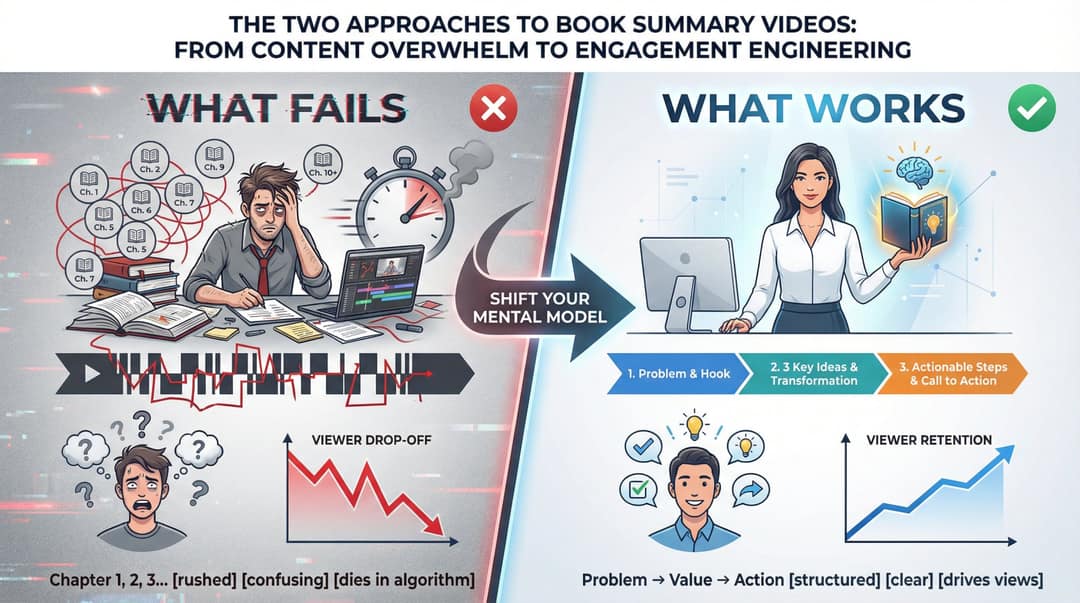
This format rewards people who don't film themselves. In Revid's analysis of 176,367 TikToks with 1,000+ likes posted between October 2025 and October 2026, faceless tutorials had a median of 156K views, against 52K for tutorials with someone on camera. The mistake that wastes that edge is treating the video as an actual summary: chapter one, chapter two, rushed, skipped.
The demand is there. TikTok's business blog on BookTok reported nearly 53 million #BookTok posts and about 59 million U.S. print book sales tied to BookTok content, and Publishers Weekly has covered the trend's pull on print sales for years. People are already searching "[book title] summary" before they buy. Your job is to be the version they finish.
- Median views for faceless tutorials on TikTok, vs 52K with someone on camera
- 156K
- Revid analysis of 176,367 TikToks
- #BookTok posts on TikTok
- 53M
- TikTok business blog
- U.S. print book sales tied to BookTok content
- 59M
- TikTok business blog
- Median TikTok views for posts with 4 hashtags, the best of any count
- 77K
- Revid analysis of 176,367 TikToks
The rule: sell one transformation, not the whole book
A book summary video is not a compressed book. It is a trailer for one change in how the viewer thinks: here is the problem this book solves, here are up to three ideas that fix it, here is what to do today.
If you cram every chapter into 60 seconds, the script turns into a list of half-explained points, viewers swipe, and the platform stops showing the video. One angle, explained well, keeps people watching and makes them want the book.
Step 1: Choose a book summary video format
Five formats work reliably. Pick one and commit to at least 20 videos before switching, because a consistent look is what makes viewers recognize your channel.
| Format | Best for | Main challenge | Production speed |
|---|---|---|---|
| Talking head with captions | Trust and personal authority | Showing up on camera every time | Slower |
| Faceless voiceover with b-roll | Daily, high-volume posting | Visuals that match the words | Fast |
| Kinetic text and slides | Nonfiction frameworks | Keeping typography moving | Fast |
| Background gameplay ("brainrot") | Gen Z audiences | Keeping text readable over motion | Fast |
| Animated or illustrated | Fiction, mood and premium feel | Keeping one consistent style | Slower |
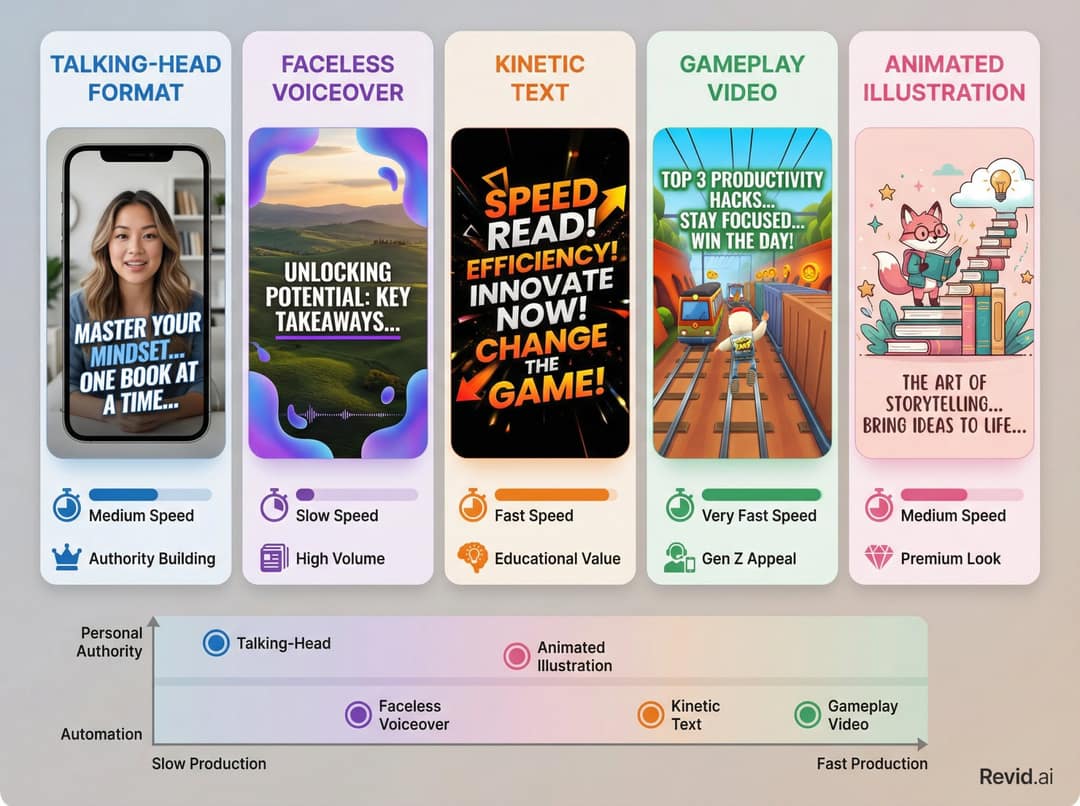
Talking head works when you want viewers to follow you, not just the books. Deliver one to three points with real conviction and let captions carry the key phrases.
Faceless voiceover with b-roll is the speed option: no filming, so daily posting is realistic. The risk is generic stock footage, so direct each scene to show what the sentence says.
Kinetic text and slides drop b-roll entirely and suit "three ideas" frameworks. Change color, scale or position every line or two so the screen never sits still. On TikTok, keep a voiceover: text-only videos don't count as original for Creator Rewards.
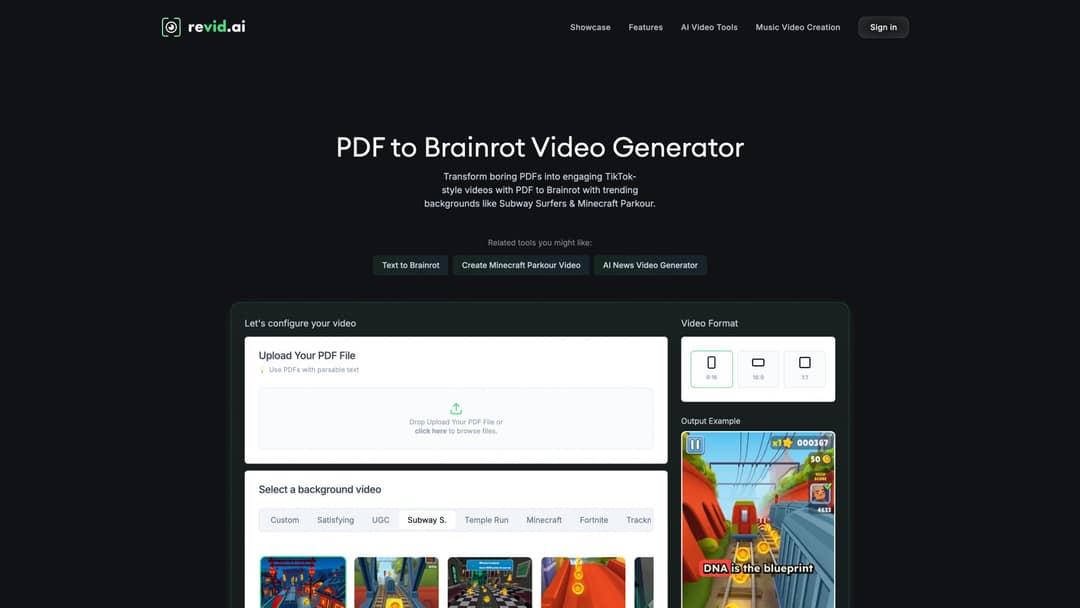
Background gameplay puts your narration and captions over Subway Surfers or Minecraft parkour footage. Revid's PDF to Brainrot generator turns book notes in a PDF into this format directly.
Animated or illustrated summaries fit fiction, where the vibe sells the book. The hard part is keeping the same characters and style across episodes; Revid University shows how a series with consistent characters is built.
If your goal is volume, start faceless or with kinetic text. If your goal is authority, go on camera. The data favors faceless for educational content: in Revid's TikTok study, faceless videos overall had a 114K median and 17.4% passed 1 million views, versus 67K and 12.7% for one person on camera, and the gap was widest for tutorials (22.1% of faceless tutorials passed 1 million views, against 10% on camera). The sample only includes TikToks that already reached 1,000+ likes, and it shows what top videos have in common, not causes.
Faceless tutorials earned about 3x the median views of on-camera tutorials (156K vs 52K).
Source: Revid analysis of 176,367 TikToks with 1,000+ likes posted between Oct 1, 2025 and Oct 16, 2026 (61,203 creators)
Show the data
| Median views | Share that passed 1M views | |
|---|---|---|
| Faceless tutorials | 155.6K | 22.1% |
| Product or object tutorials | 80.7K | 14.9% |
| On-camera tutorials | 52.5K | 10% |
| Faceless storytelling | 72.7K | 13.3% |
| On-camera storytelling | 64.4K | 11.7% |
| Faceless comedy | 326.7K | 26.4% |
| On-camera comedy | 135.5K | 20.7% |
Step 2: Pick the book and the angle
Start with books people already look for. Type the title plus "summary" into YouTube and TikTok search and watch the autocomplete, check Google Trends, and browse viral TikTok book review videos to see which titles and hooks are getting views. Mix evergreen titles (steady search for years) with trending ones (a short spike).
Then pick the angle before you write. These outperform a neutral summary:
- The one idea that changed my mind
- Three rules from this book that feel illegal
- Why most people misunderstand this book
- The framework in 60 seconds
- What this book gets right, and what it gets wrong
- I tried the method for seven days (only if you actually did)
- If you only remember one thing, remember this
- The best quote and what it actually means
- The villain in this book is a belief, not a person
- Who should read this, and who shouldn't
For nonfiction, sell ideas and applications: each idea needs a real-life example. For fiction, sell the premise, the tropes, the mood and the stakes, and skip spoilers unless your channel is openly a spoiler channel.
Prompt to try
Make a 60-second vertical book summary of Atomic Habits that opens with the hook "This book made me stop procrastinating in 48 hours." Name the problem of starting ten things and finishing none, then explain three ideas, each with a quick real-life example and a micro-action. Use fast-changing b-roll, word-by-word captions with the key phrase highlighted, and end with "Try this today and comment the next book you want."
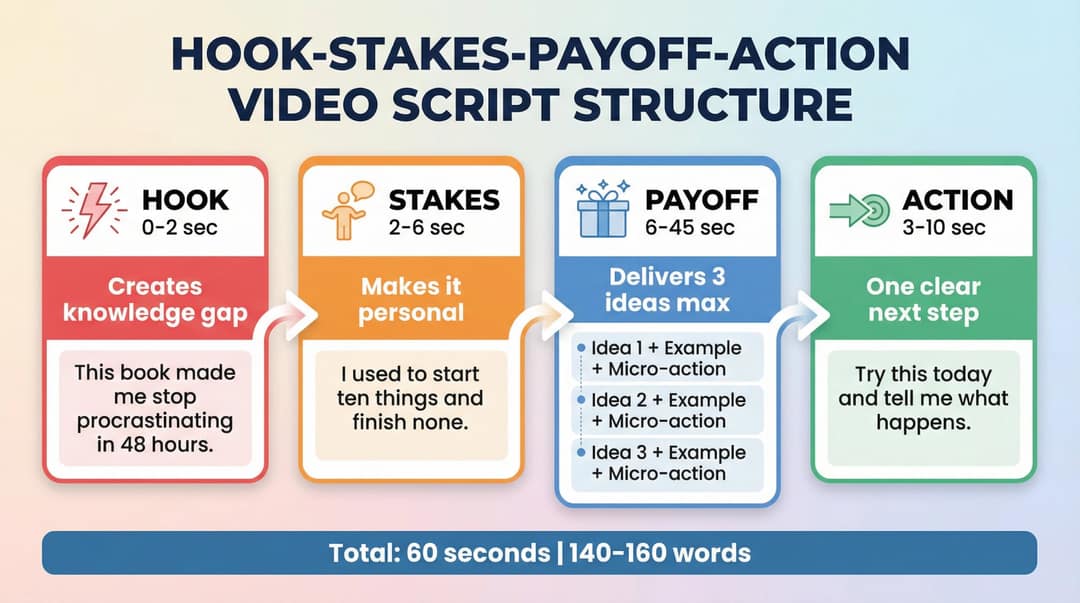
Step 3: Write the script (Hook, Stakes, Payoff, Action)
TikTok's ad research found that 90% of ad recall impact happens in the first six seconds and recommends a hook, story, call-to-action structure. Organic videos aren't ads, but the first sentence decides the same thing: whether anyone hears the second.
Hook (0 to 2 seconds). Open a knowledge gap with a statement, not a question. Borrow patterns from these copy-paste TikTok hooks.
- "This book made me stop procrastinating in 48 hours."
- "If you can't focus anymore, this is why."
- "This is the most dangerous belief in modern work culture."
Stakes (2 to 6 seconds). Name the problem the viewer feels.
- "I used to start ten things and finish none."
- "I'd read a book, feel inspired, then do nothing."
Payoff (6 to 45 seconds). Three ideas maximum, each in three sentences: the concept, a quick example, a micro-action. For longer videos, stretch this part, not the intro.
Action (last 3 to 10 seconds). One next step the viewer can do, not "like and subscribe": "Try this today and tell me what happens" or "Comment the next book you want."
For 60 seconds, write 140 to 160 words. Cut minor details; clarity beats completeness.
One thing to plan for: summaries talk the whole way through, and in Revid's TikTok study, videos with speech throughout had a 68K median (11.9% past 1 million views), while videos with under 40 characters of speech had 123K (20.2%). A 140 to 160 word script sits firmly in the talking group, so give the eyes work too: put the book title and each idea's key phrase on screen, and change the visual with every sentence.
How long should a book summary video be?
Make your core series about 60 seconds, and on TikTok go just past one minute (61 to 90 seconds) if you want Creator Rewards, which only pays on videos at least one minute long. Test longer breakdowns of up to three minutes as a second format.
| Platform | Maximum length | Recommended to non-followers | Default for a summary |
|---|---|---|---|
| TikTok | 60 min uploaded, 10 min recorded in-app | No stated cap | 61 to 90 seconds |
| Instagram Reels | 20 min | Up to 3 min | About 60 seconds |
| YouTube Shorts | 3 min (square or vertical) | All Shorts | About 60 seconds |
TikTok allows uploads up to 60 minutes and in-app recordings up to 10 minutes. Instagram made reels up to 3 minutes eligible for recommendation to non-followers in January 2025 (The Verge covered the change), and reels can be up to 20 minutes, but anything longer than 3 minutes is shown only to followers. YouTube classifies square or vertical videos up to 3 minutes uploaded on or after October 15, 2024 as Shorts; a Short over one minute with an active Content ID claim is blocked worldwide, so use only cleared music.
Length matters less than people think. In Revid's 12-month study, every length bucket from under 15 seconds to 10 minutes had a median between 58K and 76K views, with 61 to 90 seconds slightly ahead at 70K; clips under 15 seconds had the lowest median (58K) but the most shares per view (1.41 per 100). Revid's full index across all posting dates favored 16 to 30 seconds (about 141K median), but that edge has faded for recent posts. Pick the length your three ideas need.
Length alone barely moves views: every bucket lands between 58K and 76K median views (the 790 videos over 10 minutes are a small, unusual group). Clips under 15 seconds get shared the most per view.
Source: Revid analysis of 176,367 TikToks with 1,000+ likes posted between Oct 1, 2025 and Oct 16, 2026 (61,203 creators)
Show the data
| Median views | Share that passed 1M views | Shares per 100 views | |
|---|---|---|---|
| Under 15 s | 57.6K | 11.6% | 1 |
| 16 to 30 s | 64.9K | 12.3% | 1 |
| 31 to 60 s | 61.8K | 11.8% | 1 |
| 61 to 90 s | 70.5K | 12.2% | 1 |
| 91 s to 3 min | 63.4K | 11.1% | 1 |
| 3 to 10 min | 76.4K | 12.4% | 1 |
| 10 min+ | 129.6K | 13.8% | 0 |
Step 4: Add voice, captions and sound
TikTok reports that 88% of people say sound is essential to the TikTok experience. Even viewers who watch muted feel the pacing, so the voice and music decide how professional the video seems.
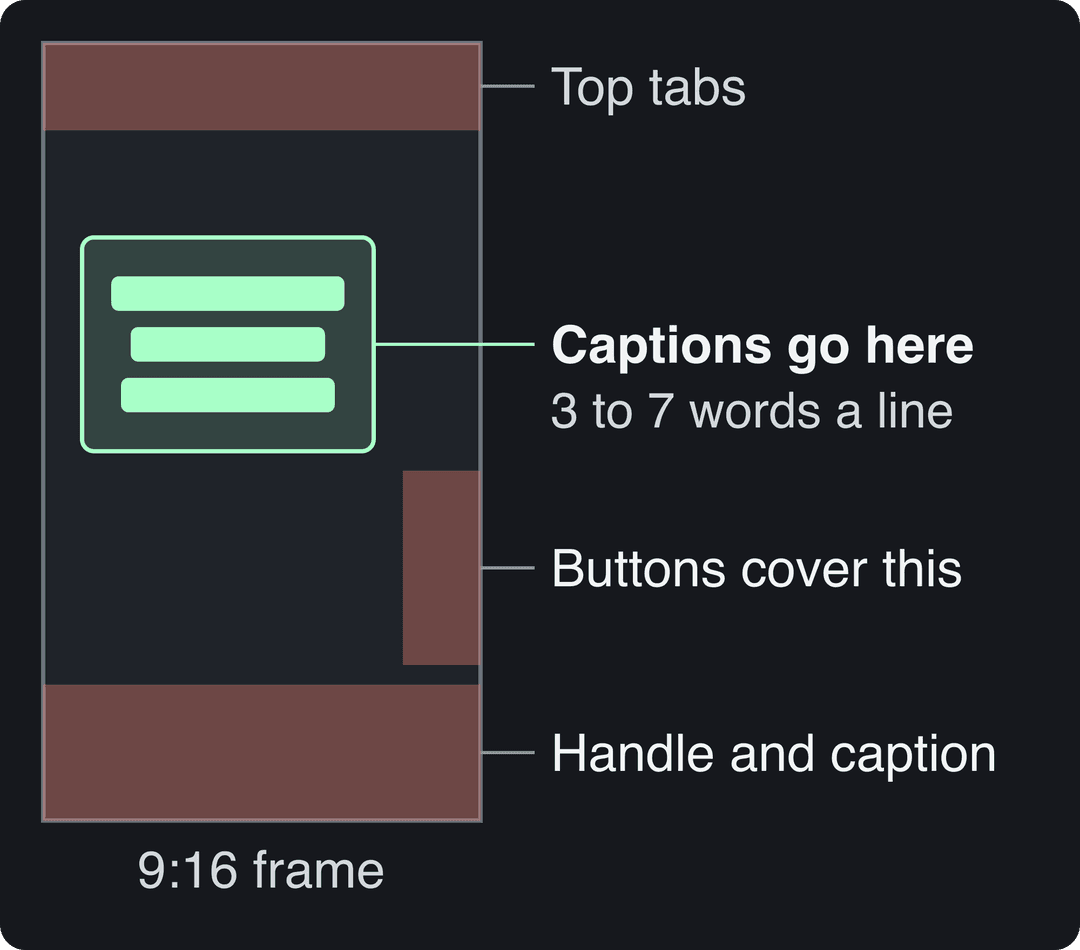
Captions: use word-by-word highlighted captions, 3 to 7 words per line, with the key term emphasized by color or size. Place them in the upper or middle part of the frame, away from the platform buttons and the caption area at the bottom. Check your layout against a TikTok safe zone overlay before exporting.
Voice: record yourself with a USB condenser mic in a quiet room at a moderate pace, or use an AI voice. A half-second pause before the key line ("Here's the breakthrough") makes it land harder either way.
Music: keep it well under the voice so every word stays clear, and use only licensed tracks: the YouTube Audio Library, a royalty-free library, or music included by your video tool.
Step 5: Make the video with Revid
Revid turns a script into a finished vertical video: scene visuals, voiceover, synced captions and music, which you can then edit and publish.
- Open the AI TikTok video generator (or the faceless video generator) and paste your script, or a link to a blog post or review.
- Control pacing in the script: each new line starts a new scene,
[bracketed text]describes a visual without being spoken, and<break time="1.0s" />adds a pause. - Choose the visuals (stock footage, AI images or AI video), a voice from 1,000+ AI voices in 70+ languages, and one of 30 caption styles.
- Fix any scene in the timeline editor, export in 720p, 1080p or 4K, and publish or schedule to TikTok, Instagram and YouTube from one queue.
- For a daily series, set up an Auto-Mode worker that creates a new video every day from a prompt or content source.
This book explains why motivation fails. [someone staring at a phone, overwhelmed]

Here are 3 ideas that actually work.

Idea 1: Motivation comes after action. [crossing items off a checklist]

Idea 2: Make habits smaller than your excuses. [tiny two-minute routine]

Idea 3: Track identity, not outcomes. [text on screen: I am a reader]

Try this: do 2 minutes today, no more. Then stop. [timer]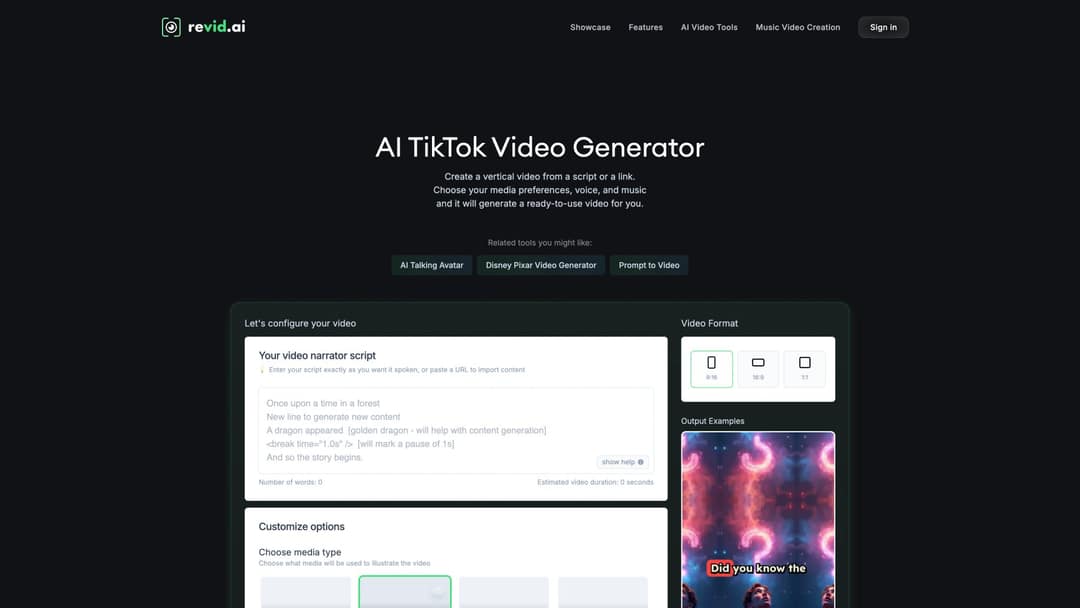
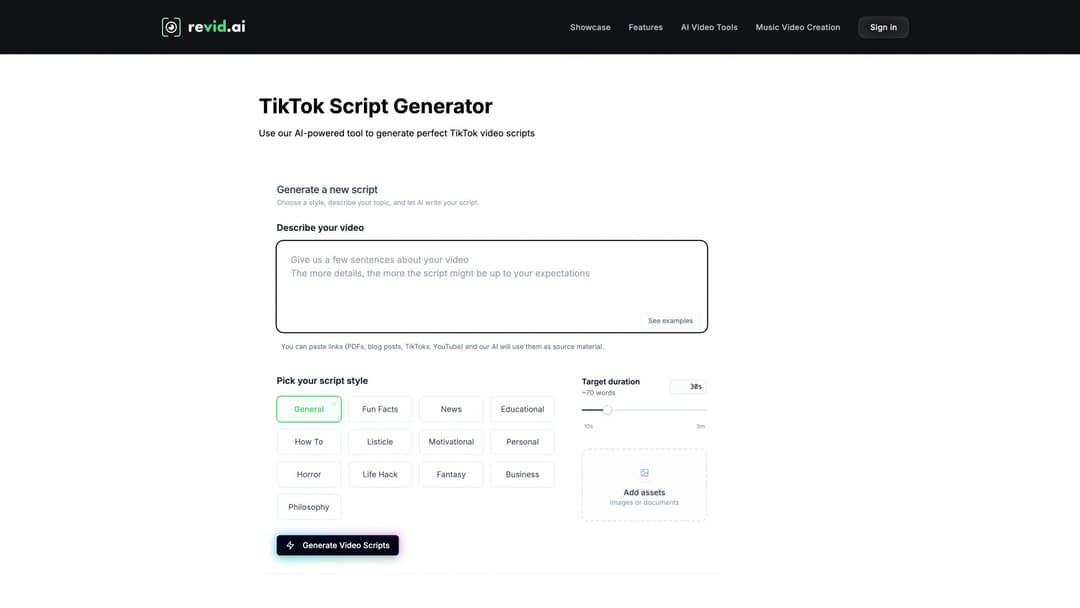
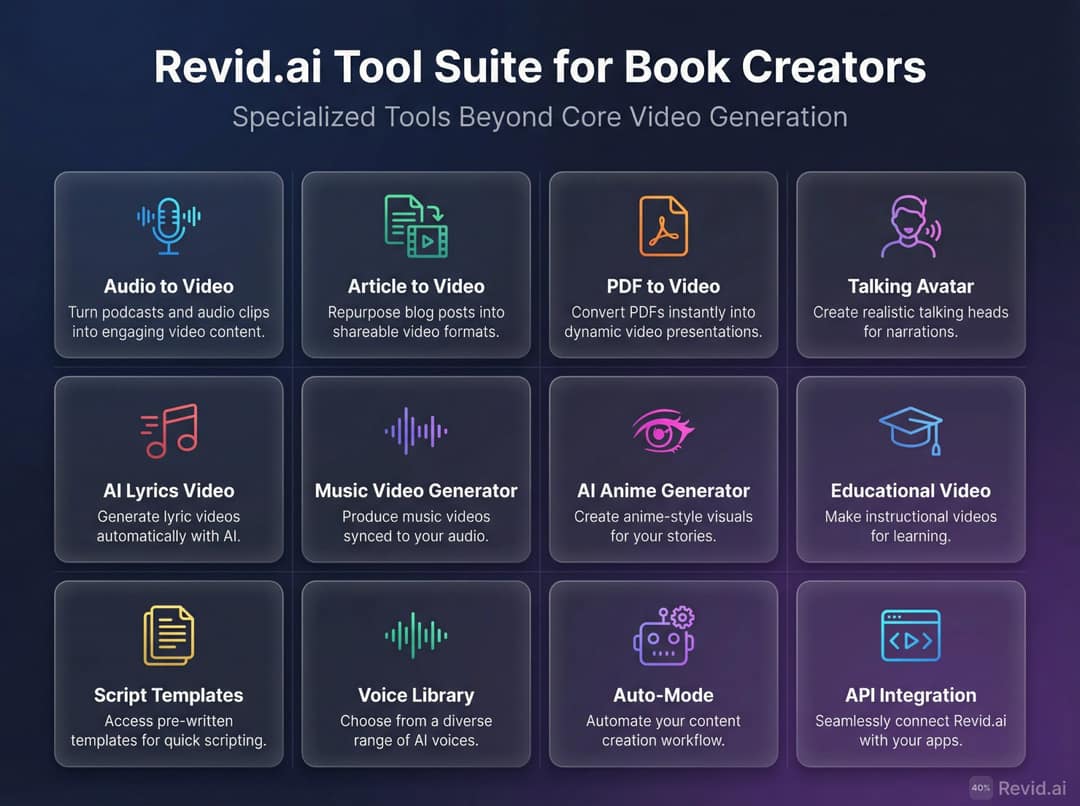
If you don't have a script yet, the free TikTok script generator writes one from a topic or a link with an Educational style and a target duration. You can also search Revid's library of viral videos for BookTok posts and use one as a reference ("Make it about your topic") to keep its hook style and pacing with your own book and words. Book notes in a PDF can go through the PDF to Video converter, and an AI talking avatar sits between faceless and on-camera. Sign-up is free and new accounts get free credits to try video creation, no credit card needed; regular creation then uses the monthly credits of a paid plan, starting at $39/month.
Prompt to try
Create a 45-second spoiler-free fiction vibe check for a dark academia mystery, opening with "If you like secret societies plus unreliable narrators, you need this book." Give the premise in one line, describe the mood in three adjectives over moody candlelit library visuals, and close by asking viewers whether they want a spoiler summary next.
Copy-paste book summary script templates
Use these for your next 20 videos and adapt them to each book.
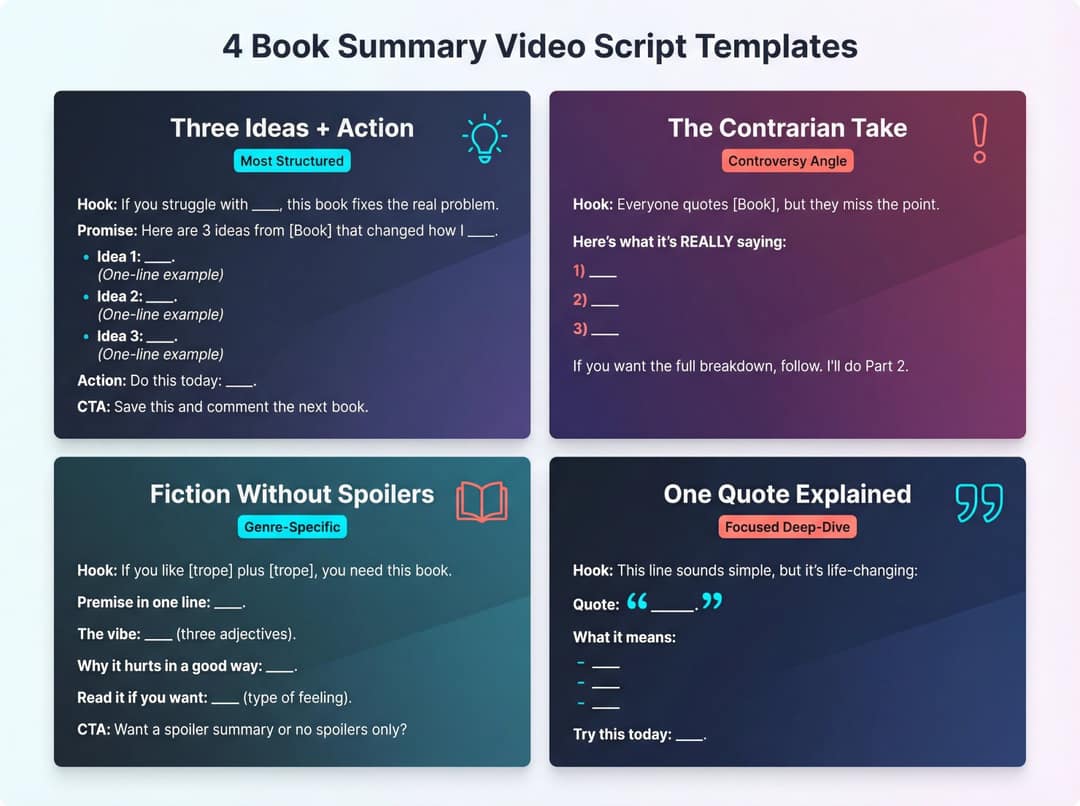
Template 1: Three ideas plus one action
[Hook] If you struggle with ____, this book fixes the real problem.
[Promise] Here are 3 ideas from [Book] that changed how I ____.
Idea 1: ____. (one-line example)
Idea 2: ____. (one-line example)
Idea 3: ____. (one-line example)
[Action] Do this today: ____.
[CTA] Save this and comment the next book you want.Template 2: The contrarian take
[Hook] Everyone quotes [Book], but they miss the point.
Here's what it's really saying:
1) ____
2) ____
3) ____
If you want the full breakdown, follow. Part 2 is next.Template 3: Fiction without spoilers
[Hook] If you like [trope] plus [trope], you need this book.
Premise in one line: ____.
The vibe: ____ (three adjectives).
Why it hurts in a good way: ____.
Read it if you want: ____ (a feeling).
[CTA] Spoiler summary next, or no spoilers only?Template 4: One quote explained
[Hook] This line sounds simple, but it changes how you work:
[Quote] "____."
What it means:
- ____
- ____
- ____
Try this today: ____.Is it legal to make book summary videos?
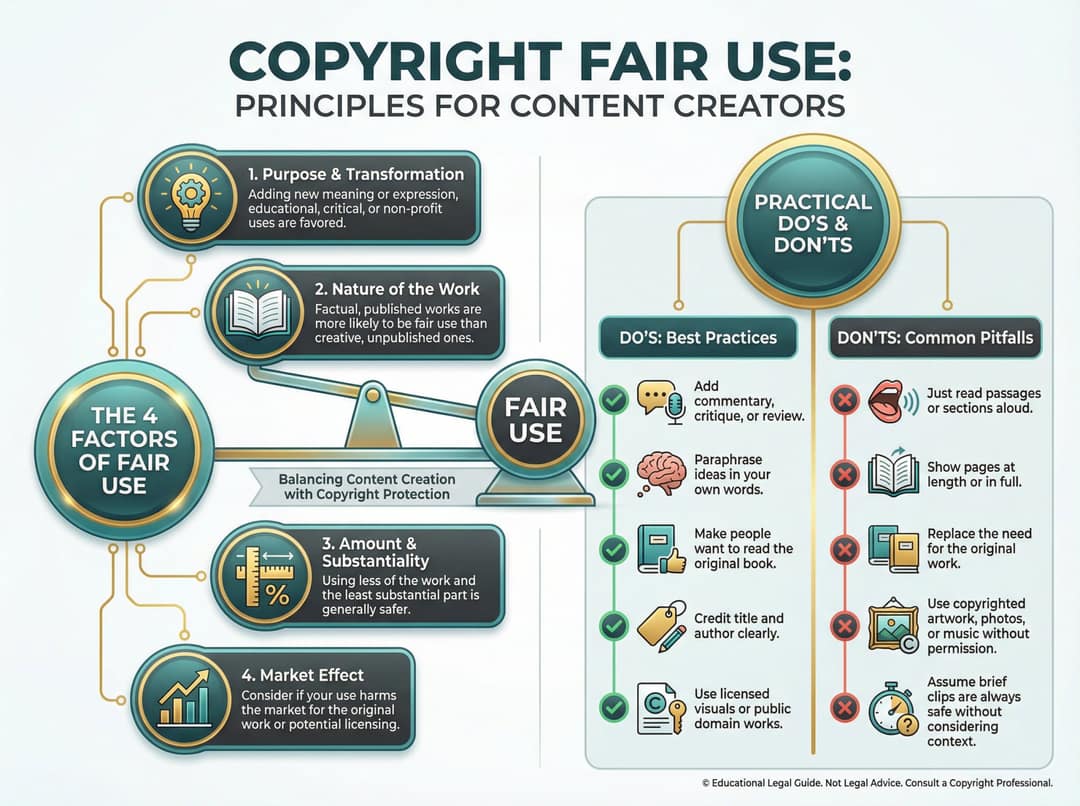
Generally yes, if you explain the ideas in your own words. U.S. copyright law protects the author's expression, not the ideas, and fair use under 17 U.S.C. § 107 weighs four factors: the purpose of your use, the nature of the work, how much you take, and the effect on the market for the book. This is general information, not legal advice.
Your video should make people want to read the book, not feel they already did. Guardrails that keep you on the right side:
- Transform it: add commentary, critique, teaching or a new angle.
- Quote sparingly: short, purposeful quotes; paraphrase the rest.
- Don't show pages: no scrolling through chapters or full pages of text.
- Credit clearly: title and author on screen at least once.
- License every asset: stock footage, your own footage or AI visuals that don't copy protected characters.
Book covers: showing a cover briefly to identify the book is common in reviews and commentary. For paid ads or client work, be more conservative and use publisher-provided assets.
Pre-publish checklist
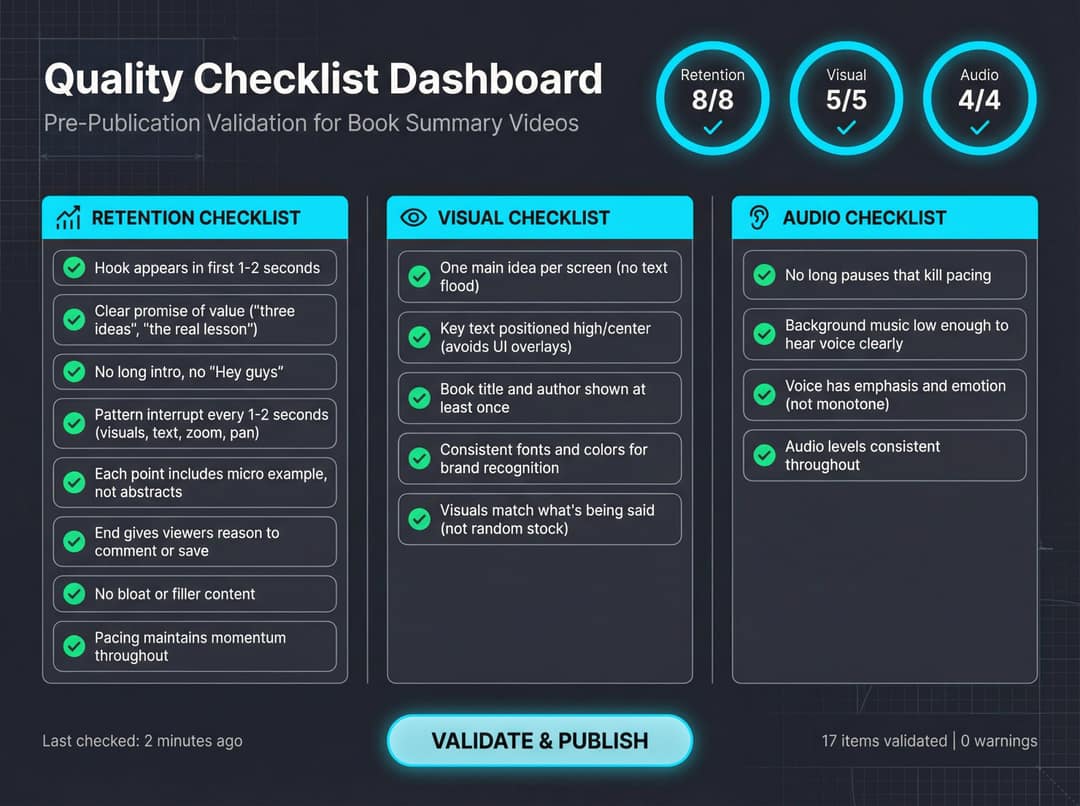
Retention:
- Hook in the first one to two seconds, no "Hey guys" intro
- A clear promise ("three ideas", "the real lesson")
- A visual change every one to two seconds (new shot, zoom, text emphasis)
- A micro example for every idea
- An ending that gives a reason to comment or save
Visuals:
- One idea per screen
- Key text high or centered, clear of the interface
- Book title and author shown at least once
- The same fonts and colors in every episode
- Visuals that match what is being said
Audio:
- No dead pauses
- Music low enough to hear every word
- A voice with emphasis, not a monotone
- Even levels from start to finish
Titles, descriptions and hashtags that get found
Title: lead with the book title and the word summary, then a benefit: "Atomic Habits Summary: 3 Ideas That Change Your Routine". YouTube titles allow 100 characters, but put the book name first because the end gets cut off on phones.
Description: open with one or two sentences of value, then add the author, an outline, timestamps for longer videos, and your affiliate link to the book.
Thumbnail: for long-form YouTube, show the cover or title with two or three words of bold text (YouTube recommends 3840x2160). Custom Shorts thumbnails can only be uploaded in YouTube Studio on a computer by verified accounts.
Hashtags and captions: in Revid's TikTok study, posts with 4 hashtags had the best median (77K views) and posts with 9 or more only 16K; captions of 41 to 80 characters did best (67K median) and no caption worst (36K). Instagram allows at most 5 hashtags per post.
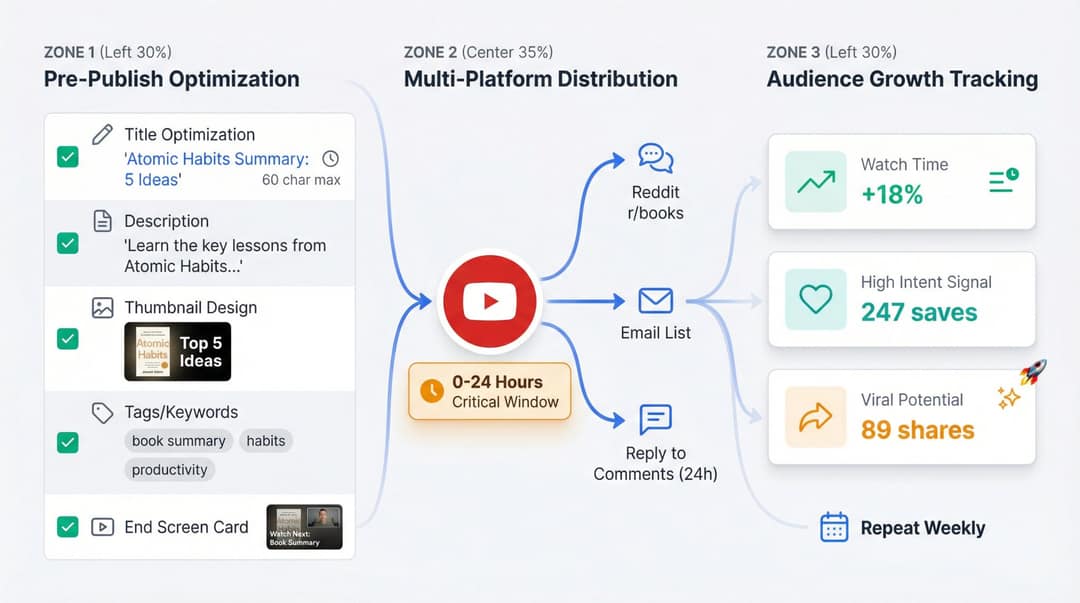
Reply to every comment in the first 24 hours; comments asking for the next book are your content plan.
Turn summaries into a series
One viral video is luck; a series viewers recognize is a channel. By the third episode, a viewer should think "this is one of those" before the hook ends. Series names that make a promise:
- "1-Minute Books That Fix Your Life"
- "Fiction in 60 Seconds: Vibe Plus Premise"
- "Three Ideas From a Book I Wish I Read Earlier"
- "Books That Changed How I Think About Money"
Keep a backlog of books and angles so you never start from zero, and produce in batches: write five scripts in one session, generate five videos in one afternoon. This guide to batch creating TikTok videos lays out the full system.
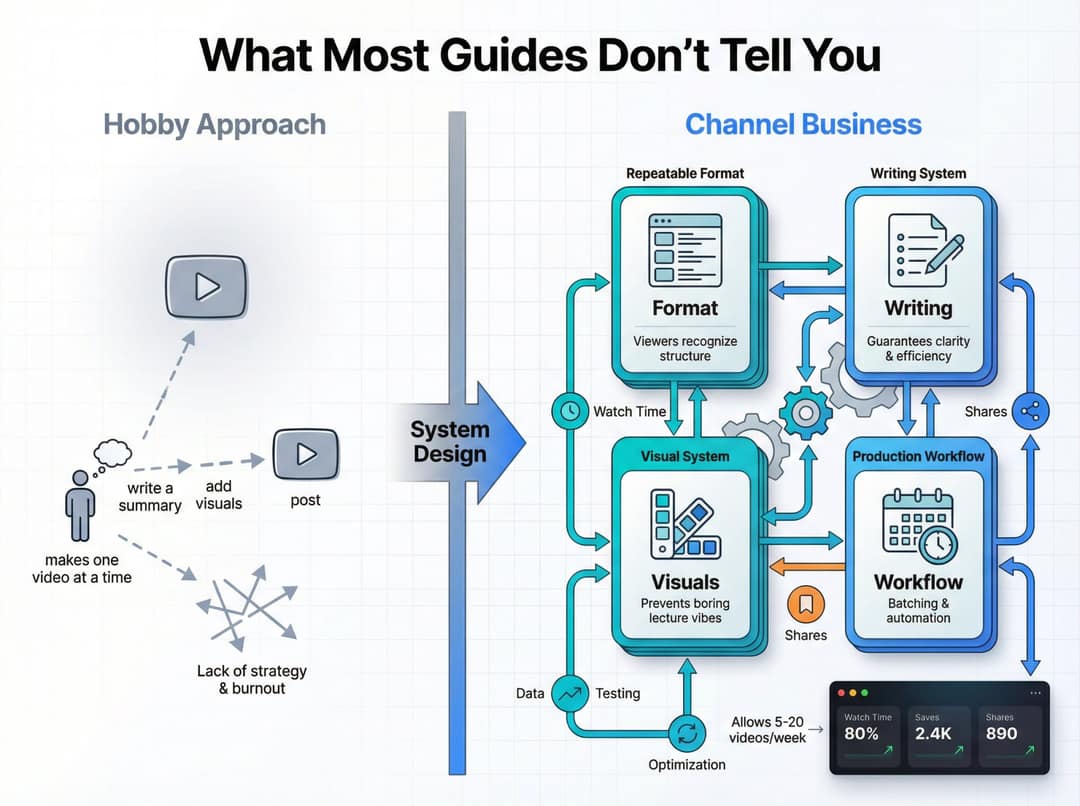
Judge a format after 20 videos, not 3. Watch completion rate, saves and shares more than views: a summary people save is one they plan to act on, and that is the signal to make more like it.
How book summary channels make money
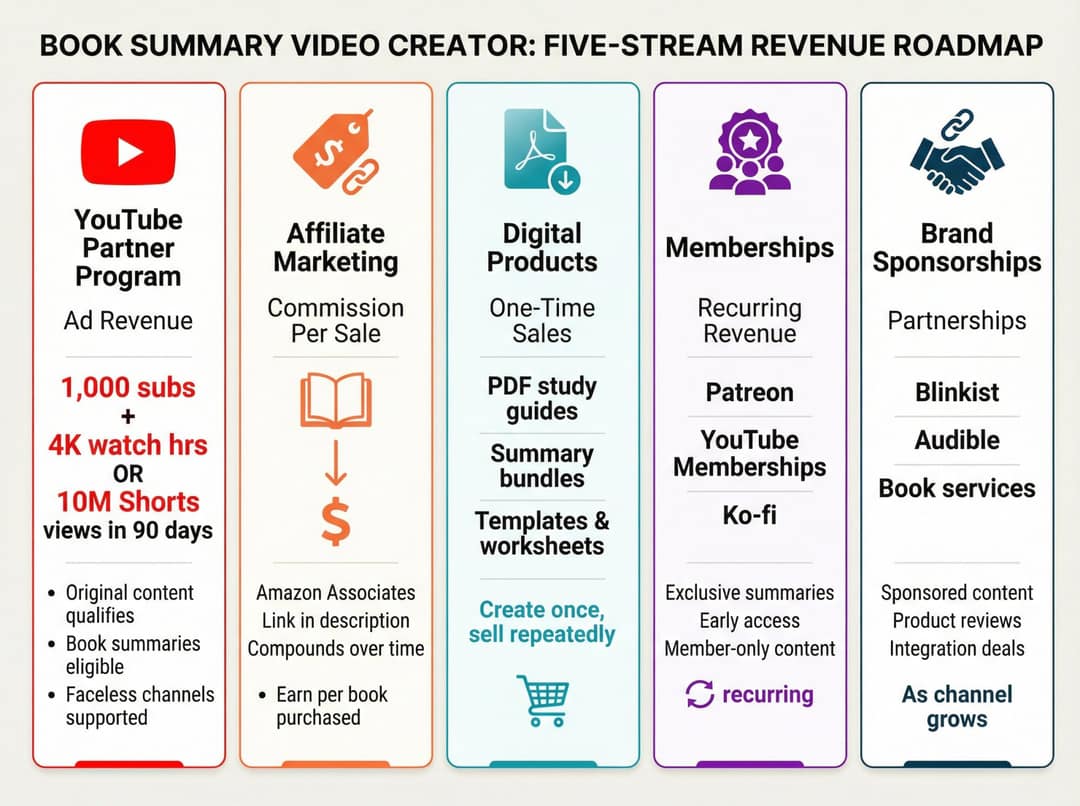
YouTube Partner Program. Ad revenue today needs 1,000 subscribers plus either 4,000 public watch hours in the last 12 months or 10 million Shorts views in the last 90 days; check YouTube's creator site for current rules. Watch hours from the Shorts feed don't count toward the 4,000 hours. From February 1, 2027, new applicants need 8,000 watch hours in 365 days or 20 million Shorts views in 90 days, and earning Shorts ad revenue in any month will need 10 million qualified Shorts views over the previous 90 days.
AI-made summaries can monetize if each one carries your own angle and insight. Videos built from generic templates that look mass-produced fall under YouTube's inauthentic content policy and can't earn.
TikTok Creator Rewards. You need to be 18+, have 10,000 followers and 100,000 views in the last 30 days, and use a Personal account. Only original videos of at least one minute earn, which is another reason to run your TikTok series just over 60 seconds.
Affiliate links to the books you summarize are the most natural income for this niche: every viewer you convince is a potential sale. Many channels add study guides or note templates as digital products, memberships with extra summaries, and sponsorships from reading and audiobook apps.
FAQ
Can I use AI voices for book summary videos?
Yes. AI voices are faster and more consistent than recording yourself; a human voice can feel more personal. YouTube doesn't require disclosure for AI-written scripts or a clone of your own voice; disclosure is for realistic content, such as a real person appearing to say something they didn't.
Do I have to label AI-generated book summary videos?
Only when they contain realistic AI images, video or audio. TikTok requires a label for realistic AI content and says the label doesn't reduce distribution; YouTube asks for disclosure in the "AI use" setting for realistic scenes.
What if a book already has lots of summaries?
Make one anyway, with a different angle. Popular books are where the searches are; a contrarian take, a fiction vibe check or a one-quote breakdown can win where a tenth neutral summary won't.
How many videos before a book summary channel grows?
Plan for 20 to 30 videos over six to twelve weeks before judging results. Older videos often pick up views later from search once the platform understands your niche.
Can I show the book cover in my video?
Usually yes, briefly, to identify the book in a review or commentary. For paid ads or client work, use publisher-provided assets.
What background music can I use in book summary videos?
Only licensed music: the YouTube Audio Library, a royalty-free library, or music supplied by your video tool. On YouTube Shorts, most Audio Library songs can be used for up to 90 seconds in a 3-minute Short.
Sources
- Revid analysis of 176,367 TikToks with 1,000+ likes posted between Oct 1, 2025 and Oct 16, 2026 (61,203 creators)
Charts and figures checked on November 6, 2026.