
On this page
The TikToks that go viral most often are challenges, comedy and reactions, carried by a strong emotion (outrage or humor) and a payoff the viewer can see coming. In Revid's analysis of 176,367 TikToks with 1,000+ likes, challenges reached a median of 182K views and comedy 155K, against 64.4K for all videos.
The bigger surprise is what loses. Selfie-style videos, the way most people film by default, had a median of 48K views, less than half of POV videos at 107K. Faceless videos beat one person on camera 114K to 67K. The method and every chart are in our study of 176,367 TikToks; this guide turns the findings into choices you can make on your next post.
- Median views for TikTok challenges, the top format
- 182K
- Revid analysis of 176,367 TikToks
- Share of challenge videos that passed 1M views, vs 11.9% for all videos
- 25.6%
- Revid analysis of 176,367 TikToks
- Median views for faceless TikToks, vs 67K for one person on camera
- 114K
- Revid analysis of 176,367 TikToks
- Median views across all TikToks with 1,000+ likes
- 64.4K
- Revid analysis of 176,367 TikToks
What kinds of TikTok videos go viral the most?
Format is the clearest pattern in the data. Challenges had a 182K median and 25.6% passed 1 million views, more than double the 11.9% rate across the whole sample. Comedy followed at 155K (22% past 1M), then reactions at 105K (16%). Storytelling (66K) and tutorials (62K) sat right at the sample median.
Challenges and comedy passed 1M views about twice as often as tutorials and storytelling, which are the most common formats.
Source: Revid analysis of 176,367 TikToks with 1,000+ likes posted between Oct 1, 2025 and Oct 16, 2026 (61,203 creators)
Show the data
| Median views | Share that passed 1M views | |
|---|---|---|
| Challenge | 182.3K | 25.6% |
| Comedy | 154.8K | 22.1% |
| Reaction | 104.8K | 16% |
| Dance | 83.8K | 15.5% |
| Storytelling | 66.1K | 12.2% |
| Lip Sync | 61.7K | 12.3% |
| Tutorial | 61.9K | 12.1% |
| Format | Median views | Share past 1M views | Why it travels |
|---|---|---|---|
| Challenges | 182K | 25.6% | Viewers can copy it, so every remake spreads the original |
| Comedy | 155K | 22% | Built to be sent to a friend |
| Reactions | 105K | 16% | Borrows a subject people already care about |
| Dance | 84K | n/a | Rides a shared song or routine |
| Storytelling | 66K | 12.2% | Works when the first line promises the outcome |
| Tutorials | 62K | 12.1% | Earns saves and keeps getting found through search |
| All videos | 64.4K | 11.9% | Baseline |
The ranking is stable across samples. Revid's full index of about 2.39 million TikToks, across all posting dates, also puts challenges and comedy at the top (short-form video statistics).
Prompt to try
Make a 20-second vertical TikTok challenge called "Rank these 4 gas station snacks". Open on all four snacks on screen with the rule in a few words, show a quick ranking with punchy captions, and end by asking viewers to post their own ranking in the comments.
Challenges and participatory prompts
A challenge invites the viewer to try, answer, duet or stitch. It only spreads if the rule is understood in one look. Show the attempt first, state the rule in a few words on screen, and end on the invitation. Opinion prompts work the same way: "Rank these four snacks" gets comments because answering takes two seconds. If the rule needs a paragraph of explanation, it is not a challenge yet.
Comedy and reactions
Comedy wins because it is the content people forward. Keep the setup to one line, land the punchline early, and add a second, smaller beat at the end for anyone who stayed. Reactions work when you add something the original lacks: expertise, a joke or a strong opinion. Show the thing you react to in the first second. A reaction that opens on your face before the viewer knows what you are reacting to loses them.
Tutorials, demonstrations and before-and-afters
Tutorials sit at the median for views, but they do two things the table does not show: they earn saves, and they keep being found through search long after posting. Start on the result or the broken state, not the intro. "Here's how to fix a loose cabinet hinge" is stronger when the first frame shows the hinge wobbling.
Before-and-after transformations use contrast as the hook: flash the after, show the before, then prove the change. Name the topic precisely. "Small bedroom layout, before and after" tells the viewer and the algorithm more than "room makeover."
Prompt to try
Create a 30-second faceless TikTok exposing the hidden fees in airline basic economy tickets. Hook: "That $49 flight will cost you $180, here's why." Show each fee with bold on-screen numbers, fast cuts every two seconds, and end on one tip to avoid them.
Which emotions make TikToks go viral?
Emotion is the second strong pattern. Videos whose dominant mood was outrage had a median of 156K views, with 23.7% passing 1 million. Humor followed at 121K (19.3%), then sadness at 104K. Inspirational videos, a favorite of brand accounts, trailed at 45K (11.3% past 1M).
High-arousal emotions (outrage, humor, sadness) earned the most views. Calm, inspirational videos earned the least, even though they collect the most likes per view.
Source: Revid analysis of 176,367 TikToks with 1,000+ likes posted between Oct 1, 2025 and Oct 16, 2026 (61,203 creators)
Show the data
| Median views | Share that passed 1M views | |
|---|---|---|
| Outrage | 156K | 23.7% |
| Humor | 121K | 19.3% |
| Sadness | 104.4K | 16.5% |
| Excitement | 92.5K | 15.9% |
| Joy | 89.9K | 18% |
| Informative | 64.1K | 11.2% |
| Neutral | 61.2K | 11.5% |
| Inspirational | 44.6K | 11.3% |
Decision rule: if your topic has a common mistake, a hidden cost or an unfair rule, lead with it. If it doesn't, aim for a laugh. Save the motivational voice-over for when you have a concrete story behind it. Point outrage at a problem (a hidden fee, a bad habit, a myth), never at a person, and back it with evidence, or the comments turn on you.
Do faceless videos go viral on TikTok?
Yes, more often than on-camera videos in this sample. Faceless videos had a median of 114K views and 17.4% passed 1 million, against 67K and 12.7% for one person on camera. Animal videos did even better at 147K (24.1% past 1M). The gap widens inside formats: faceless tutorials reached 156K against 52K for on-camera tutorials, and faceless comedy 327K against 136K.
Shooting style tells the same story. POV videos led at 107K (19% past 1M), followed by screen recordings at 91K, handheld at 80K and tripod at 77K. Selfie-style videos trailed at 48K (9.2%). If you film yourself talking into the front camera by default, test a POV or hands-only version of the same idea before deciding the topic is weak. If you want to skip filming entirely, a faceless video generator builds the voice-over, visuals and captions from a script.
How should a viral TikTok start?
The opening has three jobs: name the subject, open a gap, and promise a payoff. "Hey guys, today I'm going to show you a few tips" does none of them. "If your product videos look flat, move the light before you change the camera" does all three in one sentence.
Run three tests on your first line:
- Subject test: can a stranger tell the topic without reading the caption? "Budget meal prep for night shifts" beats "What I eat in a day."
- Gap test: what stays unresolved? State the common assumption, then signal that you will break it.
- Payoff test: can the viewer picture what staying gets them? Flash the result or name the decision they will be able to make.
Less talking helps. Videos with under 40 characters of speech (a line or two at most) had a 123K median and 20.2% passed 1 million, against 68K and 11.9% for videos with speech throughout. Silent videos landed in between at 73K. That does not mean you should stop talking: the picture should carry the video, and the words should add what the picture cannot. For ready-made openers, browse these 130+ TikTok hooks and adapt one to your niche.
A strong first second will not carry a dull middle. Add a re-hook whenever the first idea starts to repeat: a new piece of evidence, a cut to a close-up, a question, a beat change. Then make the ending pay off the opening promise and, ideally, make a replay worth it.
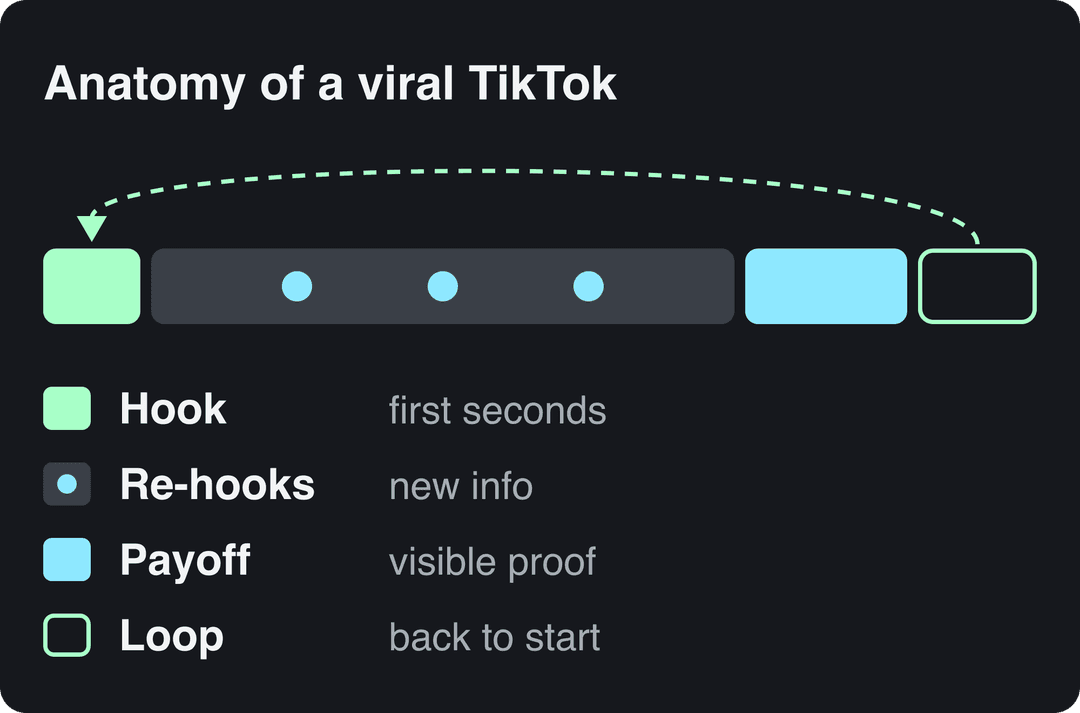
Audit a draft against that shape:
- Opening: is the premise visible before any context?
- Middle: does new information arrive before the first idea gets repetitive?
- Payoff: does the result answer the opening promise directly?
- Loop: does the last frame make a replay useful or satisfying?
Cut anything that spends attention before the viewer knows why to stay: logo animations, a bio, a broad setup.
Do trending sounds make a TikTok go viral?
Rarely on their own. A trending sound is packaging: it signals genre, sets the mood and makes a clip feel native to the feed. It helps when it organizes attention, for example a beat drop timed to a reveal. It does nothing for a vague premise or a slow opening, which is why copying a popular track onto a weak idea produces flat results.
Build the structure first (promise, opening action, pace, payoff), then pick audio that marks the same moments. If the music peaks before your reveal, it flattens the payoff. In tutorials, keep the track low enough that the spoken instructions stay clear.
Does follower count decide what goes viral?
Less than most creators assume. A study of 347 users and 9.2 million TikTok recommendations found that videos from accounts a viewer does not follow were watched to the end at roughly 44% to 46%, compared with 38% to 42% for followed accounts (TikTok recommendation study). Strangers will finish your video if it earns it.
These are the signals to read after posting, because each one points to a different weak spot:
- Average watch time and completion: did viewers stay to the payoff?
- Rewatches: did the ending or the density of information make a second view useful?
- Shares: was it funny or useful enough to send to someone?
- Saves: did it solve a problem worth coming back to?
- Comments and profile visits: did it make people curious about you?
Total views tell you how far a post traveled. These signals tell you why.
Editing, captions, hashtags and length
Cut pace and on-screen text
A new visual every 1.5 to 2.5 seconds is a reasonable starting point for most niches, not a law. Each cut should add information, movement or contrast; a held close-up is fine when the viewer needs time to see the evidence. Add text to the video so the topic is clear with the sound off, and write what the viewer gets ("3 ways to reduce echo in a bedroom"), not what you are doing ("come with me while I test this").
If you are still choosing software, this roundup of affordable video editing tools for beginners covers the basics. Any editor works if it lets you check every cut, caption and audio change.
Captions and hashtags
Captions of 41 to 80 characters had the best median (67K views, 12.5% past 1M); posts with no caption had 36K. Four hashtags did best (77K median), three were close behind (75K), no hashtags reached 51K, and nine or more dropped to 16K. Write one short, searchable sentence plus 3 to 4 specific hashtags.
Video length
Length barely mattered in the recent sample: every bucket from under 15 seconds to 10 minutes had a median between 58K and 76K views, and 61 to 90 seconds reached 70K. Videos under 15 seconds had the lowest median (58K) but the most shares per view. Make the video as long as the payoff needs and no longer. If you want to earn from the Creator Rewards Program, only videos of at least one minute qualify.
How TikTok decides who sees your video
Stay in a clear niche
TikTok sorts videos into interest groups. A large-scale analysis found users moved through an average of 52.5 content clusters a day, and roughly 30% to 50% of recommendations in a user's first 1,000 videos reflected predicted personal interests (analysis of TikTok's recommendations). A precise topic, said aloud, shown on screen and written in the caption, helps the system place the clip with the right group. "Small-space cooking for students" is easier to route than "my kitchen."
Post enough to learn
Pew Research Center found that the most active 25% of U.S. adult TikTok users produced 98% of the public videos from that group (Pew Research Center's TikTok study). Most accounts barely post, so steady output alone puts you ahead, and every upload is another test of a hook or topic. For a posting routine, see how to grow on TikTok.
Treat search as a second feed
TikTok is also a search engine. Search Engine Land, reporting TikTok data, says 73% of users search on the platform at least daily and 25% type a query within 30 seconds of opening the app (coverage of TikTok Creator Search Insights). Where Creator Search Insights is available to you, use it to find questions with demand and thin coverage. Put the exact phrase in your script, on-screen text and caption, and still open with a result or a mistake rather than a string of keywords. A good answer keeps collecting search views after a trend has faded.
Read early results as a diagnosis
- Low early retention: rewrite the opening and cut the setup.
- Strong opening, weak middle: add a re-hook or shorten the explanation.
- Good completion, few shares: make it more useful, surprising or funny.
- Many saves, modest reach: keep the topic and test a clearer first line.
- Many rewatches, few profile visits: make your account's promise clearer in the bio and pinned videos.
A 14-day test to find your viral format
Test one idea in several versions instead of burning a new idea on every post. Change one thing at a time, or you will draw the wrong conclusion.
- Days 1 to 2: pick one problem in your niche and write several one-sentence promises.
- Days 3 to 5: produce versions in two formats from the table above, for example a faceless tutorial and a reaction.
- Days 6 to 8: compare opening retention and completion; keep the clearest premise.
- Days 9 to 11: test a different opening (result first, problem first, constraint first) and a search-led caption.
- Days 12 to 13: review shares, saves, rewatches and profile visits.
- Day 14: keep the winning format, write down what changed, and plan the next batch around a related problem.
Teams producing many versions can organize the creative production workflow so variants and results stay comparable. For brand videos, Boocoo's business video production guide covers planning and shooting, though the format choice should still come from the data above rather than a template.
How to make a TikTok from a proven viral format with Revid
- Search Revid's library of viral videos (about 2.77 million videos and posts with their engagement data) by topic, and filter by engagement tier.
- Open a video and run the free deep analysis (up to 60 a day): it explains the hook, the timed structure and three ways to adapt it to your niche.
- Choose "Same energy, new script" or "Make it about your topic". Revid writes an original script with new visuals, voice-over and captions, and you can adjust any scene in the timeline editor.
- Publish or schedule directly to TikTok, Instagram and YouTube. Each post reports its views, likes and comments, and a winner can be remixed in one click for your next test.
Sign-up is free and new accounts get free credits to try video creation; regular creation then uses the monthly credits of a paid plan, from $39/month. For the full production walkthrough, see how to make a viral TikTok video.
FAQ
Can a small account go viral on TikTok?
Yes. TikTok recommends videos to people who don't follow you, and in the recommendation study cited above, non-followers finished videos at least as often as followers. A clear premise and a fast opening matter more than follower count.
How many views count as viral on TikTok?
There is no official threshold. For reference, the median TikTok in Revid's sample of videos with 1,000+ likes had 64.4K views, and 11.9% passed 1 million.
Do AI-generated TikToks go viral?
They can. In Revid's comparison, AI-generated TikToks averaged twice the views of real footage. TikTok requires a label on realistic AI content, and says the label alone does not affect a video's distribution.
What is the best time to post on TikTok to go viral?
In Revid's data (English TikToks, US Eastern time), posts at 3 to 6 a.m. had the best median views and 5 to 9 p.m. the weakest, but those early US hours also cover daytime in Europe and Asia. Check when your own followers are active in TikTok Studio analytics before changing your schedule.
Sources
- Revid analysis of 176,367 TikToks with 1,000+ likes posted between Oct 1, 2025 and Oct 16, 2026 (61,203 creators)
Charts and figures checked on November 6, 2026.