
On this page
Yes, AI-generated videos can grow a YouTube Shorts or TikTok channel, but only when the AI handles production and you supply the idea. In Revid's study of 292,784 TikToks, AI-generated videos had an estimated median of 151.7k views against 67.3k for real footage, yet YouTube will not monetize mass-produced, template-made AI content.
The same study holds the catch: AI videos earned fewer likes per view, 3.9% against 7.7% for real footage. People watch them but like them less. Audiences also punish the generic kind: Sprout Social research published in March 2026 found that 50% of Gen Z have blocked, muted or unfollowed a brand or creator because their content felt like "AI slop". The tool is not your advantage. What you feed it is.
- Estimated median views of AI-generated TikToks, against 67.3K for real footage
- 151.7K
- Revid study of 292,784 TikToks
- Like rate of AI-generated TikToks, against 7.7% for real footage
- 3.9%
- Revid study of 292,784 TikToks
- Gen Z who blocked, muted or unfollowed a brand or creator over AI slop
- 50%
- Sprout Social, March 2026
- YouTube channels publishing Shorts each day as of March 2026
- 10M+
- Alphabet, April 2026
Has using an AI video tool helped creators grow on Shorts and TikTok?
For many, yes. Revid's own analytics for 2026 count more than 30,000 videos made with Revid published to TikTok, Instagram and YouTube every month, and more than 400 creators who have reached 100,000+ views with videos made on Revid. That shows the approach works for some channels; it does not guarantee it will work for yours.
The channels that grow use AI to post more often and test more ideas, not to post the same video in bulk. The competition is heavy: Alphabet said that as of March 2026, more than 10 million channels were publishing Shorts each day. When production gets cheap for everyone, you compete on the idea, the hook and the structure.
Using AI is now normal, not an edge. In Wyzowl's 2026 survey, 63% of video marketers said they had used AI video tools to create or edit marketing videos, up from 51% a year earlier. More sourced figures are on our short-form video statistics page.
Do you need an AI video editor or an AI video generator?
They solve different problems. Pick by what you start with.
| You start with | Tool type | What it does | Examples |
|---|---|---|---|
| Footage you filmed | AI video editor | Cuts, captions, zooms and reframing on your own clips | CapCut, Descript, Submagic |
| Long videos or podcasts | AI clipping tool | Finds highlights and cuts them into vertical clips | OpusClip, Klap, Vizard |
| An idea, a script or a link | AI video generator | Writes the script, generates visuals, voice, captions and music | Revid, InVideo, Fliki |
If you are comfortable on camera and already film, an editor saves the most time. If you will not film, a generator is the only realistic way to post every day. Revid covers the third row and also turns long YouTube videos into Shorts.
Prompt to try
Make a 30-second faceless vertical video on why octopuses can taste with their arms. Open with the hook "Your arms can't do this, but an octopus's can." Keep the narration to two short lines and let close-up underwater visuals carry the rest, with bold captions and calm music.
What Revid's TikTok data says about AI videos
Revid's AI videos vs real footage study looked at TikToks posted between May 2025 and September 2026. AI-generated videos drew about 2.3 times the median views of real footage, with a lower like rate. The effect does not carry over everywhere: on X, Instagram and Threads, AI visuals cluster in the lowest engagement tier. If you cross-post to Reels, test there before you assume your TikTok results will repeat.
Most AI-generated videos are faceless, and faceless content does well on TikTok. In Revid's analysis of 176,367 TikToks with 1,000+ likes posted between October 2025 and October 2026, faceless videos had a median of 114K views and 17.4% passed 1 million views, against 67K and 12.7% for videos with one person on camera. Faceless tutorials beat on-camera ones by a wider margin: 156K median views versus 52K. The full study of what makes a TikTok go viral has the method and every chart.
Faceless videos earned a median of 114K views, against 67K for videos with one person on camera, and passed 1M views 38% more often.
Source: Revid analysis of 176,367 TikToks with 1,000+ likes posted between Oct 1, 2025 and Oct 16, 2026 (61,203 creators)
Show the data
| Median views | Share that passed 1M views | |
|---|---|---|
| Animals | 147.4K | 24.1% |
| Faceless | 113.9K | 17.4% |
| Groups of people | 96.1K | 16% |
| Objects or products | 70.8K | 13.2% |
| One person on camera | 67.4K | 12.7% |
The finding that matters most for AI tools is about speech, because many generators default to a voice-over that narrates every second. Videos with under 40 characters of speech had a median of 123K views and 20.2% passed 1 million; videos talking throughout (300+ characters of speech) had 68K and 11.9%; silent videos had 73K and 14.3%. Let the visuals carry the video and keep the narration short.
Videos with just a few spoken words (a line or two) beat both silent videos and videos that talk the whole way through, which were the most common and the weakest.
Source: Revid analysis of 176,367 TikToks analyzed by AI, with 1,000+ likes posted between Oct 1, 2025 and Oct 16, 2026 (61,203 creators)
Show the data
| Median views | Share that passed 1M views | |
|---|---|---|
| No speech | 73.3K | 14.3% |
| Under 40 | 122.7K | 20.2% |
| 40 to 120 | 97.2K | 17.6% |
| 120 to 300 | 91.6K | 16.8% |
| 300+ | 67.7K | 11.9% |
Read these figures with their limits. The index only holds TikToks that reached 1,000+ likes, so it compares videos that already did reasonably well, and it shows what top performers have in common, not what causes views. Perspective and format come from Revid's AI analysis of each video. This is TikTok data; YouTube Shorts audiences may behave differently.
What YouTube and TikTok allow for AI-generated videos
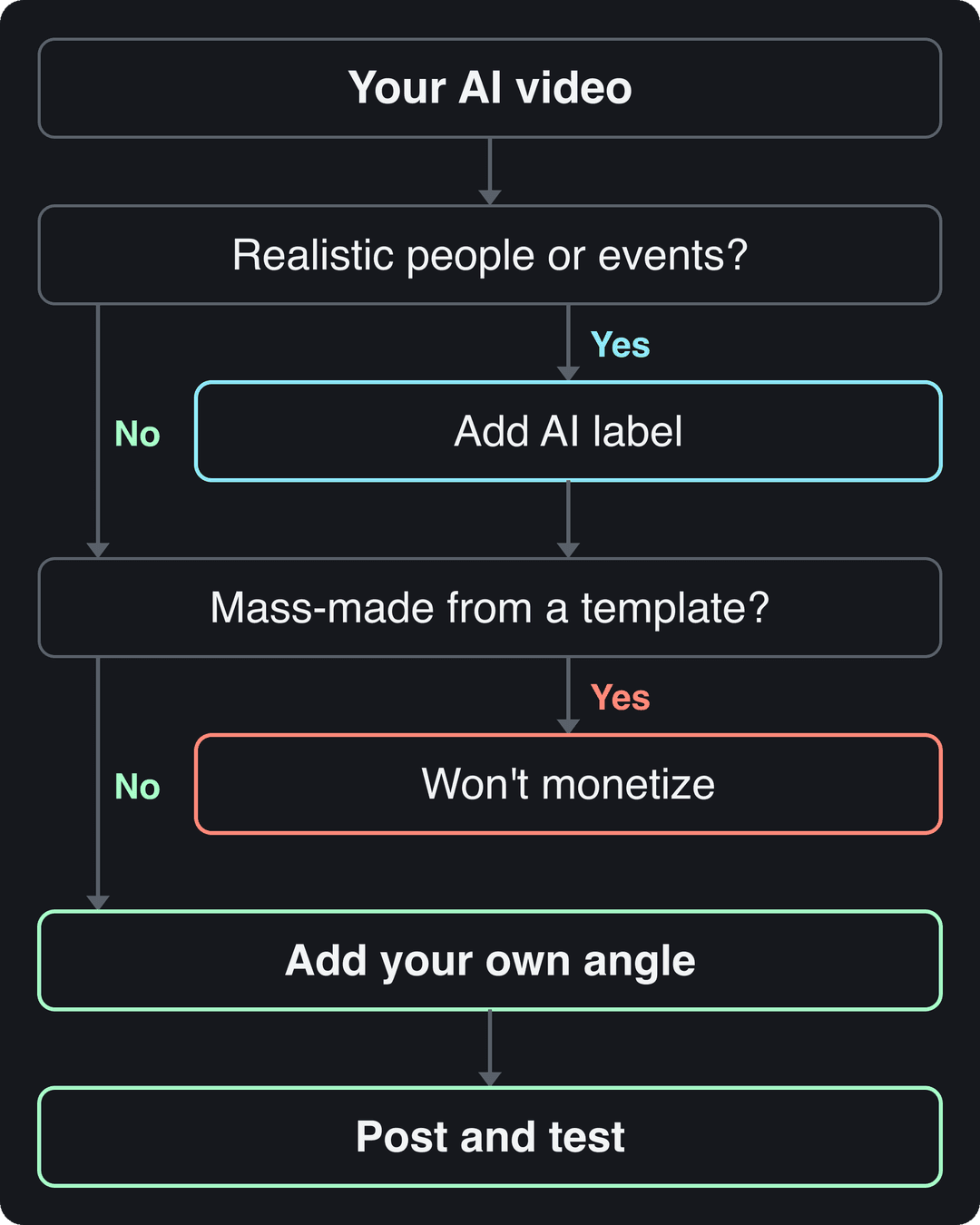
Both platforms accept AI-made videos. Both ask you to label realistic ones, and YouTube draws a hard line on mass-produced content.
| Rule | YouTube Shorts | TikTok |
|---|---|---|
| When you must label AI | Realistic content, such as a real person saying something they did not, or a realistic scene that never happened (the "AI use" setting in YouTube Studio) | Realistic AI-generated images, audio or video (the label reads "creator labeled as AI-generated") |
| What needs no label | Non-realistic content, AI-written scripts, titles, thumbnails and captions, and cloning your own voice for voice-overs | The requirement applies to realistic content |
| Does the label hurt reach? | No: disclosure alone does not limit audience or eligibility to earn | No, as long as the video follows the Community Guidelines |
| Automatic labels | Since May 2026, undisclosed photorealistic AI gets labeled; the label is permanent for content made with Veo or Dream Screen or carrying fully generative C2PA metadata | Uploads with C2PA Content Credentials or made with TikTok AI effects can get an "AI-generated" label you cannot remove |
| What won't earn | Mass-produced AI from generic templates, unrelated AI clips stitched together to shock, AI personas posing as health, legal, financial or political experts, and reading out text you did not write | Duets, Stitches, lightly modified reposts, looping videos, and photo-only or text-only videos are not original for Creator Rewards |
| Earning requirements | YPP ad revenue: 1,000 subscribers plus 4,000 public watch hours in 12 months or 10 million Shorts views in 90 days | Creator Rewards: 18+, Personal account, 10,000 followers, 100,000 views in the last 30 days, videos of at least 1 minute |
YouTube is tightening the numbers. From February 1, 2027, new YPP applicants need 8,000 watch hours in 365 days or 20 million qualified Shorts views in 90 days, and earning Shorts ad revenue in a given month requires at least 10 million qualified Shorts views in the last 90 days. A Shorts-only AI channel needs real scale before YouTube pays it.
How to make AI Shorts and TikToks people actually watch
- Start from a format with evidence. Browse viral TikTok videos in your niche and pick one whose structure you can adapt. A blank prompt with no reference drifts toward a generic average, and generic gets skipped.
- Write the hook first. The opening line decides whether anyone sees the rest. Start from the structures in this list of TikTok hooks that stop the scroll, then make yours specific to your topic.
- Cut the script. Following the speech data above, say less and show more. One idea per video, no intro, no recap.
- Keep scenes consistent. One character, one setting, one story. Random clips stitched together read as AI filler, and YouTube will not monetize them.
- Add captions. Many people scroll with the sound off. An automatic caption generator covers 100+ languages and saves the manual syncing.
- Pick the length by goal. Shorts can run up to 3 minutes and TikTok accepts uploads up to 60 minutes. TikTok's Creator Rewards Program only pays on videos at least 1 minute long, and on YouTube any Short over 1 minute with an active Content ID claim is blocked worldwide, so use licensed or original music. In Revid's 12-month TikTok study, every length bucket from under 15 seconds to 10 minutes had a median between 58K and 76K views: holding attention matters more than the exact duration.
- Label realistic AI. Turn on the AI disclosure when a video shows realistic people, places or events that did not happen. If you generate scenes with Google Veo, expect YouTube to label them anyway.
- Post on a schedule and repeat what works. Check which videos earned the most views and shares, then make the next one from the same structure. If daily posting is the bottleneck, automate video creation from a prompt or a content source.
How to make AI Shorts and TikToks with Revid
Revid builds the whole video from an idea, a link or a proven viral format, then publishes it.
- Open Revid's AI video generator and paste an idea, a script or a link, or search Revid's library of viral videos and choose "Same energy, new script" on one that fits your niche.
- Revid writes the script and generates the visuals scene by scene. You can choose the AI model per scene: Seedance 2.5, MiniMax Hailuo H3, Wan 3.0 or Google Veo 3.
- Pick a voice (1,000+ AI voices in 70+ languages) and one of 30 caption styles, then adjust anything in the timeline editor.
- Export in 1080p or 4K and publish or schedule directly to TikTok, Instagram and YouTube.
For a channel without a face, the faceless video generator is a narrower starting point. Sign-up is free and new accounts get free credits to try video creation, no credit card needed; regular creation then uses the monthly credits of a paid plan, starting at $39/month (see Revid's current plans).
FAQ
Can you monetize AI-generated YouTube Shorts?
Yes, if the video shows your own creative vision and gives educational or entertainment value. YouTube will not monetize AI content made from generic templates that looks mass-produced, and from February 1, 2027 monthly Shorts revenue requires 10 million qualified Shorts views in the last 90 days.
Do AI videos get less reach on TikTok?
Not because of the label: TikTok says turning on its AI-generated content setting does not affect distribution if the video follows the Community Guidelines. In Revid's study, AI TikToks got more views than real footage but fewer likes per view.
Do I need to disclose an AI voice-over?
On YouTube, no if it is your own cloned voice, and yes if it makes a real person appear to say something. TikTok's rule covers realistic AI audio, so label the video when the voice imitates a real person.
Can faceless AI videos earn from TikTok Creator Rewards?
Yes, if they are original and at least 1 minute long, posted from a Personal account with 10,000 followers and 100,000 views in the last 30 days. Photo-only, text-only and looping videos, and lightly modified reposts, do not count as original.
Can I still use Sora 2 for Shorts and TikToks?
No. OpenAI discontinued the Sora app on April 26, 2026 and removed Sora 2 from its API on September 24, 2026. Revid offers Seedance 2.5, MiniMax Hailuo H3, Wan 3.0 and Google Veo 3 instead.
Sources
- Revid analysis of 176,367 TikToks with 1,000+ likes posted between Oct 1, 2025 and Oct 16, 2026 (61,203 creators)
- Revid analysis of 176,367 TikToks analyzed by AI, with 1,000+ likes posted between Oct 1, 2025 and Oct 16, 2026 (61,203 creators)
- Sprout Social, Social Media is Now the Top Source for Breaking News, New Sprout Social Research Finds (press release) (March 2026)
- Alphabet, Q1 2026 earnings call transcript (April 2026)
Charts and figures checked on November 6, 2026.