On this page
Funny AI videos work when one absurd, AI-made twist lands inside a format viewers already recognize: a pet reacting like a judgmental friend, a fail clip narrated by an overconfident AI voice, a deadpan tutorial for an impossible task. Keep one premise per video, state it in the first second, and cut right after the punchline.
Comedy has one of the clearest edges in Revid's data. In Revid's analysis of 176,367 TikToks with 1,000+ likes posted between October 2025 and October 2026, comedy videos had a 155K median and 22% passed 1 million views, behind only challenges (182K). Tutorials sat at 62K. The method and every chart are in our study of what makes a TikTok go viral.
Challenges and comedy passed 1M views about twice as often as tutorials and storytelling, which are the most common formats.
Source: Revid analysis of 176,367 TikToks with 1,000+ likes posted between Oct 1, 2025 and Oct 16, 2026 (61,203 creators)
Show the data
| Median views | Share that passed 1M views | |
|---|---|---|
| Challenge | 182.3K | 25.6% |
| Comedy | 154.8K | 22.1% |
| Reaction | 104.8K | 16% |
| Dance | 83.8K | 15.5% |
| Storytelling | 66.1K | 12.2% |
| Lip Sync | 61.7K | 12.3% |
| Tutorial | 61.9K | 12.1% |
The catch for AI creators: novelty earns the view, not the laugh. In Revid's study of AI videos vs real footage, AI-generated TikToks averaged 1.4M views against 661.4K for real footage, but earned a 3.9% like rate against 7.7%. People stop for a strange image and scroll on without liking it unless there is an actual joke. The formats below are built to supply one. (A limit worth knowing: the index only holds TikToks that already reached 1,000+ likes, so it shows what successful videos have in common, not guaranteed causes.)
- Median views of comedy TikToks, second only to challenges
- 155K
- Revid analysis of 176,367 TikToks
- Share of comedy TikToks that passed 1 million views
- 22%
- Revid analysis of 176,367 TikToks
- Median views of faceless comedy TikToks, vs 136K with a person on camera
- 327K
- Revid analysis of 176,367 TikToks
- Like rate of AI-generated TikToks, vs 7.7% for real footage
- 3.9%
- Revid study of AI videos vs real
The 8 funny AI video formats at a glance
| Format | First-second hook | Comedy engine | Effort | Main risk |
|---|---|---|---|---|
| Pet reactions | Animal face plus a trigger on screen | The animal judges a human situation | Low | Viewers mistake it for real footage |
| Celebrity parodies | A famous face in a trivial crisis | Serious persona, silly stakes | Medium | Likeness rights, fake-statement confusion |
| Fail compilations with an AI voice | The moment before the fail | A narrator reinterprets the accident | Low | Reposting clips you don't own |
| Absurd scenarios | One impossible object in a normal setting | Committed nonsense | Medium | Too many surreal details |
| Meme evolutions | A meme layout viewers know | Escalation, one change at a time | Medium | Source image rights |
| Voice skits | A conflict stated in one line | Characters with clashing goals | Low | Flat, interchangeable voices |
| Tutorial parodies | A confident title for an impossible task | Borrowed authority | Low | Absurd advice read as real |
| "What if" videos | A specific hypothetical question | A chain of consequences | High | Invented consequences read as news |
Why AI comedy fits faceless accounts
Most AI comedy is faceless by design: the star is a dog, a narrator, a pasta car or a cartoon support agent. In the same TikTok study, faceless comedy had a 327K median and 26.4% passed 1 million views, against 136K for comedy with a person on camera. Faceless tutorials showed a similar gap (156K vs 52K), which matters for the tutorial parodies below.
Faceless tutorials earned about 3x the median views of on-camera tutorials (156K vs 52K).
Source: Revid analysis of 176,367 TikToks with 1,000+ likes posted between Oct 1, 2025 and Oct 16, 2026 (61,203 creators)
Show the data
| Median views | Share that passed 1M views | |
|---|---|---|
| Faceless tutorials | 155.6K | 22.1% |
| Product or object tutorials | 80.7K | 14.9% |
| On-camera tutorials | 52.5K | 10% |
| Faceless storytelling | 72.7K | 13.3% |
| On-camera storytelling | 64.4K | 11.7% |
| Faceless comedy | 326.7K | 26.4% |
| On-camera comedy | 135.5K | 20.7% |
The format and perspective labels come from Revid's AI analysis of each video, and they show correlation, not cause. Still, the practical point holds: a recurring faceless character never needs filming and stays consistent from episode to episode, which is exactly what AI video does well.
1. AI pet reaction videos
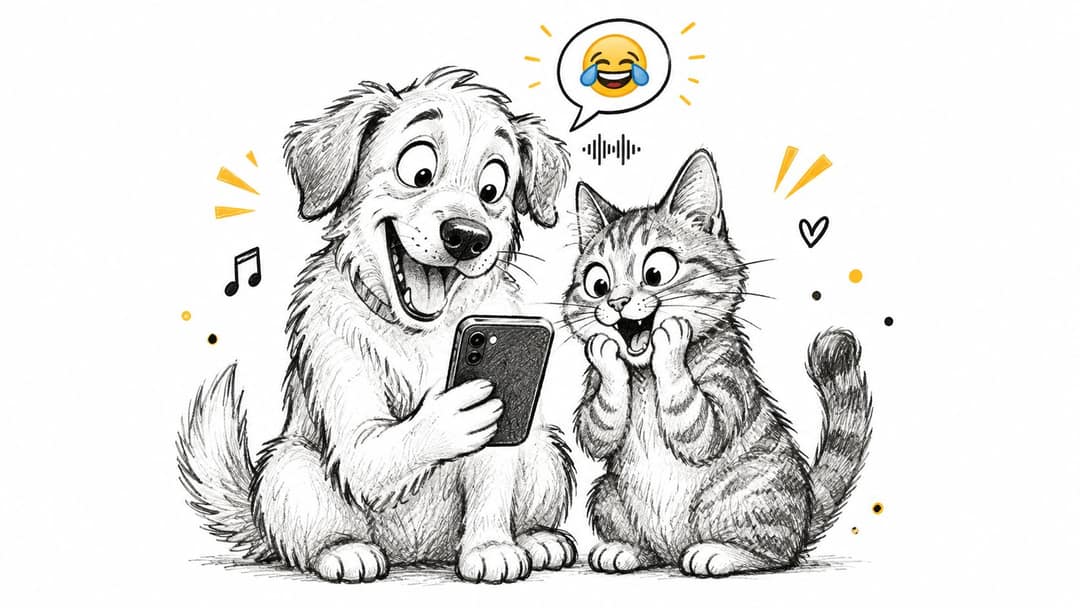
Pet reactions work because the premise reads in one frame: a dog staring at a phone after hearing relationship gossip sets up the animal, the situation and the emotional turn at once. Animal videos were among the strongest perspectives in Revid's TikTok data, with a 147K median and 24.1% past 1 million views.
The engine is anthropomorphism with one readable attitude: suspicion, judgment, panic, jealousy or exhausted disbelief. A cat watching a failed recipe is funnier when its face says "you served that to people?" than when it acts out a plot.
How to build one:
- Pick the punchline emotion first, then the trigger: relationship drama, a failed recipe, an embarrassing dance.
- Prompt for one subject, one eyeline and one change of expression. Walking, talking and extra props make the generator miss.
- Let the audio build tension before the face changes, then cut on the expression.
- End by asking what the animal should judge next. The comments become your next scripts.
Sample prompt: "Close-up of a golden retriever on a couch, looking at a phone held by an off-screen owner, expression shifts from curiosity to open disbelief, slow push-in, warm indoor light, vertical 9:16."
Revid's AI animal video generator turns a prompt like that into a voiced, captioned clip. Keep the same animal and personality across episodes and change only the trigger. If the result looks like a real recording, label it as AI (rules by platform below).
2. AI celebrity parodies and lip-syncs
Recognition supplies the hook and the mismatch supplies the joke. A famous actor delivering a grave speech about a lost sandwich works because the persona is serious and the stakes are trivial.
Show the recognizable face, frame the impossible situation in the caption, then cut to the line. Script direction needs four elements: the fictional line, the delivery, the setting and the contrast. "A celebrity says something funny" gives the model nothing to aim at; "an overly serious farewell speech about a missing sandwich, delivered in a rainy parking lot" does.
This is the riskiest format on the list. YouTube requires you to disclose realistic AI content that makes a real person appear to say or do something, and TikTok requires a label on realistic AI-generated video. Before you publish:
- Keep the fiction visible: "AI parody" in the caption or on screen.
- Never simulate endorsements, confessions or announcements about real events.
- Ask whether the clip could damage the person's reputation. If yes, drop it.
- Check publicity, voice and copyright rules where you post.
Disclosure does not have to kill the joke. Research on AI disclaimers in deepfake parodies found that disclaimers affected how well viewers recognized and understood the parody, while enjoying the humor was linked to wanting to share it. A short, plain label protects the context without reading like a legal notice. Revid's AI celebrity video generator handles the talking-avatar part; the labeling and the judgment stay with you.
3. Fail compilations with an AI voice
This is the format behind most TikTok fail channels: real or generated accidents, narrated by an AI voice that gives each one a point of view. The footage supplies the physical event and the voice supplies the interpretation. Someone drops a cake, the narrator calls it "a structural engineering decision", and the edit cuts to the aftermath.
Pick one narrator role and keep it across every clip: a judgmental cooking instructor, a solemn sports commentator, a detective treating every pet mishap as evidence. The role is the channel's real asset, because it carries kitchen, sports, DIY and animal fails as one recognizable show.
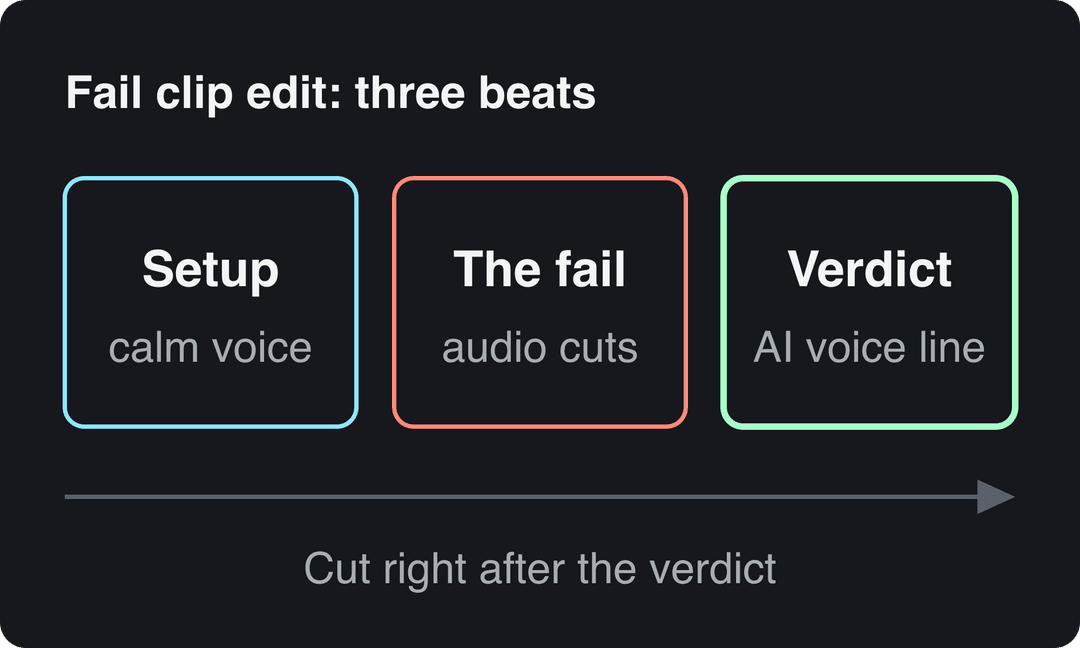
Edit each clip in three beats:
- Setup: calm narration introduces the person and the task.
- The fail: cut the narration or music the moment it goes wrong.
- Verdict: one short line that gives the outcome an absurd cause or diagnosis, then cut to the next clip.
Keep the narration sparse. In Revid's TikTok data, videos with very little speech (under 40 characters) had a 123K median and 20.2% passed 1 million views, while videos talking throughout had 68K. A narrator who fills every second competes with the footage.
How to write the feelings narration and the description
The voice gets funnier when it narrates what the person feels, not what viewers can already see. "He falls off the skateboard" repeats the picture. "At this moment, Kevin felt the confidence of a man who had watched one tutorial" adds a second layer.
Narration templates you can adapt:
- Inner monologue: "She believed, with her whole heart, that the ladder would hold."
- Nature documentary: "Here we observe the adult male, moments after deciding stretching was optional."
- Corporate memo: "Following a brief review, the cake has selected a lower, more stable position."
- Sports commentary: "The confidence is high. The planning is not."
For the TikTok description, name the feeling and invite a reply. Captions of 41 to 80 characters had the best median in Revid's data (67K, against 36K with no caption), and 3 to 4 hashtags did best (4 hashtags: 77K median), while 9 or more dropped to 16K. Description examples:
- "The confidence-to-outcome ratio here is concerning"
- "Narrated by someone who has never once fallen"
- "Which of these hurt your soul the most?"
Revid's add AI voice to silent video tool writes and voices commentary over a clip you upload, which is the quickest way to test several narrator roles on the same fail.
Whose clips can you use?
Use footage you shot, clips submitted by their owners with permission, licensed libraries, or fails you generate with AI. Fully generated fails sidestep the rights problem, but give them a through-line: YouTube does not monetize videos that stitch together unrelated AI clips to shock viewers, and a consistent narrator character is what turns a compilation into a show. Injuries, humiliation and identifiable people in private moments need extra judgment even when you have the rights.
Input
A strawberry discovers her fiance banana is secretly in love with the new mango. Episode 1 of a fruit drama series.
Output
4. Absurd AI scenario videos
A spaghetti car on the morning commute, a cat conducting an orchestra in space, an office building doing choreography. These work when the impossible premise reads instantly and the scene treats it as routine: committed nonsense. A serious traffic report over pasta vehicles beats frantic music and a pile of unrelated distortions.
Build each episode on three decisions:
- Hook: state the premise in the opening caption ("Monday commute, but the cars are pasta").
- Prompt: one impossible object, one recognizable setting, one dominant action. Start from that single sentence in prompt to video.
- Escalation: keep one rule across episodes (a world made of food, objects in office jobs) and push it further each time.
A slightly "obvious AI" look can help, because odd motion and impossible scale signal that this world has its own rules. It hurts when viewers can't tell what the subject is, so check every clip for a readable silhouette and one clear focal point. Audio decides the tone: workplace ambience makes the pasta commute bureaucratic, a generic chaotic track flattens it.
For timing, study how this live-action sci-fi comedy short plays an absurd setup completely straight:
5. AI meme evolution videos
Start with a meme layout viewers know (Drake, Expanding Brain, Distracted Boyfriend), then change the setting, subject or logic one step at a time while the panel structure stays put. The hook is recognition; the joke is escalation.
Use a transformation curve:
- Anchor: show the familiar layout fast.
- Shift: swap in the first altered subject.
- Pressure: make each beat stranger or more specific.
- Break: end on a version that keeps the structure but abandons ordinary logic.
The prompt rule: preserve the panel relationships and change one variable per beat. A narrator describing each stage in a solemn documentary voice adds a second layer, and a sound effect on each change marks the moment the meme stops behaving. Check that the source image is fine to reuse, and never present an altered image of a real person as something they actually said.
6. AI voice comedy skits
AI voice skits turn a small conflict into a playable audio scene. A voice becomes a character when it wants something specific, so give each speaker a goal before you write a line.
Customer: "I bought a laptop that refuses to open." Support agent: "Our records show the device is open to receiving feedback." Customer: "It is closed." Support agent: "Then please remain patient while it processes your complaint."
The agent's literal reading turns a refund into an argument about language, and the last reply extends the misunderstanding instead of resolving it. A manager can arrive later with a confident fix that creates a new problem.
Set delivery rules before generating:
- The customer speaks fast, with rising urgency.
- The agent uses measured pacing and formal wording.
- The manager sounds certain, even when the advice is useless.
Label speakers in the captions and sync captions to the key words so the misunderstanding lands on screen. Cut the pause after each literal reply. Workplace, dating and customer-service premises invite viewers to suggest the next dispute.
Can the AI write the jokes too? Partly. A study of AI-generated humor found AI jokes can be rated comparably to human ones, that ratings improved when viewers did not know the source, and that younger viewers responded more favorably. That is not a reason to hide AI use. It means the joke has to work on its own, so treat AI drafts as raw material and keep the lines that make you laugh.
Prompt to try
Make a 30-second deadpan tutorial parody titled "How to become a cloud in 4 easy steps". Open on the title card as the hook, then a calm, formal narrator lists absurd materials like a ladder and a positive attitude, and gives precise-sounding steps that get less useful each time. End on a fake testimonial from a cloud, held one beat longer than feels natural. Clean instructional style, vertical 9:16, bold captions.
7. AI tutorial parodies and absurd how-tos
Tutorial parodies borrow authority. A clean title, a materials list, numbered steps and calm narration make an impossible goal sound briefly credible, so every absurd detail lands harder than it would in a chaotic sketch. The straighter the delivery, the stranger the instruction can get.
Structure the script as escalation:
- Promise: present the impossible result as a normal tutorial outcome.
- Materials: repurpose ordinary objects for a task they cannot serve.
- Procedure: precise-sounding steps that get less useful each time.
- Proof: a fake result or testimonial that exposes the contradiction.
Example: a deadpan narrator explains that becoming a cloud starts with "cloud-compatible confidence", while the visuals show someone reaching toward a floating cloud and captions list materials with no connection to the task. Hold the final contradiction a beat longer than feels natural so the payoff registers.
Keep the fiction unmistakable. Parody impossible goals, not dangerous ones someone could actually try, and add a short absurd disclaimer if any step could be read as real advice.
Prompt to try
Create a 40-second "what if" video: "What if gravity reversed for one hour every Monday morning?" Hook with the question and a coffee mug floating off the table in the first second, then climb from a family pinning down breakfast to buses drifting off their routes, labeling each stage in the captions. Serious news-report narration, realistic but obviously fictional visuals, vertical 9:16, ending on a commuter calmly reading a newspaper upside down.
8. AI "what if" scenario videos
A strong "what if" video turns one impossible premise into a visible chain of consequences. "What if every animal became human-sized before breakfast?" supplies scale, a deadline and a familiar routine. "What if animals were different?" supplies nothing.
Build it as a logic ladder:
- Hook: state the question in one line and show its first visual consequence immediately.
- Climb: move from a physical change to a household problem, then to a public one.
- Payoff: push that problem to an absurd result and hold the final image.
A gravity-reversal script could show loose objects lifting, a family pinning down breakfast, then buses drifting off their routes. Label each stage in the captions so fast cuts don't erase the reasoning, and prompt each shot with the change, the setting, the camera move and the escalation. For premises about health, public safety or real people, make the fiction obvious and never present invented consequences as advice or news.
How to make a funny AI video with Revid
Revid starts from formats that already made people laugh instead of a blank prompt:
- Find a proven format. Search Revid's library of about 2.77 million short-form videos by topic and engagement tier, or browse viral funny TikToks for pet reactions, skits and fail clips.
- See why it worked. Run a Deep analysis (free, up to 60 a day) to get the hook, the timed structure and the scroll-stopping moment.
- Make it yours. Choose "Same energy, new script" or "Make it about your topic" to get an original video on the same recipe, with new words and visuals. The repurpose viral videos page shows every remix option.
- Tune the joke. Pick a narrator from 1,000+ AI voices in 70+ languages, choose one of 30 caption styles, and trim the pause before the punchline in the timeline editor.
- Publish and learn. Post or schedule to TikTok, Instagram and YouTube from one queue, check each post's views, likes and comments, and remix the episode that did best.
Labels and rights: what each platform requires
Cartoon pets and pasta cars rarely mislead anyone. Realistic animals, real people and fake events do. Here is when each platform expects a label:
| Platform | When to label | What to know |
|---|---|---|
| TikTok | Realistic AI images, audio or video | The label reads "creator labeled as AI-generated"; uploads with C2PA Content Credentials may be labeled automatically. TikTok says the label alone does not affect distribution. |
| YouTube | Realistic altered content, such as a real person appearing to say something or a realistic scene that didn't happen | Use the "AI use" setting in YouTube Studio. Non-realistic content and AI-written scripts are exempt. Since May 2026 YouTube auto-labels undisclosed photorealistic AI. |
| Instagram and Facebook | Photorealistic video or realistic-sounding audio that was created or altered | Meta shows the label as "AI info" and may penalize undisclosed realistic AI. |
For monetization, YouTube allows AI-assisted videos that show your creative vision, but not AI content built from generic templates that looks mass-produced. A recurring character, original writing and a consistent world are what separate a comedy series from a content farm.
Turn one format into a series
All eight formats share one structure: a familiar container plus one absurd premise. Pile on several twists and viewers spend their attention decoding the image instead of laughing. To build a series:
- Choose one format and one comedic mechanism: judgment, contrast, escalation, misunderstanding or transformation.
- Write several hook lines before generating any visuals.
- Generate or source footage you have the rights to.
- Edit for the punchline: cut on the expression change, pause before the absurd line, sync captions to the word that carries the reversal.
- Label realistic AI elements and check that the joke can't harm a real person.
- End with a focused question that turns comments into next week's premises.
The category is growing fast. Fortune Business Insights values the AI video generator market at USD 716.8 million in 2025 and forecasts USD 3.35 billion by 2034, though market definitions vary between research firms. For adoption and feed figures, Ngram keeps a roundup of AI video statistics for 2026 compiled from third-party reports; check each number's original source before quoting it. More AI video means more competition for the same laugh, which is why the joke, not the generation, decides who gets the likes. For writing and timing jokes in general, see our guide on how to make funny videos people watch.
FAQ
Can AI make funny joke videos on its own?
Yes, but the best results come from a human picking the premise and the punchline. AI can draft jokes, voice characters and generate the visuals, and research shows AI jokes can be rated close to human ones, yet a generic prompt produces generic humor.
Do I have to label funny AI videos?
Only when they look or sound real. TikTok, YouTube and Meta all require disclosure for realistic AI content, especially real people saying things they never said; obvious cartoons and impossible scenes generally don't need it on YouTube.
Can you make money from AI comedy videos?
Yes, if the content is original. TikTok's Creator Rewards Program requires 10,000 followers, 100,000 views in the last 30 days and videos at least one minute long, and YouTube monetizes AI-assisted videos that show creative vision but not mass-produced template content.
What AI voice works best for a fail compilation?
A voice whose tone contrasts with the footage: calm, formal, documentary-style or overly proud. Keep the same voice and role on every video so viewers recognize the channel by its narrator.
Do AI videos get more views than real footage on TikTok?
On average, yes, but fewer likes. In Revid's study, AI-generated TikToks averaged 1.4M views against 661.4K for real footage, with a 3.9% like rate against 7.7%.
Sources
- Revid analysis of 176,367 TikToks with 1,000+ likes posted between Oct 1, 2025 and Oct 16, 2026 (61,203 creators)
Charts and figures checked on November 6, 2026.