How to Make Funny Videos for YouTube and TikTok, Step by Step
A step-by-step guide to making funny videos for YouTube, TikTok and Reels. It covers how jokes are built, scripting, solo filming, editing for timing, and what Revid's data on 176,367 TikToks says about comedy.

On this page
To make a funny video, pick one relatable situation, write a setup that points viewers one way and a punchline that flips it, film it in short clean takes, and cut every second that does not lead to the laugh. Open inside the situation, not on an intro, and end right after the punchline or one short tag.
The format is worth the effort. In Revid's analysis of 176,367 TikToks with 1,000+ likes posted between October 2025 and October 2026, comedy videos had a 155K median views, and 22% passed 1 million. That is more than double the 64.4K median of the whole sample. Only challenges (182K) did better.
Challenges and comedy passed 1M views about twice as often as tutorials and storytelling, which are the most common formats.
Source: Revid analysis of 176,367 TikToks with 1,000+ likes posted between Oct 1, 2025 and Oct 16, 2026 (61,203 creators)
Show the data
| Median views | Share that passed 1M views | |
|---|---|---|
| Challenge | 182.3K | 25.6% |
| Comedy | 154.8K | 22.1% |
| Reaction | 104.8K | 16% |
| Dance | 83.8K | 15.5% |
| Storytelling | 66.1K | 12.2% |
| Lip Sync | 61.7K | 12.3% |
| Tutorial | 61.9K | 12.1% |
The sample only holds TikToks that already cleared 1,000 likes, so it shows what successful videos have in common, not what causes success. The method and every chart are in our study of what makes a TikTok go viral.
- Median views of comedy TikToks, more than double the 64.4K sample median
- 155K
- Revid analysis of 176,367 TikToks
- Share of comedy TikToks that passed 1 million views
- 22%
- Revid analysis of 176,367 TikToks
- Median views of faceless comedy TikToks, vs 136K with one person on camera
- 327K
- Revid analysis of 176,367 TikToks
- Marketers who say funny content yields the highest short-form ROI
- 48%
- HubSpot, September 2026
What makes a video funny?
Most funny videos run on three ingredients: relatability, surprise and timing.
- Relatability: the viewer recognizes the situation from their own life, so they are in on the joke before it starts.
- Surprise: the outcome is one they did not predict, but it makes sense the moment they see it.
- Timing: the beat before the payoff. A short pause, or a cut at the exact moment of the reaction, is often the difference between a smile and a laugh.
Picture someone assembling flat-pack furniture: vague instructions, a screw left over, a panel that will not fit. That is the relatable setup. They finish, sit down proudly on the chair, pause, and it collapses. The pause is the timing and the collapse is the surprise.
Funny videos spread because sharing them is social. People send a clip to say "this is us" or "this is you", so the most shareable jokes are specific enough that a viewer thinks of one person to tag. For another angle on why funny clips travel, watch this YouTube video on funny video content.
How to make a funny video, step by step
- Pick one situation. Write it as a sentence: "When you ___ and ___ happens." Narrow beats broad: "When the group chat goes silent after you send a voice note" is funnier than "texting".
- Find the turn. Write the obvious outcome, then three less obvious ones. Keep the one that surprises you but still feels true.
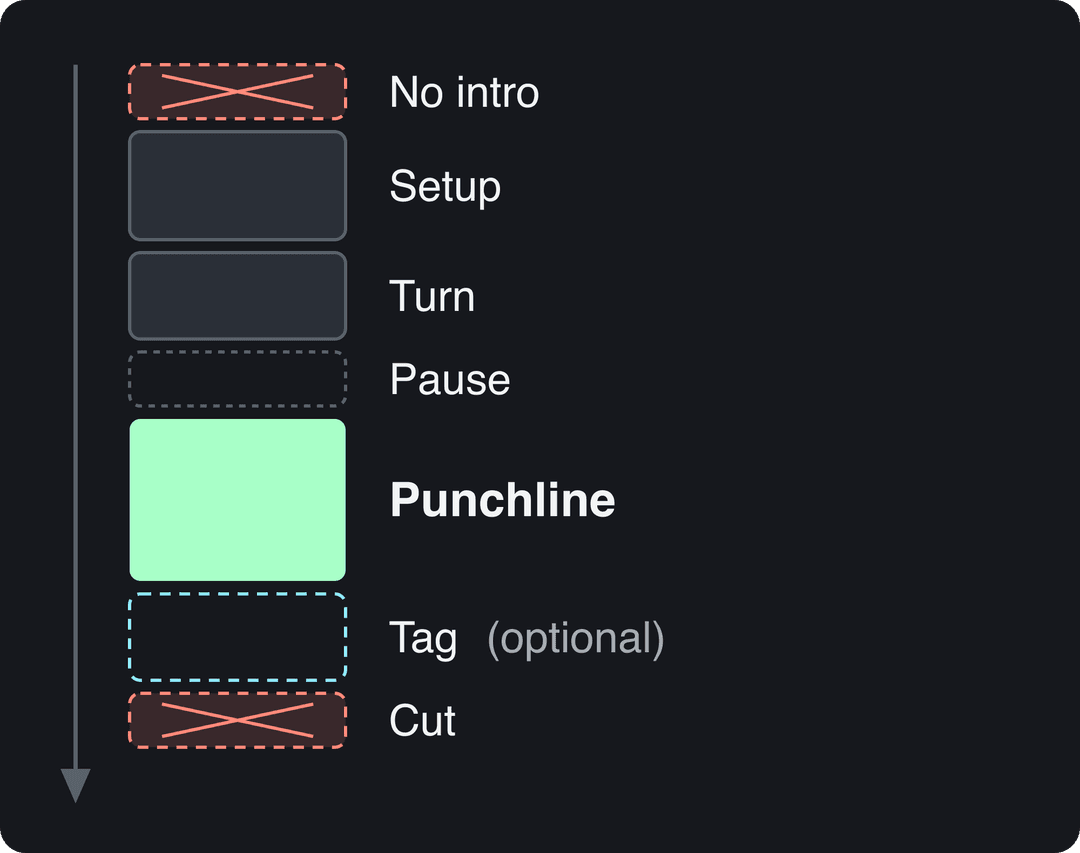
- Script it in beats: setup, turn, punchline, and an optional tag (a second, smaller laugh). Cut setup lines until removing one more would break the joke.
- Plan the first frame. Start in the middle of the situation. No greeting, no "so this happened".
- Film several takes of the punchline. Vary the delivery and the length of the pause, then pick the best one in the edit.
- Edit tight. Cut breaths and dead air, hold a beat on the reaction, and add captions so the joke works with the sound off.
- Post and listen. Note which line people quote back in the comments, and build your next video around it.
How do you write a comedy script that lands?
Good comedy videos feel spontaneous, but most are planned. A script keeps the setup short, makes the turn clear and lands the punchline on the right beat.
If you get stuck on premises, this guide to creative thinking has idea-generation exercises that work for jokes too. An AI script generator can draft variations of a premise for you to rewrite in your own voice.
Write dialogue the way people actually talk
Stiff lines kill jokes. Real speech has interruptions, half-sentences, slang and people talking past each other. Read your script out loud and rewrite any line you would never say in real life.
Build tension, then pay it off
The setup creates an expectation and the punchline breaks it. Someone fights a jar lid for what feels like forever (tension), finally wins, and the contents explode across the kitchen (payoff). Two classic tools help:
- The rule of three: two normal items, then an absurd one.
- Misdirection: the setup makes viewers assume one meaning, and the punchline reveals another.
Match the format to the length
| Format | Typical length | Setup time | Where it fits |
|---|---|---|---|
| One-liner or visual gag | Under 15 seconds | Almost none | TikTok, Instagram Reels, YouTube Shorts |
| Short sketch | 30 to 60 seconds | 5 to 10 seconds | TikTok, Reels, Shorts |
| Longer sketch | 1 to 3 minutes | 15 to 30 seconds | YouTube Shorts (up to 3 minutes) or long-form YouTube |
| Stand-up style bit | 2 to 5 minutes | 30 to 60 seconds | Long-form YouTube, Facebook |
For more on comedy structure, this interview with Steve Kaplan covers the tools screenwriters use to write comedy:
Prompt to try
Make a 30-second vertical funny how-to video titled 'How to look busy in a meeting: a professional guide'. Open on a close-up of someone frantically typing nothing, with a dead-serious narrator presenting numbered steps like nodding slowly and saying 'let's circle back'. Use a calm corporate tutorial style with on-screen step numbers and captions, and end on the boss walking in as the narrator whispers 'step five: panic'.
Funny video ideas, including funny how-to videos
| Idea | How it works | Example premise |
|---|---|---|
| Expectation vs reality | Show the plan, then the result | "The recipe photo vs my kitchen" |
| POV skit | Put the viewer inside the situation | "POV: you're the only one who read the group chat" |
| Funny how-to | A tutorial delivered completely straight, about something absurd | "How to look busy in a meeting: a professional guide" |
| One person, every character | You play everyone, with a costume or framing change | Your boss, your coworker and you in the same meeting |
| Voiceover on pets or objects | Narrate what the animal or object is "thinking" | Your cat judging your life choices |
| Recurring character | Same character, new situation each episode | "The overly honest waiter" as a series |
| Text-on-screen relatable | One shot, and caption text carries the joke | Staring into the fridge: "checking if new food appeared" |
The funny how-to is the most underused. It borrows the structure of a tutorial (numbered steps, confident tone, close-ups) and applies it to a ridiculous goal. Every line does not need a punchline, because the gap between the serious tone and the silly topic is the joke.
To see what works right now, browse viral funny TikToks and write the premise of each in one sentence. This roundup of video types that attract the most viewers is also useful: kids' and animal content, often with a humorous angle, keeps showing up near the top. For more premises, see our guide on creating funny videos for social media.
How to make a funny video by yourself
Solo comedy is easier than it looks.
- Play every character. Swap a hat or jacket, film each character's lines facing a different side of the frame, then cut them together as one conversation.
- Use a tripod and a timer or remote so you can do many takes without help.
- Go faceless. Use a voiceover over footage, screen recordings, POV shots or text on screen.
The faceless option is not a compromise. In the same Revid study, faceless comedy TikToks had a 327K median views (26.4% past 1 million), against 136K for comedy with one person on camera. POV footage also beat selfie-style footage: 107K median views vs 48K.
Faceless tutorials earned about 3x the median views of on-camera tutorials (156K vs 52K).
Source: Revid analysis of 176,367 TikToks with 1,000+ likes posted between Oct 1, 2025 and Oct 16, 2026 (61,203 creators)
Show the data
| Median views | Share that passed 1M views | |
|---|---|---|
| Faceless tutorials | 155.6K | 22.1% |
| Product or object tutorials | 80.7K | 14.9% |
| On-camera tutorials | 52.5K | 10% |
| Faceless storytelling | 72.7K | 13.3% |
| On-camera storytelling | 64.4K | 11.7% |
| Faceless comedy | 326.7K | 26.4% |
| On-camera comedy | 135.5K | 20.7% |
These are TikTok results for videos that already performed, and a strong on-camera persona can still win. But if being on camera is what stops you from posting, you do not need it.
Filming tips that make the joke land
- Camera angle: a low angle makes a character look pompous. A tight close-up catches the reaction, which is often the real punchline.
- Framing: leave empty space where the gag will enter the shot, so the viewer's eye is already there.
- Lighting: use bright, even light so expressions read on a phone screen. Face a window if you have no lights.
- Sound: get the mic close. Viewers forgive a soft image but not a mumbled punchline.
- Vertical first: shoot 9:16 for TikTok, Reels and Shorts, and keep faces and text away from the edges where the app interface sits.
For tactics specific to Instagram, Boostfluence has a guide on how to make Reels go viral.
Editing: where comedy timing is made
The edit decides whether a joke lands. Cut into the action rather than before it, hold one beat on the reaction, and never keep footage after the laugh.
| Technique | What it does for the joke | Best use |
|---|---|---|
| Quick cuts | Speed up the setup, sharpen the surprise | Slapstick, fast relatable bits |
| Holding on the reaction | Gives viewers a beat to laugh | Any punchline with a face in it |
| Jump cuts | Skip time abruptly for an absurd effect | Surreal humor, montages |
| Slow motion | Stretches the moment before impact | Physical comedy, fails |
| Freeze frame | Stops on the funniest expression | Reactions, "record scratch" openings |
| Sound effects | Punctuate a beat (a boing, a gasp, sudden silence) | Visual gags, transitions |
| On-screen captions | Make the joke work with the sound off | Every short-form video |
Visual jokes travel well. In Revid's TikTok study, videos with under 40 characters of speech had a 123K median and 20.2% passed 1 million, against 68K for videos with talking throughout. If a joke can be shown instead of said, show it.
DaVinci Resolve, Adobe Premiere Pro and Final Cut Pro give you frame-level control over timing. A mobile editor is enough for most short bits. For captions, an AI caption generator adds synced captions in 100+ languages.
How to make comedy videos on YouTube
YouTube gives comedy two formats, and they reward different jokes.
- Shorts (square or vertical, up to 3 minutes) suit single bits, one-liners and short sketches.
- Long-form videos suit sketches with characters, running gags and callbacks to earlier episodes.
Title the situation, not the punchline. A title can be up to 100 characters, and "When your mom finds the group chat" tells viewers what they will recognize without spoiling the turn.
Recurring characters are where YouTube comedy channels build loyalty. In September 2026, YouTube began rolling out Shorts series, which lets creators organize Shorts into seasons and episodes. If you plan a character series, see how an animated series with consistent characters is built. Wegic's overview of funny videos on YouTube also covers the formats audiences watch.
Know the monetization rules before you pick a format. Content that relies on mostly non-verbal reactions to someone else's material counts as reused content and cannot monetize, and the policy applies to the whole channel. AI-made comedy can earn if it shows your creative vision. Videos that stitch together unrelated AI clips to shock viewers cannot.
How to create funny content for TikTok and Instagram
On TikTok, comedy works best when the first frame already shows the situation and the caption sets it up in a few words. If you want to earn through the Creator Rewards Program, plan sketches of at least one minute. Only videos that long can earn, and lip syncs with copyrighted music running over one minute do not count as original. Our guide to funny TikTok videos covers TikTok-specific formats.
Instagram Reels can run up to 20 minutes, but Reels longer than 3 minutes are not recommended to non-followers, so keep comedy well under that. Instagram allows up to 5 hashtags per post. Trial reels are useful for testing jokes: they are shown first to non-followers, so you can try two versions of a punchline without affecting your regular reels. You need a public account with at least 200 followers (professional) or 1,000 (personal).
Comedy also works for brands. In HubSpot's 2026 research, 48% of marketers said funny content yields the highest ROI among short-form content types. If your sketch is an ad, this guide to making video ads that convert covers the offer and call to action that a joke alone will not.
How to make a comedy video go viral
No one controls virality, but the data shows where the ceiling is highest.
- Pick a format with reach. Challenges, comedy and reactions (105K median) led every content type in Revid's TikTok study.
- Make humor the dominant mood. Humorous videos had a 121K median and 19.3% passed 1 million, against 45K for inspirational ones. Outrage scored higher (156K), but it is a poor base for a comedy brand people want to come back to.
- Keep it shareable. Median views barely moved with length (58K to 76K across buckets), but videos under 15 seconds got the most shares per view: 1.41 per 100 views. Short, specific, taggable bits get passed around.
- Repeat what works. A recurring character or running gag turns one hit into a series that viewers come back for.
How to make a funny video with Revid
Revid turns an idea or a proven viral format into a finished short. Its library of about 2.77 million real videos with engagement data lets you start from a comedy structure that already worked.
- Search the viral library for comedy in your niche and open a video that performed well. The free deep analysis (up to 60 a day) explains its hook, its timed structure and its scroll-stopping moment. Here is how remixing viral videos works.
- Choose "Make it about your topic" or "Same energy, new script". Revid keeps the structure, pacing and energy, and writes a new script and new visuals.
- Starting from your own premise instead? Describe the situation and the twist in prompt to video. Revid writes the script and generates the visuals, voice-over, captions and music.
- Fix the timing in the timeline editor: trim the setup and hold on the punchline.
- Publish or schedule to TikTok, Instagram and YouTube from one queue.
For examples, see these funny AI videos and the tactics behind them. If a video shows realistic AI people or scenes, turn on the platform's AI label. TikTok and YouTube both say the label alone does not reduce reach.
FAQ
How long should a funny video be?
Make it as long as the joke needs and no longer. In Revid's TikTok study, median views stayed between 58K and 76K across length buckets, so pacing matters more than length. Clips under 15 seconds got the most shares per view.
Do you have to be naturally funny to make comedy videos?
No. Comedy videos are mostly craft: a specific situation, a clear turn, tight editing and a lot of takes. Writing several punchlines and keeping the one that makes you laugh beats waiting for inspiration.
What is the best app for making funny videos?
For editing footage you filmed, CapCut is a common choice: it has a free tier with 1080p export and auto-captions. DaVinci Resolve, Premiere Pro and Final Cut Pro give finer timing control. To make funny videos without filming, use an AI video generator such as Revid.
Can funny AI videos make money on YouTube?
Yes, if the final video shows your own creative vision and entertains. YouTube does not monetize AI content that looks mass-produced from generic templates, or compilations of unrelated AI clips made to shock. Disclose realistic AI scenes in YouTube Studio; disclosure alone does not limit earnings.
Sources
- Revid analysis of 176,367 TikToks with 1,000+ likes posted between Oct 1, 2025 and Oct 16, 2026 (61,203 creators)
- HubSpot, The Future of Social Media [Research]: What Marketers Need to Know in 2026 (September 2026)
Charts and figures checked on November 6, 2026.