How to Get an AI to Write a Script That Doesn't Sound Like AI
Give the AI a real brief, work in three passes and cut the narration. Copy-paste prompts, a script audit and Revid's TikTok data on how much talking performs best.
On this page
To get an AI to write a usable script, give it a brief first: audience, platform, length, one goal, hook, voice, structure and what it must not say. Then work in three passes: hooks and a beat sheet, timed scenes, then a targeted edit. Read it aloud and check every claim before recording.
The model is rarely what holds a script back. In a preregistered 2023 experiment, 453 college-educated professionals who used ChatGPT for defined writing tasks finished 40% faster, and evaluators rated their work 18% higher in quality, according to the Science study on ChatGPT and writing productivity. The tasks were clearly defined. Type "write me a TikTok script about skincare" and you get the opposite: a fluent script with nothing specific to say.
- Median TikTok views for videos with under 40 characters of speech
- 123K
- Revid analysis of 176,367 TikToks
- Median TikTok views for videos that talked throughout (300+ characters)
- 68K
- Revid analysis of 176,367 TikToks
- Faster completion of defined writing tasks with ChatGPT
- 40%
- Science study, 2023
- Median TikTok views when the dominant mood was outrage
- 156K
- Revid analysis of 176,367 TikToks
Write the brief before the AI writes anything
A vague prompt forces the model to guess, and it guesses the safest average: a familiar hook, a middle that repeats the premise, and "follow for more" at the end. Treat it like a fast junior copywriter who knows nothing about your audience. You still own the idea, the facts and the final edit.
Put these in every brief:
| Element | What to tell the AI | Example |
|---|---|---|
| Subject | The exact topic, not the category | Why home cold brew tastes bitter |
| Audience | Knowledge level and main problem or objection | Coffee drinkers who gave up after one batch |
| Platform | TikTok, Reels, Shorts or long-form YouTube | Vertical TikTok |
| Objective | One result only | Get them to try a coarser grind |
| Hook | The tension, contrast or promise to open on | Your cold brew isn't bitter because of the beans |
| Voice | Attitude, vocabulary, pace | Blunt, plain words, no hype |
| Structure | The order of beats | Hook, context, three points, payoff, call to action |
| Constraints | Length, banned claims, required sources, words to avoid | No brand claims, no invented numbers |
Copy this starting prompt and fill in the brackets:
Write a 40-second script for a vertical TikTok. Subject: [exact topic]. Audience: [knowledge level, main problem or objection]. Objective: [one result, such as explain or persuade]. Hook: open with [tension, contrast or promise]. Voice: [attitude, vocabulary, pace]. Structure: hook, context, three points, payoff, call to action. Constraints: about [word count] words, no [prohibited claims], cite [required sources], avoid [terms or ideas]. Give a rough duration for each scene.
A word count only estimates runtime. Pauses, pronunciation and visual beats all change timing, so ask for a duration per scene and read the draft aloud with a timer. For the craft of structure and pacing without AI, see our guide on how to write a video script.
Why one prompt fails and three passes work
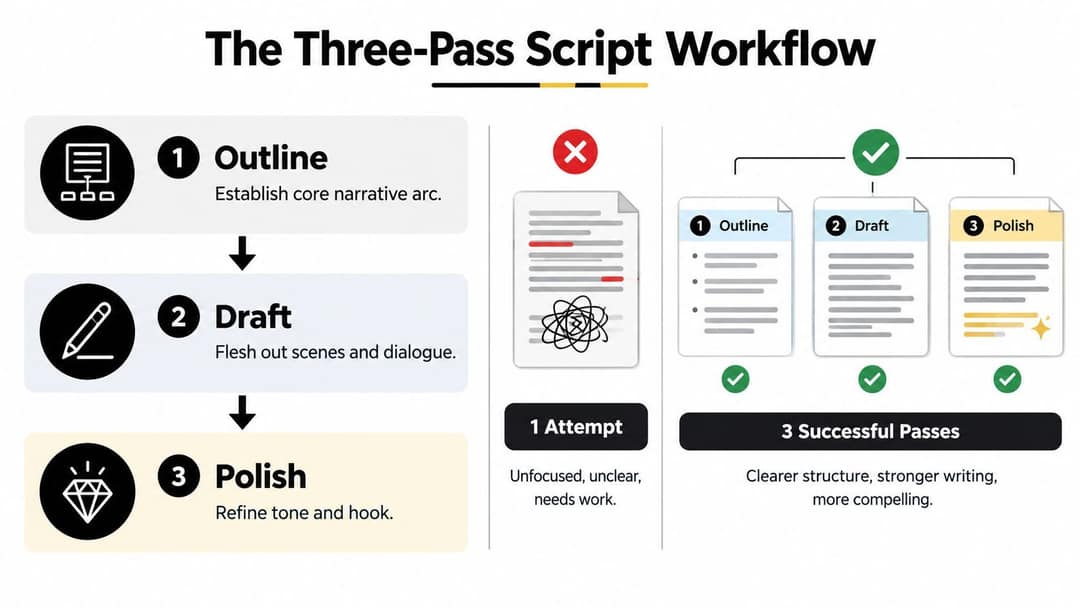
Ask for a finished script in one go and the model solves every problem at once, so it drifts toward safe, interchangeable language. Splitting the work into outline, draft and polish lets you reject a weak premise before you spend time on sentences.
Pass 1: get hooks and a beat sheet, not a script
Start with options for the opening only:
Write several opening hooks for this brief. Give each one a different approach: a statement, a question, a contrast and a surprising mistake. Keep each hook short enough to say in one breath, and don't write the rest of the script yet.
Pick the hook yourself. As a benchmark, 51% of TikToks with over 100 million views that have a transcript open with a statement and 16% with a question, according to Revid's analysis of the 100M Club. If none of the AI's options are sharp, take a pattern from our list of TikTok hooks that stop the scroll and give it to the model as the template.
Then ask for a beat sheet: the chosen hook, the viewer's problem, the order of reveals, the proof or example, and the payoff. No polished prose yet. You are checking one thing: is there a reason to keep watching after the hook?
Pass 2: turn the beats into timed scenes
Turn this beat sheet into timed scenes for a 40-second vertical video. For each scene, give the duration, the narration, the visual and any on-screen text. Keep the hook exactly as written, and don't add claims or examples that aren't in the beat sheet.
Scene-by-scene output lets you change the pacing or rewrite one beat without regenerating everything else. If the script will feed an AI video generator, write the visual column as instructions for shots and movement; our prompting guide for AI video generation covers that translation.
Pass 3: edit like an adversary
Asking the model to "make it better" invites a full rewrite that can erase the lines that already work. Ask for specific checks instead:
Review this script without rewriting it. List every line that repeats an earlier point, every claim that needs a source, every transition that does no work, and any scene where the narration runs longer than its duration. Suggest a fix for each problem and leave everything else unchanged.
There is a creative reason to keep the decisions with you. In a 2024 experiment, stories written with AI-generated ideas came out about 5.2% more alike in one condition: AI help can lift a single piece while pulling everyone toward the same patterns, as the Science Advances study on AI and creative writing reports. Use the model to widen your options, then choose.
Prompt to try
Make a 30-second vertical video about why home cold brew tastes bitter. Open with the line "Your cold brew isn't bitter because of the beans." Keep the narration to one or two short lines and let close-up shots of coarse versus fine grind and steeping jars carry the explanation, with bold on-screen text for each point. Blunt, plain tone, no hype.
Make the AI write fewer words
Language models pad. Ask for a 40-second script and you often get narration for every second, with the visuals reduced to illustrations of the voiceover. The data points the other way. In Revid's analysis of 176,367 TikToks with 1,000+ likes posted between October 2025 and October 2026, videos with under 40 characters of speech had a median of 123K views, and 20.2% passed 1 million. Videos that talked throughout (300+ characters of speech) had a 68K median and 11.9% past 1 million, below even silent videos (73K, 14.3%).
Videos with just a few spoken words (a line or two) beat both silent videos and videos that talk the whole way through, which were the most common and the weakest.
Source: Revid analysis of 176,367 TikToks analyzed by AI, with 1,000+ likes posted between Oct 1, 2025 and Oct 16, 2026 (61,203 creators)
Show the data
| Median views | Share that passed 1M views | |
|---|---|---|
| No speech | 73.3K | 14.3% |
| Under 40 | 122.7K | 20.2% |
| 40 to 120 | 97.2K | 17.6% |
| 120 to 300 | 91.6K | 16.8% |
| 300+ | 67.7K | 11.9% |
The sample only includes videos that already cleared 1,000 likes, and the figures show what strong performers have in common, not what causes views (the full TikTok virality study explains the method). The lesson for a script is still practical: write narration only where the picture can't carry the point. Add this to your Pass 2 prompt:
Write narration only for scenes where the visual cannot explain the point alone. For every other scene, describe the visual and the on-screen text, and leave the narration empty.
Then check the result against footage you can actually get. Fewer words only help if the visuals do real work.
Prompt to try
Create a 35-second vertical TikTok calling out the most common meal prep mistake: cooking all your chicken on Sunday and eating dry leftovers by Wednesday. Hook: "You're ruining your meal prep before Monday even starts." Use a blunt, slightly irritated narrator with short sentences and plain words, and end on one simple fix.
How do you control the tone of an AI script?
Unprompted, AI scripts sound helpful, balanced and mildly upbeat, a register that disappears in a crowded feed. Put tone in the brief, with one of these methods:
| Method | Best for | How to do it |
|---|---|---|
| Style reference | Matching pacing, density or structure | Provide your own sample or a permitted reference. Tell the model to study pacing and organization, not wording, jokes or distinctive phrases. |
| Voice profile | A recognizable brand voice | Define attitude, sentence length, vocabulary, humor, point of view, relationship with the viewer and banned clichés. |
| Prohibition list | Removing default AI habits | Ban generic openings, inflated promises, repeated transitions, empty adjectives, unsupported certainty and stock calls to action. |
| Contrast brief | Competing goals | State the priority order, such as educational first, entertaining second, selling only in the final line. |
A voice profile you can paste:
The narrator is a blunt, experienced practitioner talking to a friend who is new to the topic. Use short sentences and plain words, with no jargon unless it is explained in the same line. Skip hype and empty adjectives. Take a clear position when the evidence supports one. Sound conversational: write the way you would explain this out loud, with contractions and the occasional direct question to the viewer.
That turns "conversational" into instructions a model can follow.
Pick the emotion on purpose too. In the same Revid TikTok study, videos whose dominant mood was outrage had a 156K median views and 23.7% passed 1 million; humor had 121K (19.3%), sadness 104K, and inspirational content only 45K (11.3%). The default AI tone sits closest to inspirational. Name the reaction your topic can honestly earn (surprise at a common mistake, irritation at a bad practice, a laugh) and put it in the brief. Mood labels come from Revid's AI analysis of each video.
High-arousal emotions (outrage, humor, sadness) earned the most views. Calm, inspirational videos earned the least, even though they collect the most likes per view.
Source: Revid analysis of 176,367 TikToks with 1,000+ likes posted between Oct 1, 2025 and Oct 16, 2026 (61,203 creators)
Show the data
| Median views | Share that passed 1M views | |
|---|---|---|
| Outrage | 156K | 23.7% |
| Humor | 121K | 19.3% |
| Sadness | 104.4K | 16.5% |
| Excitement | 92.5K | 15.9% |
| Joy | 89.9K | 18% |
| Informative | 64.1K | 11.2% |
| Neutral | 61.2K | 11.5% |
| Inspirational | 44.6K | 11.3% |
Two more rules. For each scene, ask what changes, why the viewer needs it now and what they should feel before the next scene; if the answer is nothing, cut the scene. And when you give the model a writing sample, use your own and ask it to describe measurable traits (sentence length, directness, use of questions, jargon), then turn those into prompt rules. Don't ask it to imitate a living creator's phrasing: borrow structure, and supply your own words, examples and opinions.
Check the script before you record
Fluent prose hides production problems: a source that doesn't support the claim, a scene with more narration than screen time, captions that repeat the voiceover word for word.
Ask the model to return a fixed scene schema (scene number, duration, narration, visual, on-screen text, transition, source) and validate every scene against it. Research on structured outputs found an average formatting success rate of 82.55%, with results ranging from 0% to 100%, so output that looks valid still needs checking, per the arXiv paper on LLM structured output.
Then run this audit:
- Timing: add up the scene durations and read the narration aloud at a natural pace.
- Claims: highlight every number, name, date, quote and cause-and-effect statement, and verify each against an authoritative source.
- Continuity: names, products, promises and examples stay consistent from opening to close.
- Visuals: each visual adds information or emotion instead of showing the spoken sentence as text.
- Captions: on-screen text reinforces the point rather than duplicating the voiceover.
- Action: the call to action follows from what the viewer just got.
Audit this script against the checklist above. Return a table with the scene number, the problem and the fix. Flag any number, name, date or quotation that has no source. Then give a revised version that changes only the flagged lines.
Automation catches missing fields, repeats, long sentences and banned words. It can't judge whether a joke lands with your audience, whether an example feels real, or whether the central claim deserves trust. Those calls stay with a person.
Sales calls are a separate job. A video script is watched; a call script is spoken live to someone who can interrupt and object. If what you need is people running outbound calls rather than a video, Lathire's page on hiring cold callers covers that side, and any sales video still gets the same claim and timing checks.
Do you have to disclose an AI-written script?
Not for the words alone on YouTube: its disclosure policy lists AI-written outlines and scripts among uses that don't need a label, and so is cloning your own voice for a voiceover. What needs disclosure is realistic synthetic media, such as making a real person appear to say or do something, or generating a realistic scene that didn't happen.
TikTok requires creators to label AI-generated content that contains realistic images, audio or video, and may apply a label automatically, per TikTok's rules on AI-generated content. Since May 2026, YouTube also labels undisclosed photorealistic AI automatically and shows the label as an overlay on Shorts. Both platforms say the disclosure label alone does not reduce a video's reach or its eligibility to earn, so there is no reason to skip it.
Monetization is the bigger risk for heavy AI users. YouTube allows AI to write or edit scripts in monetized videos when the final product shows your creative vision, but content made from generic AI templates that looks mass-produced is not allowed to monetize. Running the same prompt on repeat is exactly what that rule targets, which is one more reason to make real decisions in every pass.
Add a compliance block to your first prompt:
Compliance: do not invent quotes, statistics or events. Do not make a real person appear to say or do something they did not. Mark every scene that uses an AI voice, a cloned voice or realistic AI visuals, and note where the upload will need an AI-generated content label.
Before upload, confirm four things:
- Facts: every material claim has been checked against its source.
- Media: you have the rights to the voice, likeness, footage, music and images.
- Labels: the upload settings and any visible disclosure match how the video was actually made.
- Meaning: AI hasn't changed the meaning of the source material or implied that a real event happened.
The same line applies to career content. If you script interview tips, an AI answer generator guide for job seekers can help plan talking points, but the video should separate your own experience from general advice.
How to write a script with AI in Revid
Revid's free AI script generator turns a one-line idea, topic or URL into a structured script with a hook, scenes, voiceover and a call to action. When Revid writes a script from a prompt, it first retrieves transcripts of related TikToks with more than 10,000 likes and uses them as references for style and story, so the draft starts from formats people already watch instead of a blank page.
- Enter your brief (topic, audience, tone) in the script generator, or use the TikTok script generator for a TikTok-specific hook and structure.
- Run your passes on the draft: choose the hook, check scene timing, then audit claims.
- Paste the approved script into script to video to generate visuals, a voiceover in 70+ languages and synced captions.
- Fix any scene in the timeline editor, then publish or schedule to TikTok, Instagram and YouTube.
You can also start from a video that already performed: Revid analyzes the reference, keeps its spoken structure, timing and tone, and writes new words and visuals. Our walkthrough on writing scripts for Revid videos shows the product steps in detail.
FAQ
Can ChatGPT write a video script?
Yes. ChatGPT, Claude, Gemini or any capable chat model can draft a usable script when you give it a full brief and work in passes. Weak results usually come from one-line prompts, not from the model.
What is the best AI to write a script?
For a first draft, the brief matters more than which general chat model you use. A dedicated script tool helps when you want the draft grounded in real viral references and turned straight into a finished video.
Can AI write a movie script or screenplay?
Yes, as a drafting partner. Use the same method at a larger scale: a logline and character brief, a beat outline, scenes, then a targeted edit, with story decisions and final dialogue kept in your hands.
How do I stop an AI script from sounding like AI?
Give it a prohibition list, a voice profile with sentence length and attitude, and details only you know. Then do a final edit out loud, in your own voice.
How can I write scripts in batches without them all sounding the same?
Generate several premises and hooks first, then give each script a different objection, example, angle or reveal order. Run a repetition check across the batch and rewrite any openings, metaphors and calls to action that sound interchangeable.
Sources
- Revid analysis of 176,367 TikToks analyzed by AI, with 1,000+ likes posted between Oct 1, 2025 and Oct 16, 2026 (61,203 creators)
- Revid analysis of 176,367 TikToks with 1,000+ likes posted between Oct 1, 2025 and Oct 16, 2026 (61,203 creators)
Charts and figures checked on November 6, 2026.