
Instagram Clone Script: How to Choose One and Build a Niche App
What an Instagram clone script includes, which features and specs it needs today, and how to judge a vendor on code ownership, moderation and video before you buy.

On this page
An Instagram clone script is ready-made source code for a photo and video social app: profiles, follows, a feed, Stories, short vertical video, comments, direct messages, notifications and an admin panel. You license it, rebrand it and launch faster than a from-scratch build. It pays off only when you own the code and your edge is a specific community.
The feature list is the easy part, and most vendor demos look alike. What separates a usable script from a future rewrite is what demos skip: moderation tooling, the video pipeline and real ownership of the source. A niche app can survive a plain design. It won't survive a community that feels unsafe or a feed that stalls once uploads pile up.
- Year-over-year growth in US Instagram Reels watch time, Q4 2025
- 30%+
- Meta Platforms, January 2026
- Consumers concerned about running into AI-generated deepfakes
- 84%
- Sprout Social, September 2026
- Users Instagram reached on its first day in October 2010
- 25,000
- Account of Instagram's early history
- Current maximum length of an Instagram Reel
- 20 min
- Instagram Help Center
What is an Instagram clone script?
"Clone" describes the feature set, not Instagram's code. Vendors rebuild the familiar patterns (grid profiles, a scrolling feed, Stories, vertical video) and sell them as a package you can rebrand. A typical package includes:
- User apps: iOS and Android, sometimes a web version.
- Backend: the API, database, media storage and background jobs.
- Admin panel: user management, content review, reports and settings.
- Documentation and setup support: installation, configuration and sometimes deployment.
Vendors deliver it in three main ways. You get the full source code under a license, a compiled or encrypted package you can configure but not really change, or a hosted white-label service you never touch. Only the first gives you room to build the parts that make your app different.
When an Instagram clone makes sense
Use a script when the social mechanics are standard and the value is the audience. Social media is fragmenting as users move toward smaller, identity-aligned communities, which opens room for niche platforms rather than broad copies, as Primocys notes in its overview of Instagram clone features. An app for local food creators, independent designers, fitness coaches or professional photographers doesn't need every Instagram behavior. It needs one audience to feel understood.
Start the brief with a repeated need, not "build an Instagram clone":
- Local discovery: members find nearby creators, events, products or businesses.
- Professional visibility: creators show work in a portfolio-style space.
- Shared identity: a community built around a profession, interest, language or place.
- Accountability: challenges, progress updates or peer feedback bring people back.
- Commerce: creators turn attention into bookings, subscriptions or sales.
If your core experience depends on unusual permissions, specialized ranking, complex payments or custom governance, a script turns into a liability. You will spend the saved time fighting its assumptions.
Posts promoting a brand
Source: Revid social index: 388,379 posts from X, Instagram, Threads, Reddit and LinkedIn with AI labels per post, snapshot of Sep 15, 2026.
Show the data
| Posts promoting a brand | |
|---|---|
| 26% | |
| X | 24.5% |
| Threads | 15.4% |
What features should an Instagram clone script include?
Judge a script by layer, and test each layer in the demo instead of reading the brochure.
| Layer | Must-have features | What to check in the demo |
|---|---|---|
| Identity | Profiles, follows, private accounts, blocking, account verification | Can a blocked user still see or message you? |
| Publishing | Photos, carousels, captions, hashtags, mentions, drafts | Does upload resume after a dropped connection? |
| Stories | Temporary posts, viewers list, polls or stickers, highlights | Do expired Stories disappear from caches too? |
| Short video | Vertical recording or upload, trimming, sound, captions, autoplay feed | How many renditions does one upload produce? |
| Discovery | Explore, search, hashtag pages, recommendations | Can you change the ranking logic without the vendor? |
| Messaging | One-to-one and group chats, media sharing, message requests | Can moderators review reported messages? |
| Notifications | Push, in-app, email digests with user controls | Can users mute by type? |
| Admin and moderation | Report queue, roles, audit log, bans, appeals | Is every action logged with who did it and why? |
| Monetization | Subscriptions, tips, shop links, sponsored posts | Which payment providers are wired in, and who holds the keys? |
| Analytics | Creator insights, retention, publishing activity | Can you export raw events? |
Don't build every monetization feature before you know what members value. Instrument the events that show community health first: successful posts, meaningful comments, follows, saves, messages and return visits.
Match Instagram's current specs, not an old version
Many scripts copy an older Instagram. Your users arrive with today's habits, so know the current reference points before you set your own limits. These come from the Instagram Help Center and Meta's developer docs:
| Instagram today | Current rule |
|---|---|
| Reels length | Up to 20 minutes; reels over 3 minutes are not recommended to non-followers |
| Reels format | Aspect ratios from 1.91:1 to 9:16, at least 30 FPS and 720 pixels |
| Hashtags | Up to 5 per post |
| Captions | Up to 2,200 characters |
| Carousels | Up to 20 photos and videos per post |
| AI content | Labeled "AI info" when Meta detects AI signals or the creator discloses it |
You don't have to copy these limits. Decide them on purpose. A portfolio community may want long captions and big carousels, while a quick-tips app may cap video length to keep the feed fast.
Why short video can't be an afterthought
Instagram added video sharing in 2013, Stories in 2016 and Reels in 2020, a steady move from static photos to short-form video that any clone has to account for, as The Social Shepherd's Instagram history and statistics documents. The shift is still accelerating: Meta reported that Instagram Reels watch time grew more than 30% year over year in the US in Q4 2025, one of the figures in our short-form video statistics. For where formats are heading, see these current short-form video trends.
Video is a system, not an upload button. A script should handle:
- Vertical recording or upload, with trimming before publishing.
- Transcoding into several resolutions and bitrates.
- Adaptive streaming (HLS or DASH) so playback adjusts to the network.
- Captions, either uploaded or generated.
- Player overlays that stay out of the way. Look at an Instagram Reels safe zone template to see where buttons and captions sit, and keep your own UI from covering faces and text.
- A moderation hook before or after publishing.
- A clear difference between an original upload and a reshare.
If you are scoping a video-first product, reviewing a short video social app starter kit helps you list the baseline components. Use it to spot infrastructure decisions, not to copy screens.
Moderation and trust: the part most scripts skip
The gap in the clone script market isn't feed replication. It is moderation, safety and governance for niche communities, where admin controls decide whether the product holds up against real abuse, a point made in Miracuves' review of Instagram clone script features and pricing. Niche members often expose more: their identity, their work, their location or their professional reputation.
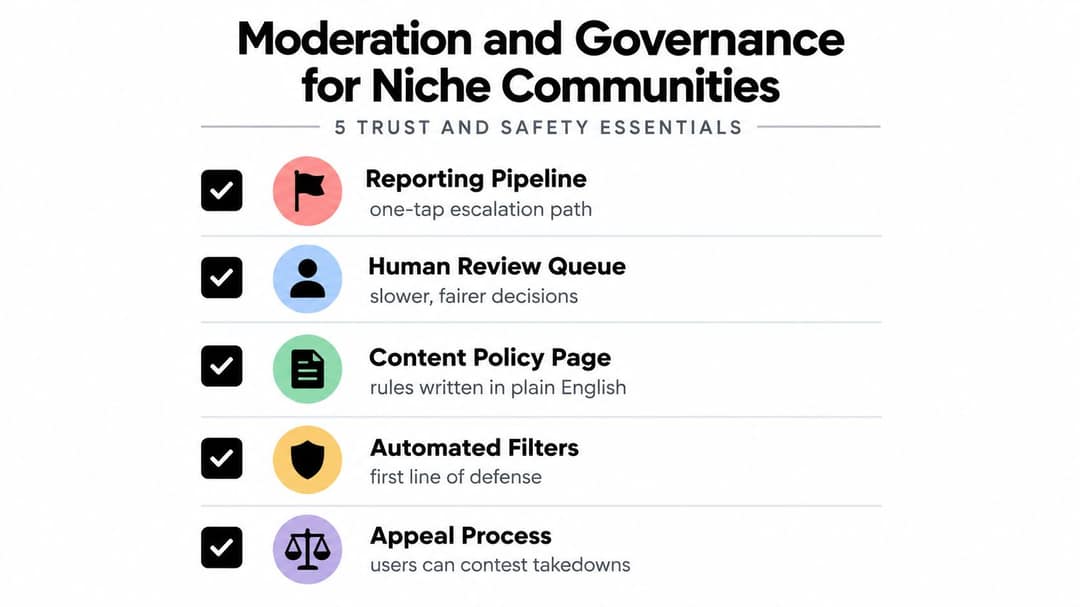
A report button is not a moderation system. Before launch, a script should give you:
- Reporting pipeline: clear categories such as harassment, spam, impersonation, dangerous content and intellectual property.
- Review queue: each report with the content, its context, the reporter's history and the available actions.
- Automated filters: a first pass for spam, banned terms and repeat abuse.
- Escalation rules: urgent threats and coordinated abuse separated from routine cases.
- Appeals: users see why content came down and can contest it.
Automation triages volume, but ambiguous cases (satire, cultural context, disputes) need a person. Write the policy in plain English, list the enforcement steps from warning to removal, and keep internal playbooks for recurring cases such as harassment, copyright complaints and spam waves.
Posts with AI visuals
Source: Revid social index: 388,379 posts from X, Instagram, Threads, Reddit and LinkedIn with AI labels per post, snapshot of Sep 15, 2026.
Show the data
| Posts with AI visuals | |
|---|---|
| High engagement | 1.6% |
| Medium engagement | 2.9% |
| Low engagement | 6.7% |
Plan for AI-generated content labels
AI video and images now arrive in every feed, so labeling belongs in your moderation plan. TikTok, YouTube and Meta all ask creators to disclose realistic AI content, and Meta reads industry signals such as C2PA and IPTC metadata to apply its "AI info" label. The European Commission says the EU AI Act transparency rules, which require deep fakes to be clearly labeled, come into effect in August 2026. Sprout Social's Q3 2026 Pulse Survey found 84% of consumers are concerned about running into AI deepfakes (more figures in our UGC statistics).
Ask the vendor whether posts can carry an "AI-generated" flag set by the creator, whether uploads keep their metadata, and whether moderators can filter by that flag. Check with a lawyer which disclosure rules apply where you operate.
Give administrators real control
The admin panel needs role-based permissions, audit trails, content status changes, account restrictions, report priority and reviewer notes. Community managers should see patterns: whether a problem comes from one account, one feature or an incentive built into the product.
White-label script vs custom build
This isn't cheap versus expensive. It is a decision about where your product needs control.
| Criteria | White-label clone script | Custom build |
|---|---|---|
| Upfront cost | Less engineering, but license, customization, hosting and support still add up | A larger engineering commitment before you can test demand |
| Time to launch | Faster when the features exist and you have the source | Slower start, since the team builds the foundation |
| Flexibility | Strong for standard profiles, feeds, media, messaging and notifications | Better for unusual content models, permissions, ranking and workflows |
| Technical debt | Can inherit awkward schemas, old dependencies and vendor shortcuts | You own the decisions, and poor custom work creates its own debt |
| Scaling | Depends on the vendor's architecture and your ability to replace weak parts | Designed around your expected workload, if the team has the expertise |
| Vendor dependence | Updates, fixes and licensing may stay tied to the supplier | You control the roadmap and carry the full engineering load |
| Best fit | A focused niche app testing demand with familiar social mechanics | A platform whose edge is a proprietary workflow or infrastructure |
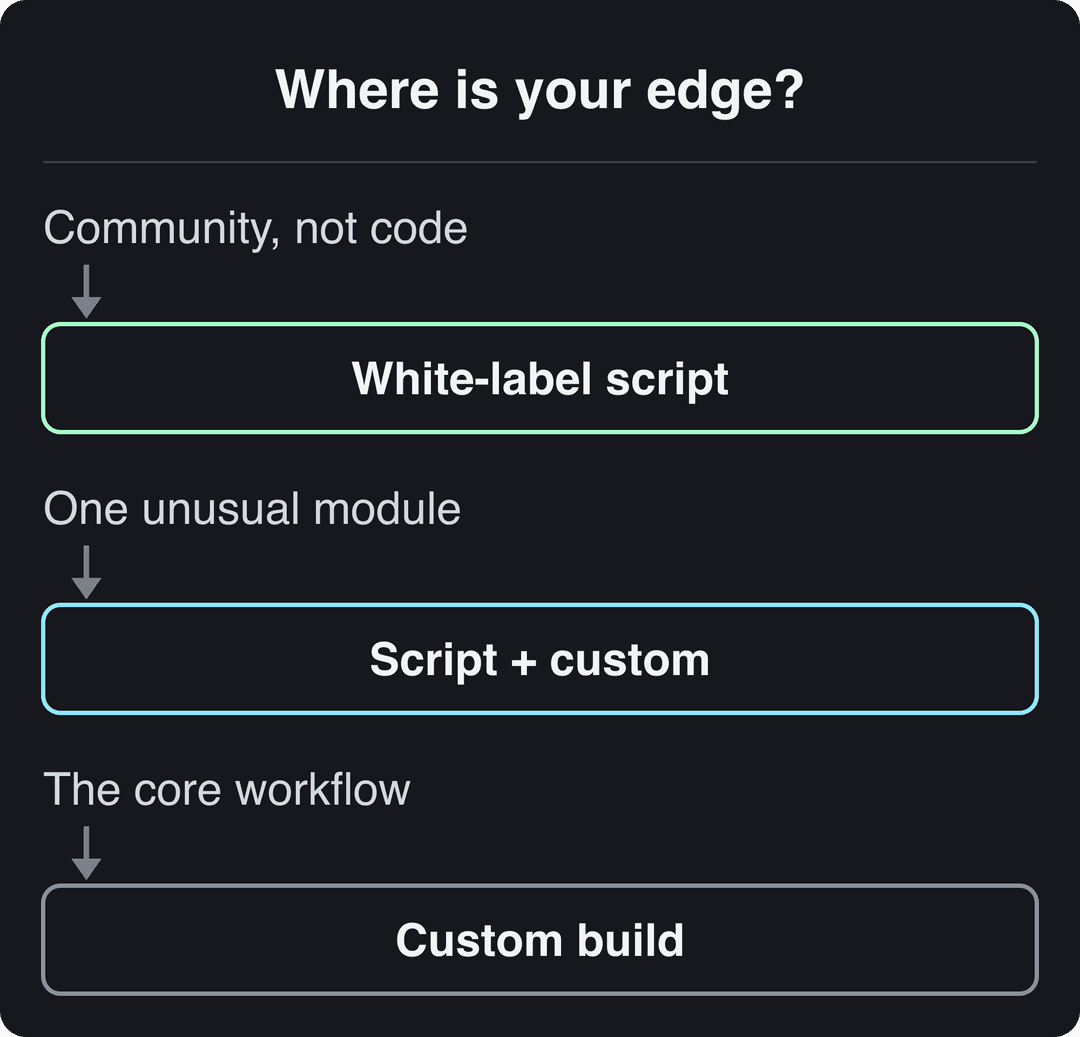
The middle path often wins: use the script for identity and publishing, then custom-build the module that defines your niche, such as ranking, moderation, analytics or payments. That only works if the vendor permits clean integration and you own enough of the code to change it.
Architecture: what the script must handle under load
A polished interface can't hide a feed that stalls, uploads that fail or video that eats bandwidth. Media-heavy apps need publishing, processing, storage and delivery kept apart.
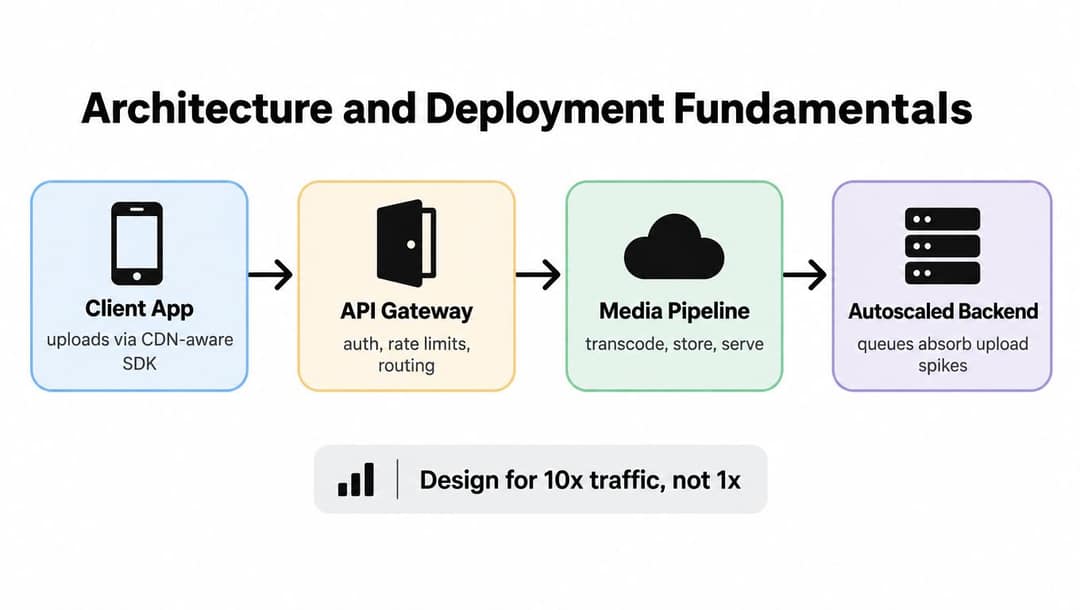
Separate writes from reads
When a member posts, the app should save the event and respond quickly, then let a queue trigger workers that add the post to followers' feed caches in the background. This separation of the write path and read path avoids slow feed queries at request time, as this social media feed architecture case study explains.
Pure fan-out on write wastes work for accounts with huge audiences. Pure fan-out on read makes every feed request expensive. A hybrid pushes most posts into caches and assembles posts from very large accounts when the feed is requested. Ask whether the script supports queues, workers, safe retries and monitoring.
Store originals, deliver through a CDN
Object storage is the right home for original images and video, but not the best layer to serve every viewer directly. Hetzner's object storage FAQ recommends putting a CDN in front of storage to reduce load on the origin and speed up delivery. Transcode video into several renditions and stream it with HLS or DASH rather than sending one large file to every phone.
Test the failure path
Ask the vendor to show what happens when things break:
- A transcode job fails: does it retry safely?
- A post is deleted: does it vanish from every cached version?
- Uploads spike: can people still browse and message?
- Something is slow: can you tell whether it is the app, API, queue, storage or CDN?
Those answers tell you more about scale than any "cloud-ready" claim.
How to evaluate an Instagram clone script vendor
Many scripts look identical in a demo because screens are easy to copy. Judge what is underneath.
- Ownership: get the license in writing. Confirm you receive full, unencrypted source code, and who owns custom work.
- Code quality: have an experienced developer review the repository: install steps, migrations, tests, API docs, background jobs and release history.
- Security: check authentication, authorization, file uploads, password recovery, rate limits and admin permissions. You will hold personal data and user media.
- Dependencies: list every external service (payments, push, messaging, media processing) and who holds each account.
- Upgrade path: ask how your customizations survive a core update.
- Operational access: confirm your team can see logs, backups, metrics and deployment settings.
- Support: ask questions before buying and note who answers. Read response commitments, security patch policy and exit terms.
Compare total cost, not the license price: customization, hosting, storage and CDN bandwidth, moderation staff and support renewals. A cheap script is expensive if the first serious change means replacing its foundation.
Walk away if the vendor hides the code, can't explain how the feed and media pipeline work, or can't support your moderation model.
How to launch a niche Instagram alternative
Speed of learning matters more than feature count. Instagram launched on October 6, 2010, reached 25,000 users on its first day, passed 100,000 in about a week and hit 1 million in roughly 10 weeks, according to this account of Instagram's early history. It did that with a narrow product, not every feature at once.
- Pick the niche before the roadmap. Write down the audience, the repeated need and the behavior that brings members back. Cut any feature that doesn't serve it.
- Seed the first creators. An empty feed kills a social app. Recruit a small group who will post before the audience exists.
- Ship one media loop. Support the format your community already makes, whether polished photos, quick tutorials or event updates.
- Govern before you open the doors. Publish rules, test blocking and reporting, staff the review queue and define appeals.
- Measure weekly. Track successful posts, meaningful interactions, follows, reports and repeat visits, then decide whether to fix onboarding, discovery, safety or monetization next.
Make your launch videos with Revid
Your new app still needs to be found on TikTok, Instagram and YouTube. Revid started in 2023 as Typeframes, a tool for SaaS founders' product intro and Product Hunt launch videos, and that is still a natural fit. The Product Hunt launch video generator reads your launch page, keeps its real screenshots, writes the script and adds voice-over, captions and music. You can edit the result on a timeline and publish it directly to TikTok, Instagram and YouTube. For a worked example, see how the Squad.so launch video was made.
FAQ
How much does an Instagram clone script cost?
It depends on the vendor and the license: a one-time source-code license, a subscription or a hosted white-label plan. Budget beyond the price tag for customization, hosting, storage, CDN bandwidth, moderation and support renewals, and get updates and security patches written into the quote.
Is it legal to build an Instagram clone?
Building an app with similar features is common practice. Copying Instagram's brand is not: don't use its name, logo, design assets or content, and don't scrape its data. Have a lawyer check trademark, privacy and content rules for the countries you launch in.
Do I get the full source code with a clone script?
Not always. Some vendors ship encrypted or compiled packages, or only a hosted service. If you plan to customize or scale, insist on full, unencrypted source code and written modification rights before you pay.
Can an Instagram clone app make money?
Yes, when it serves a niche that values something Instagram doesn't give it. Common models are creator subscriptions, tips, bookings, shop links and sponsored posts. Ads usually make sense only once the audience is large enough to sell.
Sources
- Revid social index: 388,379 posts from X, Instagram, Threads, Reddit and LinkedIn with AI labels per post, snapshot of Sep 15, 2026.
- Meta Platforms, Meta Q4 2025 Results Conference Call transcript (January 2026)
- Sprout Social, The state of social media in 2026: Data from Sprout's latest pulse survey (September 2026)
Charts and figures checked on November 6, 2026.


