Video Marketing for Ecommerce: The 2026 Playbook by Funnel Stage
Which video to make for each stage of the funnel, scripts and shot lists you can film this week, where to post each cut, and how to measure real sales lift instead of views.

On this page
Video marketing for ecommerce means giving each funnel stage its own video: short vertical hooks on TikTok, Reels and Shorts for discovery, demos and comparisons for research, fit and proof clips on the product page for the decision, and setup or care videos after purchase. Judge each one by a single sales metric, not by views.
The most common mistake is one polished brand film posted everywhere. Shoppers use short video as a research tool. In a 2024 Pew Research Center study, 62% of U.S. adult TikTok users said they use the app to look at product reviews or recommendations (see our short-form video statistics). They want to see the product zipped, poured, worn or assembled, and a mood piece does not show any of that.
- U.S. adult TikTok users who use the app to look at product reviews or recommendations
- 62%
- Pew Research Center, March 2026
- Higher conversion rate for Spark Ads built on creator content vs standard in-feed ads
- 43%
- TikTok for Business, January 2025
- Lower CPA on average when partnership ads are added to campaigns
- 19%
- Meta, December 2025
- Median TikTok views for faceless videos, vs 67K with one person on camera
- 114K
- Revid TikTok analysis
What video marketing for ecommerce covers
It covers any video that helps a shopper discover, evaluate, buy, use or reorder a product: a product-page demo, a TikTok clip, a creator review, an email preview, a retargeting ad, an unboxing or a care tutorial. Treat video as merchandising, not only as campaign creative. A demo on the product detail page (PDP) answers buying questions. A setup video after purchase cuts support tickets.
Video does not fix a weak offer or unclear positioning. It makes fit, texture, movement, scale and setup easier to judge, which is where photos fail. In Shopify's video marketing statistics roundup, 61% of shoppers said product images and videos were the most important product-page element when deciding to buy.
Use one decision rule: if a shopper has to imagine movement, scale, texture, fit or setup, film the product doing that thing.
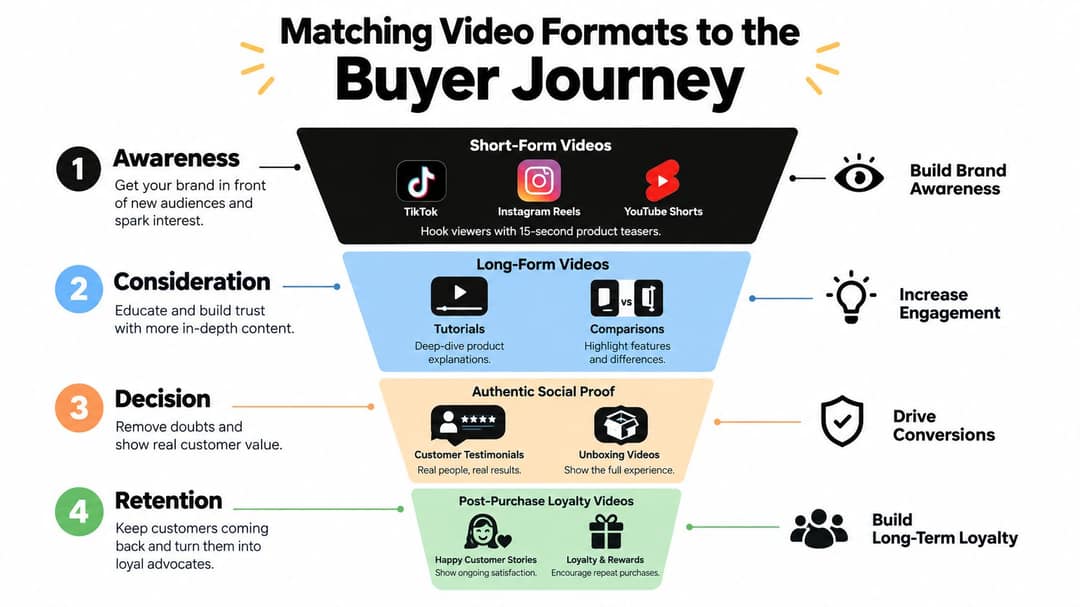
Which video formats fit each funnel stage
Give every video a stage, a channel and one KPI. If you cannot name the KPI, the video has no job.
| Stage | Format | Where it runs | One KPI |
|---|---|---|---|
| Awareness | 15 to 30 second product-led hooks | TikTok, Instagram Reels, YouTube Shorts | Qualified product-page visits |
| Consideration | Comparisons, tutorials, FAQs, creator reviews | YouTube, landing pages, retargeting | Engaged product-page sessions |
| Decision | Demos, close-ups, fit checks, 360-degree views, testimonials | Product page, next to the buy box | Add-to-cart rate of video viewers |
| Retention | Unboxing, setup, care, refill, troubleshooting | Email, help center, account area | Repeat purchase or setup completion |
Awareness: give a stranger a reason to stop
Open with the problem, the result, an unusual use or a visible transformation. "The tote that fits under an airline seat" gives a viewer a reason to keep watching. "Meet our newest collection" gives them nothing to act on.
Measure qualified product-page visits, not raw views. A clip that pulls in people with no interest in your category can look like a hit while bringing you no buyers.
Consideration: explain and compare
Comparisons, tutorials, FAQs and creator reviews belong on YouTube, landing pages and retargeting. Show the product in context, compare it with the real alternatives and answer the objection that blocks commitment. A skincare brand shows texture and application. A furniture brand shows assembly, dimensions and the piece in a real room.
For technical or tactile products, animation can show what is hard or expensive to film. This mattress product animation guide shows how exploded views and material layers explain a product without a full studio shoot.
Measure engaged product-page sessions: visitors who reach the comparison section, start the demo or use a product selector. Watch time helps you diagnose a video, but interaction with the page is closer to buying intent.
Decision: put proof next to the buy button
Place demos, texture close-ups, fit checks, 360-degree views and customer testimonials beside the price, size and delivery information they support. Keep the player close to the decision point, make it load fast, and never push price, sizing, shipping or reviews below an oversized video.
You will find many published conversion-lift figures, such as those collected in Webtonic's ecommerce video statistics. Treat them as a reason to test, not as a forecast for your store. Your KPI is the add-to-cart rate of visitors who watched the PDP video compared with those who did not.
Retention: help customers get value fast
Unboxing, setup, care, refill and troubleshooting videos go in post-purchase email, the help center and the account area. Judge a consumable by the next reorder, and a device by completed setup or fewer support contacts. A loyalty video earns its place by making ownership easier, not by collecting likes.
The same funnel logic applies outside ecommerce. This breakdown was made for coaches, but the stage-by-stage format choices transfer directly:
What should an ecommerce product video show?
Show the product and the hands using it before you show a face. Founder and creator videos have their place, but product-first footage tends to travel further on TikTok. In Revid's analysis of 176,367 TikToks with 1,000+ likes posted between October 2025 and October 2026, faceless videos had a median of 114K views and 17.4% passed 1M views, against 67K and 12.7% for videos with one person on camera. Faceless tutorials did even better (156K median versus 52K on camera), which is good news for product demos. The full method is in our study of what makes a TikTok go viral.
Faceless videos earned a median of 114K views, against 67K for videos with one person on camera, and passed 1M views 38% more often.
Source: Revid analysis of 176,367 TikToks with 1,000+ likes posted between Oct 1, 2025 and Oct 16, 2026 (61,203 creators)
Show the data
| Median views | Share that passed 1M views | |
|---|---|---|
| Animals | 147.4K | 24.1% |
| Faceless | 113.9K | 17.4% |
| Groups of people | 96.1K | 16% |
| Objects or products | 70.8K | 13.2% |
| One person on camera | 67.4K | 12.7% |
This is TikTok data, and the sample only includes videos that already reached 1,000+ likes, so it shows what successful videos have in common, not a guaranteed cause. In practice: film product-in-hand demos, POV shots and close-ups as your default, and save talking-head footage for founder stories and testimonials where a person is the point.
Scripts and shot lists you can shoot this week
Small teams rarely need more ideas. They need a repeatable brief so a shoot does not turn into a pile of pretty but unusable clips. The kit: a phone, a tripod, a small LED light, a clip-on microphone and a clean surface. Shoot vertical masters at 9:16 (TikTok recommends 1080x1920), then grab a few wider shots for the PDP.
Prompt to try
A 30-second vertical product demo for a carry-on travel tote. Open on a traveler struggling to fit a bulky bag under an airline seat with on-screen text "Struggling to fit your bag under the seat?", then show hands packing the tote, three quick close-ups of zips, pockets and fabric, and end with "See the full fit on the product page." Natural phone-shot style with bold readable captions.
The 30-second product demo
- 0 to 3 seconds: show the frustrating moment. On-screen text: "Struggling with [problem]?" Never open with a monologue about your company.
- 3 to 10 seconds: the product being picked up, opened, worn or applied, with hands and product in frame together.
- 10 to 20 seconds: three quick beats, each proving one benefit: a close-up, a real-use shot and a result shot.
- 20 to 26 seconds: the product in its normal setting, with a short benefit caption.
- 26 to 30 seconds: one action, such as "See the full fit on the product page."
Cut on physical actions. Film extra B-roll of zips, closures, texture, controls, packaging and scale. Light textured products from the side, because flat front light makes fabric, leather and finishes look dead.
The 60-second founder story
This format earns attention through context, not speed. The founder explains the customer problem in plain words instead of reciting the About page.
- Start with the moment the need became obvious.
- Cut to the first prototype, a failed version or a customer message (with permission).
- Add a short, genuine customer reaction if you have one.
- Introduce the product as the answer.
- End with an invitation to learn more, not a hard sell.
Use a locked medium shot for the founder and cover edits with workshop, packing or customer-use footage. Record in short sentences so you can cut pauses without making the delivery sound stitched.
The 15-second unboxing short
Film vertically and close. Capture the package entering frame, the seal opening, the product coming out and two sensory details (texture, sound or finish). Add one line of text that gives a reason to care, for example "The travel mug designed for one-handed opening."
Do not fake surprise or stack claims. The product should be recognizable in the first frame, captions readable with the sound off, and the last frame should point to one next step. Reshoot the opening if the packaging hides the product or the light glares.
For opening lines, borrow structures from our list of TikTok hooks that stop the scroll and swap in your product's problem.
Prompt to try
A 15-second vertical unboxing short for a travel mug designed for one-handed opening. Show the package entering frame, the seal opening, the mug coming out and close-ups of its texture and the lid click, with the caption "The travel mug designed for one-handed opening." Close, clean framing, captions readable with the sound off, and a last frame pointing to the product page.
Where to post ecommerce videos
Publish each cut where its job is easiest to finish. A PDP video has to load fast beside buying information. A short-form hook has to work with the sound off and no brand recognition. An email clip should send people back to the store, not replace it.
Start with owned placements
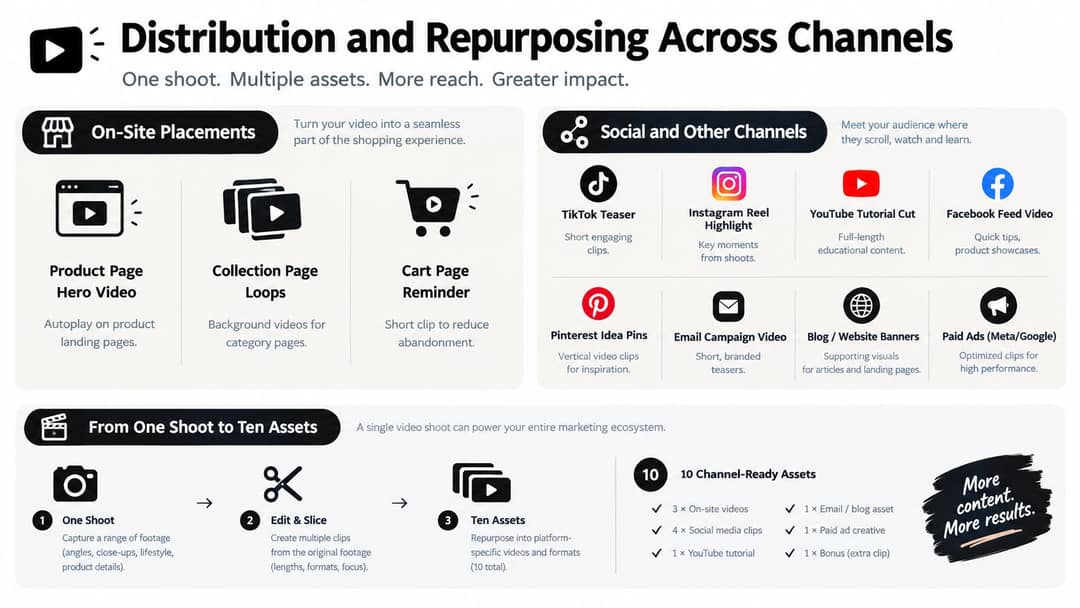
Put your strongest demo on the PDP, then lighter loops on collection and category pages. A short reminder fits cart-recovery creative, and setup or care footage belongs in post-purchase email and the help center. In welcome and abandoned-cart emails, use a thumbnail or short preview that links to the right page instead of embedding the full file. In SMS, keep the message to one action and a fast-loading destination.
Make social cuts native to each platform
| Channel | Best job | Format notes |
|---|---|---|
| TikTok | Discovery hooks, creator reviews | 9:16 at 1080x1920 recommended; uploads can run up to 60 minutes, but demos should stay short |
| Instagram Reels | Discovery and retargeting | 1.91:1 to 9:16; reels can run 20 minutes, but those over 3 minutes are not recommended to non-followers; up to 5 hashtags |
| YouTube Shorts | Discovery, quick demos | Square or vertical up to 3 minutes |
| YouTube long-form | Comparisons, tutorials, reviews | Horizontal, chaptered, linked from the PDP |
| Retargeting, broad reach | Every new video is now shared as a reel | |
| Planned, searchable inspiration | Vertical clips tied to a product pin |
On hashtags, Revid's TikTok study found 4 hashtags had the best median (77K views), while videos with 9 or more managed only 16K. Use a few specific tags, not a block of 20.
Posts with 3 or 4 hashtags earned the most views. Captions stuffed with 9 or more hashtags did worst of all, with median views cut by about 80%.
Source: Revid analysis of 176,367 TikToks with 1,000+ likes posted between Oct 1, 2025 and Oct 16, 2026 (61,203 creators)
Show the data
| Median views | Share that passed 1M views | |
|---|---|---|
| None | 51.1K | 9.8% |
| 1 | 64K | 11.8% |
| 2 | 71.3K | 12.7% |
| 3 | 75.4K | 13.1% |
| 4 | 77.2K | 13.4% |
| 5 | 67.3K | 12.1% |
| 6 to 8 | 71.8K | 12.7% |
| 9+ | 15.6K | 7.8% |
Turn one shoot into many assets
A single 90-second master can give you four to six short vertical edits, a PDP loop, customer-quote cuts for ads, still frames for retargeting and a transcript-based blog draft. Keep the raw footage, clean audio and caption file so each version can be adapted without reshooting. Our guide on how to repurpose video content covers the workflow step by step.
How to test ecommerce video ads
Creator-style footage tends to beat polished brand spots in paid social. TikTok reports that Spark Ads built on user- or creator-generated content showed a 43% higher conversion rate than standard in-feed ads, and Meta reported in December 2025 that adding partnership ads to campaigns delivered 19% lower CPAs on average (more in our UGC statistics). Freshness matters too: TikTok's internal analysis found that advertisers who refresh creatives weekly tend to see 10% to 12% higher conversions.
Change one variable at a time:
- Hook: problem statement versus visible product result.
- Opening frame: product close-up versus a person using it.
- Caption: benefit-led text versus objection-led text.
- Destination: PDP versus collection page.
- CTA: shop the product versus compare the options.
- Length: fast demo versus slower explanation.
Name every export by product, stage, channel, hook and destination (for example "jacket_demo_decision_tiktok_problemhook_pdp"). Without that naming, you cannot tell which of six live edits drove the sales.
How to measure ecommerce video ROI
Views only prove a platform delivered an impression. A shopper may watch a clip, search your brand two days later, come back through an email and buy in a direct session. Last-click reporting hands the sale to the email. Build measurement in layers instead of hunting for one perfect number.
Use a signal stack
Start with view-through revenue, assisted conversions and the add-to-cart rate of PDP visitors who watched the video versus those who did not. Then read the watch-time curve. If viewers leave before the product appears, fix the hook. If they watch the demo but do not click, the offer, page or CTA is the problem.
For paid campaigns, tag every link with UTM parameters for platform, campaign, creative, funnel stage and product, and use the same names in Shopify, GA4 and your dashboard so one video does not show up as three unrelated records.
Test incrementality when you can
A holdout test gives the cleanest answer. Show video to one audience segment and remove it for a comparable control group, whether in Meta ads or an owned flow such as Klaviyo, then compare add-to-carts, checkouts, revenue and repeat purchases over the same period. On your own store, rotate the PDP video on and off for a defined visitor group while price, stock, promotions and traffic sources stay stable.
If a true holdout is not possible, label results by confidence: observed, supported or tested. That is more honest than calling an assisted sale proven incremental revenue.
| Funnel stage | Primary metric | Secondary signal | Best attribution model |
|---|---|---|---|
| Awareness | Qualified product-page visits | Thumb-stop ratio and watch-time curve | Position-based or assisted |
| Consideration | Engaged product-page sessions | Comparison clicks and completion rate | Multi-touch |
| Decision | Add-to-cart rate | Cost per assisted checkout | Holdout or position-based |
| Retention | Repeat purchase | Setup or care-video completion | Cohort analysis |
The measurement gap is real. In Wyzowl's 2026 survey, 91% of businesses used video, but only 82% of marketers said it gave them a good ROI, down from 93% the year before. Short-form still leads on returns: it was the top ROI-driving content format in HubSpot's 2026 State of Marketing data, cited by 49% of marketers. The brands that can prove that return are the ones that measured by stage from the start.
How to make ecommerce videos faster with Revid
AI is most useful for the repetitive work (first drafts, captions, resizing, publishing), not for inventing what your product is. Here is the workflow in Revid:
- Paste a product page URL into the AI product video generator. Revid reads the product, keeps its real photos, writes the script and builds the scenes.
- Pick a voice (1,000+ AI voices in 70+ languages), a caption style and music. For footage you filmed yourself, the AI caption generator adds synced captions in 100+ languages.
- Fix any scene in the timeline editor.
- Export in 720p, 1080p or 4K, and resize the video to 4:5, 1:1 or 16:9 for feed, PDP or YouTube placements.
- Publish or schedule to TikTok, Instagram and YouTube from one queue, then check each post's views, likes and comments.
For creator-style ads, the UGC ad generator turns product images into UGC-style videos with natural-looking avatars. If you would rather start from something that already works, search Revid's library of about 2.77 million short-form videos with engagement data and remix a proven format for your own product. Sign-up is free and new accounts get free credits to try video creation, no credit card needed; regular creation then uses the monthly credits of a paid plan from $39/month.
Keep the output honest. In Sprout Social research published in March 2026, 50% of Gen Z said they had blocked, muted or unfollowed a brand or creator because its content felt like AI slop. Use AI to ship more real demos faster, not to replace them.
A 30-day ecommerce video plan
One marketer plus a founder on camera can run this if the scope stays narrow: one product, four weeks, one lesson carried into the next shoot.
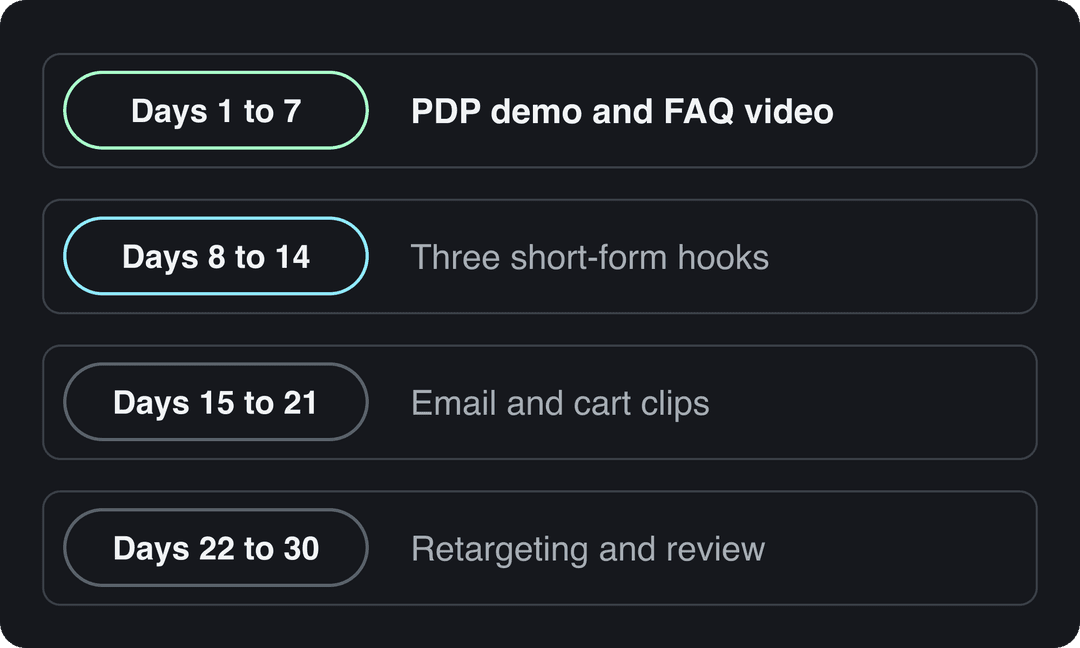
Days 1 to 7: pick one commercially important SKU. Film a PDP demo and an FAQ video covering the objections closest to purchase, and publish both beside the matching product information.
Days 8 to 14: cut three TikTok and Reels hooks from the same footage. Change the opening problem, first frame and caption, and keep the core demo the same.
Days 15 to 21: make an email-capture clip and an abandoned-cart reminder, each answering a different hesitation (fit, delivery, setup or proof).
Days 22 to 30: produce retargeting variants, review watch-time curves and add-to-cart rates, and put the clearest winning angle into the next shoot brief.
Spend on clear demonstrations and enough variations to learn from, not on a cinematic opening that never reaches the product.
FAQ
How do ecommerce brands market with video?
They map one video type to each funnel stage: short vertical hooks for discovery, comparisons and tutorials for research, demos and testimonials on the product page, and setup or care videos after purchase. Each video is judged by the action it should drive, such as product-page visits or add-to-cart rate.
How long should an ecommerce product video be?
Long enough to show the product working, with the product on screen in the first seconds. In Revid's 12-month TikTok study, every length from under 15 seconds to 10 minutes had a median between 58K and 76K views, so the hook matters more than the duration; clips under 15 seconds drew the most shares per view.
Do product videos increase ecommerce conversions?
They usually help when they answer the question blocking the purchase (fit, size, texture or setup), but published lift figures come from mixed samples. Run a holdout on your own PDP and compare add-to-cart rates for visitors who saw the video and a comparable group who did not.
Do I need to label AI-generated product videos?
Yes, when they look realistic. TikTok requires a label on realistic AI-generated content and Meta asks for disclosure of photorealistic AI video; TikTok and YouTube both say the label alone does not reduce a video's distribution.
Can a small team run video marketing for ecommerce?
Yes. A phone, tripod, clip-on microphone and small light are enough to run the 30-day plan above with one marketer and a founder on camera, as long as you stick to one product until a format proves itself.
Sources
- Revid analysis of 176,367 TikToks with 1,000+ likes posted between Oct 1, 2025 and Oct 16, 2026 (61,203 creators)
- Pew Research Center, 8 facts about Americans and TikTok (March 2026)
- TikTok for Business, Return on Influence: How TikTok Creators & Creative Variety Drive Performance (January 2025)
- Meta, New AI-powered tools to scale creator and brand partnerships (December 2025)
Charts and figures checked on November 6, 2026.