
Content Creation for Beginners: A Step-by-Step Plan for 2026
A 7-step plan for content creation beginners: pick a niche and a platform, choose a format you can repeat, post on a schedule you can keep, and read your analytics. Includes Revid TikTok data and current monetization thresholds.

On this page
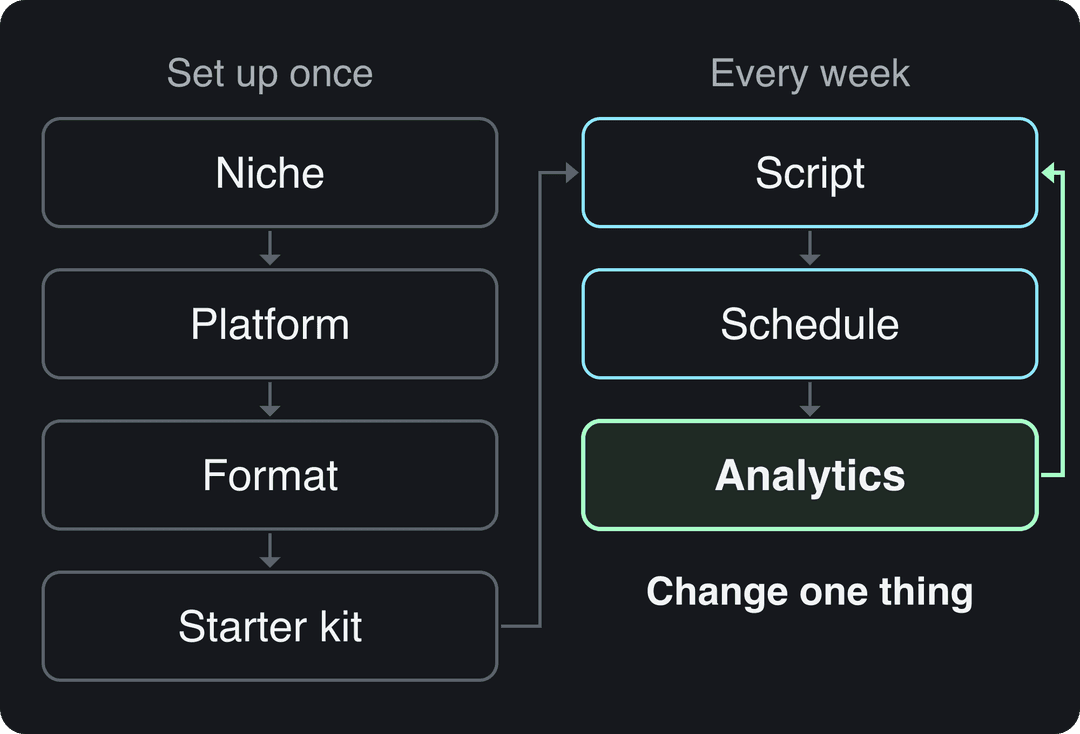
Content creation for beginners comes down to a short list: start with one niche and one platform, choose a format you can repeat, make it with a phone and free software, post 2 to 3 times a week, and let each post's analytics decide the next one. You do not need a camera, a studio or an audience to begin.
The real edge is simply showing up. A Pew Research Center study found that 98% of public TikTok videos posted by US adults came from the most active 25% of users. Most people watch and never post. If you publish every week for three months, you are already in a small minority, and you will have enough results to see what works for you.
- Share of public TikTok videos by US adults posted by the most active 25% of users
- 98%
- Pew Research Center, March 2026
- Average views per YouTube Short for accounts under 5,000 followers
- 15,160
- Socialinsider, August 2026
- Median views for faceless TikToks, vs 67K with one person on camera
- 114K
- Revid analysis of 176,367 TikToks
- Share of about 50 million creators who are pros earning over $100,000 a year
- 4%
- Goldman Sachs, April 2023
Step 1: Pick a niche you could post about every week
A niche is a topic plus a specific viewer: "meal prep" is a topic, "budget meal prep for college students" is a niche. The narrower version is easier to grow because the right viewers recognize themselves in your first line.
Use this formula: [topic] for [specific person] through [your angle]. Examples:
- Excel shortcuts for accountants, shown as 30-second screen recordings
- Home workouts for new parents, filmed in a living room
- Thrift flips for people with no sewing skills
- The local history of your city, told as short stories
Before you commit, run two tests:
- The 20-idea test. Write 20 video ideas in one sitting. If you stall halfway, the niche is too narrow or does not interest you enough to sustain.
- The demand test. Type your topic into YouTube and Google search and read the autocomplete suggestions: those are questions real people ask. Then look the topic up in Revid's free TikTok video finder to see which videos in that niche already get views.
Your niche also sets your ceiling. In Revid's analysis of 46 TikTok themes, couples videos averaged 2.4M views per video against 332.2k for crypto, a 7.3x gap. That does not mean you should fake a relationship channel. It means that if two niches excite you equally, pick the one closer to everyday emotions (relationships, food, pets, humor) over the one built on money and jargon.
Prompt to try
Make a 30-second vertical video for budget meal prep for college students. Open with the hook "You're spending $80 a week on food you could make for $25." Show three cheap prep-ahead meals with simple overhead kitchen shots, upbeat captions and a friendly voice-over, and end by asking viewers which meal they want next.
Step 2: Choose one platform to start
Start on one platform until making a video feels routine, then cross-post the same vertical file to the others. All three short-form platforms take 9:16 vertical video, and TikTok's Creator Academy recommends 1080x1920 pixels, so one export works everywhere.
| Platform | Pick it first if | Length limits (October 2026) | Beginner note |
|---|---|---|---|
| TikTok | Your audience is young and you want fast feedback | Uploads up to 60 minutes; in-app recording up to 10 minutes | Reach comes from the For You feed, not from followers |
| YouTube Shorts | You want search traffic and a path to long videos | Shorts up to 3 minutes | Shorts can feed a long-form channel later |
| Instagram Reels | Your customers or friends already follow you there | Up to 20 minutes; reels over 3 minutes are not recommended to non-followers | Up to 5 hashtags per post |
Small accounts get very different reach depending on where they post. Socialinsider's 2026 study of 69 million short-form videos found that accounts with under 5,000 followers averaged 15,160 views per YouTube Short, against 625 per Instagram Reel and 350 per TikTok. Averages hide a lot of variation, but if you are starting from zero followers, Shorts is a reasonable first bet.
Audience age matters too: Pew Research Center found that 63% of US adults under 30 use TikTok, against 12% of adults 65 and older.
Decision rule: if you want your videos to keep getting found through search, start on YouTube (our guide to starting a YouTube channel covers setup). If your audience is young and you want to test ideas fast, start on TikTok. If you run a local business or already have an Instagram following, start with Reels.
Step 3: Choose a format you can repeat
A format is the recipe each video follows: a tutorial, a list, a story, a reaction, a point-of-view (POV) skit, a before-and-after. Pick one or two and repeat them until they are easy. Repetition lets you improve the hook and pacing instead of reinventing every video, and viewers who liked one video know what to expect from the next.
Some formats travel further than others. In Revid's analysis of 176,367 TikToks with 1,000+ likes posted between October 2025 and October 2026, challenges had the highest median views (182K, with 25.6% passing 1 million), followed by comedy (155K) and reactions (105K). Storytelling (66K) and tutorials (62K) sat lower, but they are the easiest formats to build a niche around. The method and every chart are in the full study, what makes a TikTok go viral.
Challenges and comedy passed 1M views about twice as often as tutorials and storytelling, which are the most common formats.
Source: Revid analysis of 176,367 TikToks with 1,000+ likes posted between Oct 1, 2025 and Oct 16, 2026 (61,203 creators)
Show the data
| Median views | Share that passed 1M views | |
|---|---|---|
| Challenge | 182.3K | 25.6% |
| Comedy | 154.8K | 22.1% |
| Reaction | 104.8K | 16% |
| Dance | 83.8K | 15.5% |
| Storytelling | 66.1K | 12.2% |
| Lip Sync | 61.7K | 12.3% |
| Tutorial | 61.9K | 12.1% |
Do you need to show your face?
No. In the same dataset, faceless videos (no person on camera: hands, screen recordings, animation, voice-over on footage) had a median of 114K views, against 67K for one person on camera, and 17.4% of them passed 1 million views versus 12.7%. Faceless tutorials did especially well: 156K median views against 52K for on-camera tutorials.
Faceless videos earned a median of 114K views, against 67K for videos with one person on camera, and passed 1M views 38% more often.
Source: Revid analysis of 176,367 TikToks with 1,000+ likes posted between Oct 1, 2025 and Oct 16, 2026 (61,203 creators)
Show the data
| Median views | Share that passed 1M views | |
|---|---|---|
| Animals | 147.4K | 24.1% |
| Faceless | 113.9K | 17.4% |
| Groups of people | 96.1K | 16% |
| Objects or products | 70.8K | 13.2% |
| One person on camera | 67.4K | 12.7% |
Two limits to keep in mind: the sample only includes TikToks that already reached 1,000 likes, so it shows what successful videos have in common rather than what causes success, and format and perspective come from Revid's AI analysis of each video. If you are camera-shy, faceless is a strong option, not a compromise. If you are building a personal brand (coach, consultant, local business owner), your face is part of the product, so show it.
Step 4: Build a starter kit for almost nothing
Your phone is your camera. Spend on gear only after you have posted consistently for a month and know exactly what is missing.
Buy in this order:
- A clip-on microphone. Bad audio is audible in every second of a video, so this is the upgrade viewers notice most.
- Light. Face a window during the day before buying a ring light or a softbox.
- A phone tripod, if you film yourself or overhead shots.
For software, start free and upgrade only when a specific limit slows you down.
| Task | Free tools | Paid upgrades | What you need it for |
|---|---|---|---|
| Graphics and covers | Canva, Google Drawings | Canva Pro, Adobe Photoshop Elements | Thumbnails, text overlays, templates |
| Video editing | DaVinci Resolve, CapCut, OpenShot | Filmora, Adobe Premiere Elements | Cuts, captions, transitions |
| Audio | Audacity, your phone's voice recorder | Adobe Audition, Reaper | Noise reduction, voice-over cleanup |
The free version of DaVinci Resolve is enough for years of work. Professional editors often move to Adobe Premiere Pro later, but a beginner gains little from it. For a full comparison, see our picks of the best video editing software for beginners.
Prompt to try
Create a 40-second vertical tutorial on 3 Excel shortcuts every accountant should know. Hook: "Stop clicking through menus. These 3 shortcuts save you an hour a week." Give one line of context, show each shortcut as a clean screen-style visual with bold captions, and close with "Comment the shortcut you use most."
Step 5: Write a hook and a 4-part script
Most short videos are won or lost in the first line. Write every script in four parts:
- Hook (first line): promise a result, name a mistake or open a question.
- Context (one or two lines): why it matters to this viewer.
- Payoff (most of the video): the steps, the story, the reveal.
- Close (one line): a question to answer in the comments, or a reason to follow for part 2.
Sample hooks you can adapt:
- "You're [doing X] wrong, and it's costing you [result]."
- "3 things I wish I knew before [starting X]."
- "This takes 10 seconds and saves you [result]."
- "POV: you just [relatable situation]."
- "Stop [common habit]. Do this instead."
For more, browse this list of TikTok hooks you can copy. Keep scripts tight: read yours out loud and cut every sentence that does not move the viewer toward the payoff. If drafting is your bottleneck, PickAlternative's comparison of AI content writing tools can help you choose an assistant for first drafts. Rewrite whatever it gives you in your own words.
Step 6: Set a posting schedule you can keep
Start with 2 to 3 posts a week. A pace you can hold for months beats a daily burst that stops after two weeks. Batch the work: script several videos in one session, film them in another, edit in a third. Switching tasks less often is what keeps the schedule sustainable.
Here is a weekly plan for a beginner posting 2 short videos a week:
| Day | Task | Time | Output |
|---|---|---|---|
| Monday | Ideas and research | 1 hour | 3 to 5 topics |
| Tuesday | Hooks and scripts | 2 hours | 2 finished scripts |
| Wednesday | Filming or recording | 3 hours | Raw footage for 2 videos |
| Thursday | Editing and captions | 2 hours | 2 finished videos |
| Friday | Publishing and scheduling | 1 hour | Videos posted or scheduled |
| Weekend | Replies and review | 1 hour | Comments answered, notes on what worked |
Ideas come from three places:
- Your comments. Every question a viewer asks is a video.
- Search trends. Google Trends shows which topics in your niche are rising.
- Proven formats. Revid's library of viral videos holds about 2.77 million short-form videos and posts with their engagement data, so you can search your niche, see which formats people already watch, and turn one into an original video.
Repurpose everything: one script can become a Short, a Reel, a TikTok and a written post.
If you are planning content for a small business, this walkthrough covers a social media strategy plus filming and editing basics:
Step 7: Read your analytics and change one thing at a time
Follower count is the slowest signal. Look at these instead:
| Signal | What it tells you | If it's weak |
|---|---|---|
| Viewers leaving in the first seconds | The hook does not land | Rewrite the first line and the first frame |
| Average watch time | The middle drags | Cut the setup and reach the payoff sooner |
| Shares and saves | The video is useful or relatable enough to pass on | Add a tip worth saving or a moment worth sending |
| Comments | People care enough to respond | End with a specific question |
On TikTok, analytics live in TikTok Studio (profile, menu, TikTok Studio, Analytics), and the Viewers tab shows when your viewers were most active over the last 7 days. Instagram shows follower activity, including most-active times, once you reach 100 followers.
Judge a format after about 10 posts, not one. Change one variable at a time (the hook, the length or the format) so you know what made the difference. Revid's free TikTok account audit shows which of your own videos and patterns perform best.
How beginners make money from content
Expect income to come late. Goldman Sachs Research estimated in 2023 that of about 50 million creators worldwide, only about 4% are professionals earning more than $100,000 a year. Treat the first months as practice and audience building, and learn the thresholds so you know where you stand.
| Path | What you need (as of October 2026) | What it pays for |
|---|---|---|
| YouTube Partner Program, ads | 1,000 subscribers plus 4,000 watch hours in 12 months or 10 million Shorts views in 90 days | Ad revenue on long videos and Shorts |
| YouTube Partner Program, lower tier | 500 subscribers plus 3,000 watch hours in the last year or 3 million Shorts views in 90 days | Fan funding and YouTube Shopping, not ads |
| TikTok Creator Rewards Program | 18+, 10,000 followers, 100,000 views in the last 30 days, a Personal account | Original videos at least 1 minute long |
| TikTok LIVE Gifts | 18+ and 1,000 followers (may vary by region) | Gifts from viewers during LIVEs |
| TikTok Shop affiliate (US) | 18+ and 1,000 followers | Commission on products you promote |
| Affiliate links and brand deals | No platform threshold | Commission or a flat fee per post |
YouTube's thresholds rise for new applicants on February 1, 2027: 1,000 subscribers plus 8,000 watch hours in 365 days or 20 million Shorts views in 90 days. Channels already in the program are not affected. Creator Rewards is TikTok's current program, so ignore older guides that tell you to join the Creator Fund.
Affiliate links and brand deals are usually the first real income for small accounts because they depend on trust within a niche, not on raw views. A focused account in a buying niche (software, beauty, fitness gear, kitchen tools) can earn from affiliate links long before it qualifies for ad revenue. Promote products you would recommend anyway, and disclose every paid link.
For wider market context, Spiralytics keeps a roundup of content creator statistics, Market.us publishes digital content creation statistics, and Grand View Research sizes the digital content creation market. Treat figures from these roundups as directional: they mix surveys with different methods.
How to make your first videos with Revid
If filming is what keeps you from posting, Revid can produce a full short video from an idea. It writes the script, generates scene-by-scene visuals, adds a voice-over in 70+ languages, captions and music, and publishes directly to TikTok, Instagram and YouTube.
- Open the prompt to video tool and describe your video: the niche, the hook and the payoff.
- For a camera-free channel, start from the faceless video generator and pick a voice.
- Adjust any scene in the timeline editor, then export (up to 4K) or schedule it to your accounts.
- Check each post's views, likes and comments in Revid, and remix the ones that did well.
Sign-up is free and new accounts get free credits to try video creation, no credit card needed; regular video creation then uses the credits of a paid plan, starting at $39/month (Growth, 2,000 credits).
Beginner mistakes to skip
- Buying gear before posting. Post for a month first, then fix the specific weakness you notice.
- Launching on every platform at once. Learn one, then cross-post.
- Changing niche every week. The algorithm and your viewers need a few weeks of consistent topics to know who you are for.
- Judging a format after one or two posts. Give it about 10.
- Copying a viral video word for word. Borrow the structure and the hook style, then write your own words.
FAQ
Can I start content creation with just a phone?
Yes. Every short-form platform is built for vertical phone video, and a phone plus window light and a clip-on mic covers what a beginner needs. Free editors such as CapCut or DaVinci Resolve handle the rest.
How long does it take to grow as a beginner?
There is no fixed timeline, and anyone promising one is guessing. Plan on three months of consistent posting before judging your niche, and judge each format after about 10 posts.
How many followers do you need to get paid?
It depends on the program: TikTok Creator Rewards needs 10,000 followers, TikTok Shop affiliate in the US needs 1,000, and YouTube ad revenue needs 1,000 subscribers plus watch hours or Shorts views. Affiliate links and brand deals have no minimum.
Is it OK to use AI to create content?
Yes, as long as the video carries your own idea and angle. YouTube allows AI-assisted content that shows creative vision, and disclosing realistic AI video does not by itself limit reach on YouTube or TikTok.
Should beginners post every day?
No. Two to three posts a week that you can keep up for months will teach you more than a daily schedule you abandon after two weeks.
Sources
- Revid analysis of 176,367 TikToks with 1,000+ likes posted between Oct 1, 2025 and Oct 16, 2026 (61,203 creators)
- Pew Research Center, 8 facts about Americans and TikTok (March 2026)
- Socialinsider, TikTok vs. Reels vs. Shorts: 2026 Engagement Data (August 2026)
- Goldman Sachs, The creator economy could approach half-a-trillion dollars by 2027 (April 2023)
Charts and figures checked on November 6, 2026.