How to Become a Content Creator in 2026: A Step-by-Step Plan
A practical 2026 plan to become a content creator: choose a niche and format, make your first videos with or without a camera, post consistently and reach the thresholds that pay.

On this page
To become a content creator, pick one niche and one platform, publish short videos on a schedule you can keep, and check your analytics every week to repeat what works. Payouts come later: TikTok's Creator Rewards Program needs 10,000 followers, and YouTube ad revenue needs 1,000 subscribers.
You don't need to show your face or own a camera either. In Revid's analysis of 176,367 TikToks with 1,000+ likes posted between October 2025 and October 2026, faceless videos had a median of 114K views, against 67K for videos with one person on camera. Being camera-shy is not a reason to wait.
- Median views for faceless TikToks, vs 67K with one person on camera
- 114K
- Revid analysis of 176,367 TikToks
- Followers needed for TikTok's Creator Rewards Program
- 10,000
- TikTok program requirements
- Subscribers needed for YouTube Partner Program ad revenue
- 1,000
- YouTube program requirements
- Daily YouTube Shorts views
- 200B+
- YouTube Official Blog, August 2026
What does a content creator actually do?
A content creator makes and publishes content (videos, posts, podcasts, newsletters) for an audience they build over time. Most new creators in 2026 start with short vertical video on TikTok, Instagram Reels or YouTube Shorts, because those feeds show your videos to people who don't follow you yet.
The job is a loop you repeat every week:
- Find an idea your audience wants.
- Write a short script with a strong first line.
- Produce the video: film it, or generate it with AI.
- Publish it with a clear caption and a few hashtags.
- Read the results and make more of what worked.
The rest of this guide walks through each step, with the numbers that should drive your choices.
Step 1: Choose a niche and a format
Your niche decides who finds you; your format decides whether they keep watching. Pick a topic you could make videos about for months without running out of ideas, and that a specific group of people cares about.
Topic choice changes your ceiling. In Revid's study of 2.4 million TikToks, love beats money 7 to 1: couples videos averaged 2.4M views per video against 332.2k for crypto videos, a 7.3x gap. If you choose a practical niche like finance or software, give each video a human angle (a mistake, a story, a before and after) instead of pure information.
Format matters as much as topic. Here is how common formats compared in the 176,367-video TikTok study:
| Format | Median views | Share past 1M views | Good fit if you... |
|---|---|---|---|
| Challenges | 182K | 25.6% | Can join or start trends quickly |
| Comedy | 155K | 22% | Write jokes or sketches |
| Reactions | 105K | 16% | Have opinions on other content |
| Dance | 84K | n/a | Perform on camera |
| Storytelling | 66K | 12.2% | Write well, even without filming |
| Tutorials | 62K | 12.1% | Know a skill people want to learn |
These figures come from videos that already passed 1,000 likes, so they show what top performers have in common, not what causes views. The full method and every chart are in what makes a TikTok go viral.
Use them as decision rules:
- If you know a skill well, start with tutorials, and consider making them faceless (see below).
- If you are funny on camera, comedy and reactions have the highest ceilings.
- If you write better than you perform, storytelling works with a voice-over and visuals, no camera needed.
Prompt to try
Create a 40-second faceless vertical tutorial on 3 budgeting mistakes people make in their first job. Open with the hook "Nobody tells you this about your first paycheck until it's too late." Use clean motion graphics with on-screen text, a calm friendly voice-over and short captions, ending with one clear tip to try today.
Do you need to show your face to be a content creator?
No. In the same TikTok study, faceless videos had a 114K median and 17.4% passed 1 million views, against 67K and 12.7% for videos with one person on camera. Animal videos did even better, with a 147K median.
Faceless videos earned a median of 114K views, against 67K for videos with one person on camera, and passed 1M views 38% more often.
Source: Revid analysis of 176,367 TikToks with 1,000+ likes posted between Oct 1, 2025 and Oct 16, 2026 (61,203 creators)
Show the data
| Median views | Share that passed 1M views | |
|---|---|---|
| Animals | 147.4K | 24.1% |
| Faceless | 113.9K | 17.4% |
| Groups of people | 96.1K | 16% |
| Objects or products | 70.8K | 13.2% |
| One person on camera | 67.4K | 12.7% |
The gap is widest in the formats beginners pick most. Faceless tutorials had a 156K median versus 52K for on-camera tutorials, and faceless comedy reached 327K versus 136K. Shooting style points the same way: POV videos had a 107K median and screen recordings 91K, while selfie-style videos had 48K.
Faceless formats that work for a new creator: screen recordings with a voice-over, narrated stories over stock or AI visuals, hands-only demos, and POV clips. A faceless video generator can produce the visuals, voice and captions from a script if you don't want to film at all.
Step 2: Start on one platform
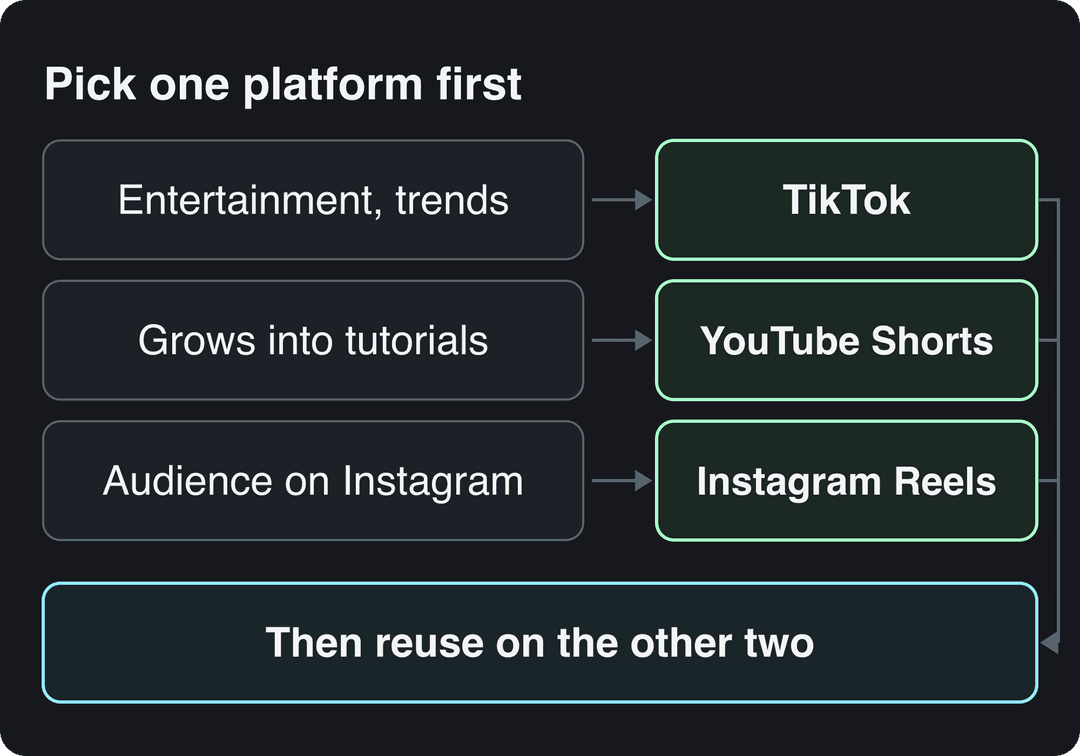
Posting everywhere from day one splits your attention before you know what works. Start where your format fits, then reuse the same vertical video on the other two once you have a system.
| Platform | Max video length | Reach rule to know | First way to earn from views |
|---|---|---|---|
| TikTok | Uploads up to 60 minutes | The For You feed shows videos to non-followers | Creator Rewards: 10,000 followers, 100,000 views in 30 days |
| Instagram Reels | Up to 20 minutes | Reels over 3 minutes are not recommended to non-followers | Brand deals and affiliate links |
| YouTube Shorts | Up to 3 minutes | Shorts can lead viewers to your long videos | YouTube Partner Program: 1,000 subscribers plus watch hours or Shorts views |
Decision rules: if your content is entertainment or trends, start on TikTok. If your topic can grow into longer tutorials or reviews, start on YouTube, where Shorts and long videos feed the same channel. If your audience already follows you on Instagram, start with Reels there.
For all three, make vertical video. TikTok's Creator Academy recommends a 9:16 aspect ratio at 1080x1920 pixels.
How to make your first video with Revid
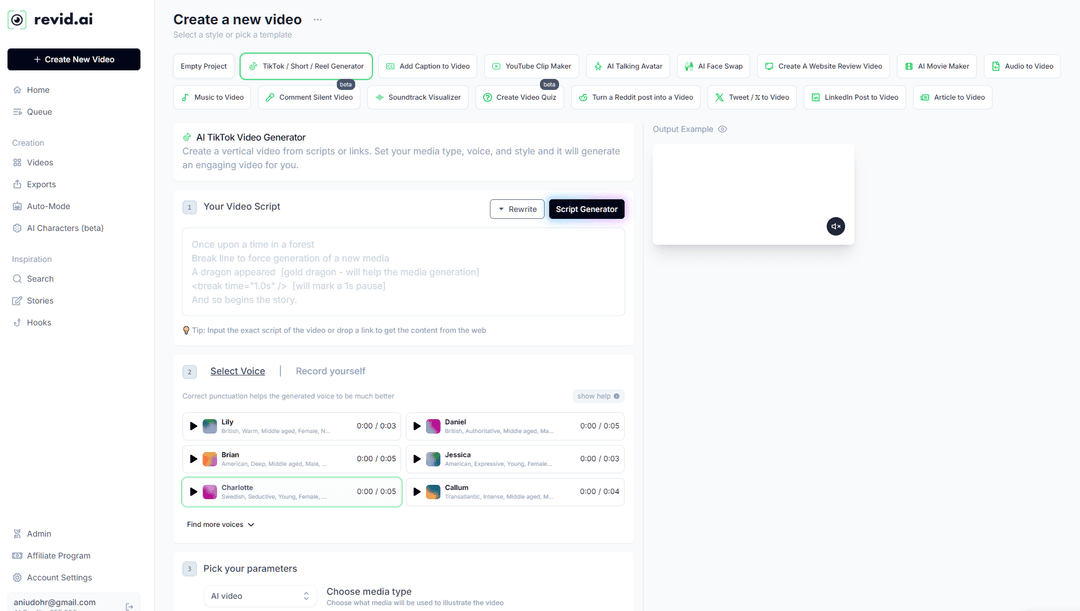
Revid turns a script, an idea or a link into a finished short video with visuals, voice-over, captions and music, so you can publish without filming or editing by hand. Here is the flow:
- Click Create New Video and pick the TikTok / Short / Reel Generator (the AI TikTok video generator).
- In Your Video Script, write your script or drop a link to get the content from the web. Click Script Generator to draft one, or Rewrite to tighten yours. The free AI script generator also works outside the app.
- In Select Voice, pick an AI voice (Revid has 1,000+ voices in 70+ languages), or choose Record yourself.
- In Pick your parameters, choose the media type: stock footage, AI images or AI video from models such as Seedance 2.5, MiniMax Hailuo, Wan 3.0 and Google Veo 3.
- Generate the video, then review it in the timeline editor: swap scenes, fix captions, adjust timing. Export in 720p, 1080p or 4K.
- Publish or schedule it directly to TikTok, Instagram and YouTube from one queue, with no download and re-upload.
If you're stuck for ideas, search Revid's viral video library of about 2.77 million short-form videos with their engagement data, open one in your niche, and choose "Make it about your topic": Revid keeps the hook style and pacing and writes an original video for your subject.
Sign-up is free, needs no credit card, and new accounts get free credits to try video creation; regular creation then uses the credits of a paid plan, from $39/month for 2,000 credits on Growth (Revid pricing).
The day matters far less than the hour: every weekday lands within a few percent of the others, and Saturday and Sunday posts pass 1M views slightly more often.
Source: Revid analysis of 123,704 English-language TikToks with 1,000+ likes posted between Oct 1, 2025 and Oct 16, 2026
Show the data
| Median views | Share that passed 1M views | |
|---|---|---|
| Monday | 63.5K | 12.5% |
| Tuesday | 63.5K | 12.4% |
| Wednesday | 62.7K | 12.5% |
| Thursday | 64.6K | 12.5% |
| Friday | 64.5K | 12.6% |
| Saturday | 70.2K | 13.4% |
| Sunday | 65.1K | 13.6% |
How often should you post as a new creator?
Post on a schedule you can keep for months, not a burst you abandon after two weeks. Each video is a test; you need a steady stream of tests to learn what your audience wants.
The day matters less than showing up. In Revid's TikTok data, weekday medians were all within 63K to 65K views, with Saturday slightly ahead at 70K. Batch your work instead: write several scripts in one sitting, produce them together, and schedule them across the week.
If you want a daily video without daily effort, Revid's Auto-Mode workers create a fresh video every day from a prompt or a content source (3 workers on Growth). Review each one before it goes out so the channel still reflects your judgment.
How to write hooks, captions and hashtags
The first line decides whether anyone sees the rest. In the TikTok study, videos with under 40 characters of speech had a 123K median and 20.2% passed 1 million views, against 68K for videos that talk throughout. Let the visual and on-screen text do the opening work, and keep spoken lines short.
Hook templates to adapt to your niche:
- "Nobody tells you this about [topic] until it's too late."
- "Stop doing [common habit] if you want [result]."
- "This is what [result] actually looks like."
- "The [niche] mistake that quietly costs you [result]."
- "I tested [popular advice] so you don't have to." (only if you really did)
For more, browse these TikTok hooks that stop the scroll.
Captions: TikTok captions of 41 to 80 characters had the best median (67K), while videos with no caption had 36K. Write one line that adds context or a question, not a paragraph.
Hashtags: on TikTok, 4 hashtags had the best median (77K) and 3 were close (75K); videos with no hashtags had 51K and those with 9 or more only 16K. Instagram now allows at most 5 hashtags per post. Use specific tags that describe the video, not generic ones.
Length: in the 12-month study, every length bucket had a median between 58K and 76K views, with 61 to 90 seconds slightly ahead at 70K. Length is not the lever; cutting every second that doesn't earn its place is.
Hook prompt to try
Make a 30-second vertical video for home cooks with the hook "Stop rinsing your pasta if you want a sauce that actually sticks." Keep spoken lines short and let close-up stock footage of cooking and bold on-screen text carry the opening. End with a one-line question to drive comments.
How do content creators make money?
Most creators earn from a mix of platform programs, brand deals and affiliate links. Here are the current thresholds:
| Income source | Requirements | What to know |
|---|---|---|
| TikTok Creator Rewards Program | 18+, 10,000 followers, 100,000 video views in the last 30 days, Personal account | Only videos of at least 1 minute earn; TikTok publishes no fixed rate per 1,000 views |
| TikTok Shop affiliate (US) | 18+, 1,000 followers | Under 5,000 followers you start in a pilot program |
| TikTok LIVE Gifts | 18+, 1,000 followers to go LIVE (varies by region) | Not available everywhere |
| YouTube Partner Program (ads) | 1,000 subscribers plus 4,000 watch hours in 12 months or 10 million Shorts views in 90 days | From February 1, 2027, new applicants need 8,000 hours or 20 million Shorts views |
| YouTube fan funding tier | 500 subscribers plus 3,000 watch hours or 3 million Shorts views | Fan funding and Shopping, not ad revenue |
| Facebook Content Monetization | Invite-only | Express interest in the Professional Dashboard |
| Brand deals and affiliate links | No platform threshold | Brands pay for a clear niche and an engaged audience |
One more 2027 change for Shorts creators: from February 1, 2027, earning Shorts ad revenue in a given month requires at least 10 million qualified Shorts views in the last 90 days. Channels below that stay in the program and keep long-form earnings, which is a strong reason to pair Shorts with longer videos on YouTube.
If you use AI, follow the platform rules
AI tools are allowed on monetized channels when the result shows your own creative choices. YouTube does not monetize content made with generic templates that looks mass-produced, videos that stitch unrelated AI clips together to shock, or AI personas presented as experts giving health, legal, financial or political advice.
TikTok and YouTube both require you to label realistic AI-generated images, audio or video, and both say the label alone does not reduce a video's reach. Turn the label on when it applies; skipping it is the real risk.
Your next step
Pick your niche and format from Step 1, write the first few scripts this week, and publish the first one before you feel ready. Then read the results every week and make more of whatever held attention.
FAQ
How long does it take to become a content creator?
You become one the day you publish your first video; earning takes longer. Reaching thresholds like 10,000 TikTok followers depends on your niche, format and consistency, so plan for months of steady posting, not weeks.
Do you need expensive equipment to start?
No. A recent phone records the 9:16, 1080x1920 frame TikTok recommends, and AI tools let you make faceless videos with no camera at all.
Can you become a content creator with no experience?
Yes. Start with a format that suits your skills (tutorials if you know a subject, storytelling if you write well), study videos that already perform in your niche, and improve one thing per video.
Is it too late to become a content creator in 2026?
No, demand keeps growing. YouTube said in August 2026 that Shorts get over 200 billion daily views, and Alphabet said more than 10 million channels were publishing Shorts each day as of March 2026, so the audience is there but so is the competition: a clear niche matters more than ever.
Is Revid free to use?
Sign-up is free with no credit card needed, and new accounts get free credits to try video creation. Regular creation then uses credits from a paid plan, starting at $39/month (Growth, 2,000 credits).
Sources
- Revid analysis of 176,367 TikToks with 1,000+ likes posted between Oct 1, 2025 and Oct 16, 2026 (61,203 creators)
- Revid analysis of 123,704 English-language TikToks with 1,000+ likes posted between Oct 1, 2025 and Oct 16, 2026
- YouTube Official Blog, New opportunities to earn and changes to the YouTube Partner Program (August 2026)
Charts and figures checked on November 6, 2026.