
Content Repurposing Statistics 2026: The Data, Metrics and Strategy
Sourced 2026 statistics on content repurposing, a step-by-step strategy that survives the new originality rules, and the metrics that show whether automated repurposing pays off.

On this page
Most solid content repurposing statistics come from video. Over half of companies repurpose their videos into social clips, with LinkedIn the top destination (67% of teams), then Instagram (49%) and YouTube (41%), according to Wistia's 2026 State of Video Report. Cross-posting also reaches new people: 45% of YouTube Shorts users are not on TikTok.
The mistake that now costs reach is reposting instead of repurposing. Since March 2026, Facebook treats reposts changed only with borders, captions or speed changes as unoriginal and deprioritizes them. TikTok's Creator Rewards Program excludes lightly modified reposts, and YouTube won't monetize videos that only read out material you didn't write. A strategy that works in 2026 rebuilds each piece for its platform.
- Teams that repurpose video clips to LinkedIn, the top destination
- 67%
- Wistia, April 2026
- YouTube Shorts users who are not on TikTok
- 45%
- Think with Google, April 2026
- Share of recommended Reels that were same-day posts in Q1 2026
- 30%+
- Meta Platforms, April 2026
- Median TikTok views for clips with under 40 characters of speech
- 123K
- Revid analysis of 176,367 TikToks
Content repurposing statistics for 2026
These are the figures we could trace to a named source and date. Most are about video, because that is where repurposing gets measured.
| Statistic | Source |
|---|---|
| Over half of companies repurpose their videos into social clips. LinkedIn is the top destination (67% of teams), then Instagram (49%) and YouTube (41%); about one in five share clips on TikTok | Wistia, State of Video Report, 2026 |
| 77% of brands repurpose creator content in their paid ads | Aspire, State of Influencer Marketing 2026 |
| 92% of brands use creator content in social media ads | LTK and Northwestern University Retail Analytics Council, September 2025 |
| 45% of YouTube Shorts users are not on TikTok, and 65% are not on Instagram Reels | GWI data (February 2025) cited by Google, April 2026 |
| 59% of Gen Z use short-form video apps to discover things they then watch longer versions of | Ipsos survey for YouTube of 5,722 people aged 18 to 24, 2022 |
| Shorts that sampled long-form videos generated over 100 billion views in April 2022 alone | YouTube, July 2022 |
| Channels got the best results when Shorts made up 25% to 40% of total uploads | AIR Media-Tech study of 18,000 channels, May 2026 |
| Same-day posts made up more than 30% of recommended Reels on Instagram and Facebook in Q1 2026, more than double a year earlier | Meta, April 2026 |
| 63% of video marketers have used AI video tools, up from 51% a year earlier | Wyzowl, 2026 |
| 50% of Gen Z have blocked, muted or unfollowed a brand or creator because their content felt like AI slop | Sprout Social, March 2026 |
More sourced figures are on Revid's short-form video statistics, YouTube Shorts statistics and UGC statistics pages.
You will also see claims that a set share of marketers find repurposing more effective or cheaper than new content. We left those out because they don't trace back to a published report. For survey-based industry benchmarks, the Content Marketing Institute keeps a running list of content marketing statistics drawn from its own research.
What the statistics mean for your plan
- Start with video. It is the format companies already repurpose most, and one long video holds many standalone ideas.
- Cross-post every strong piece. The GWI overlap figures show that a Short, a Reel and a TikTok of the same idea reach largely different people.
- Move fast on timely topics. Meta's same-day figure means a clip cut from this week's webinar beats a polished one next month.
- Automate production, not judgment. AI tools are mainstream, and so is audience fatigue with generic AI output. Every derivative needs a human pass.
How to build a content repurposing strategy, step by step
- Audit: pick source assets that already perform and are still accurate.
- Map: decide which derivatives each source becomes and where each one goes.
- Rebuild: rewrite each derivative for its platform's format and rules.
- Schedule: put every derivative on one calendar with an owner and a tracking link.
- Measure: track each derivative separately, then roll results up to the source asset.
Which content should you repurpose first?
Repurpose what has already proven itself. Look for:
- Pages with steady search traffic over several months, not a one-day spike.
- Content that generates leads or sign-ups, since its argument already persuades.
- Evergreen topics: how-tos, frameworks, FAQs, definitions.
- Webinar or podcast moments that drew questions or comments.
- Original data nobody else has, such as surveys, benchmarks and customer results.
Decision rule: if a piece performs and is still true, repurpose it now. If it performs but has outdated facts, update the source first, then repurpose it, so your derivatives don't spread old numbers.
Map each source to its derivatives
One source should produce several assets, each able to stand alone. For more ideas, Outrank has a list of content repurposing strategies, and Planable's guide to repurposing content covers research and long-form sources.
| Source asset | Repurpose into | Where it goes |
|---|---|---|
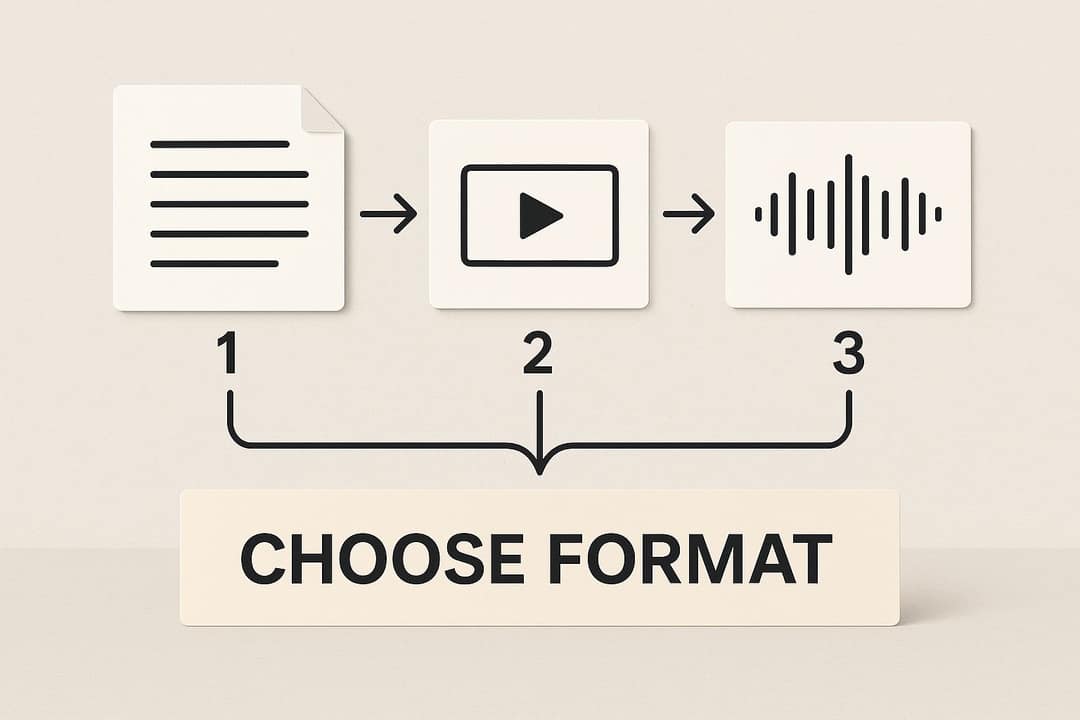
| Blog post or guide | Narrated short video, carousel, email, thread | TikTok, Reels, Shorts, LinkedIn, X, newsletter |
| Webinar or podcast | Short clips (one claim each), quote cards, recap article | Shorts, Reels, LinkedIn, blog |
| Long YouTube video | Vertical clips, newsletter section, blog embed | Shorts, Reels, TikTok, email |
| Research report | Finding-by-finding posts and videos, gated report, sales one-pagers | Everywhere (see the next section) |
| Case study | Customer quote clip, LinkedIn post, one-page summary | LinkedIn, sales emails, landing pages |
| Support docs and FAQs | Tutorial clips, FAQ video series | TikTok, Shorts, help center |
For worked cases you can copy, see these content repurposing examples.
Put every derivative on one calendar
Track each derivative as its own row: source asset, format, platform, owner, publish date and the tracking link. A spreadsheet works; a project management tool like Asana helps once several people share the work. Before anything ships, run a short quality check: facts match the updated source, the hook works without context, captions are correct, and the call to action points to the right page. For the full process, follow this content repurposing workflow.
How to repurpose research reports into demand gen assets
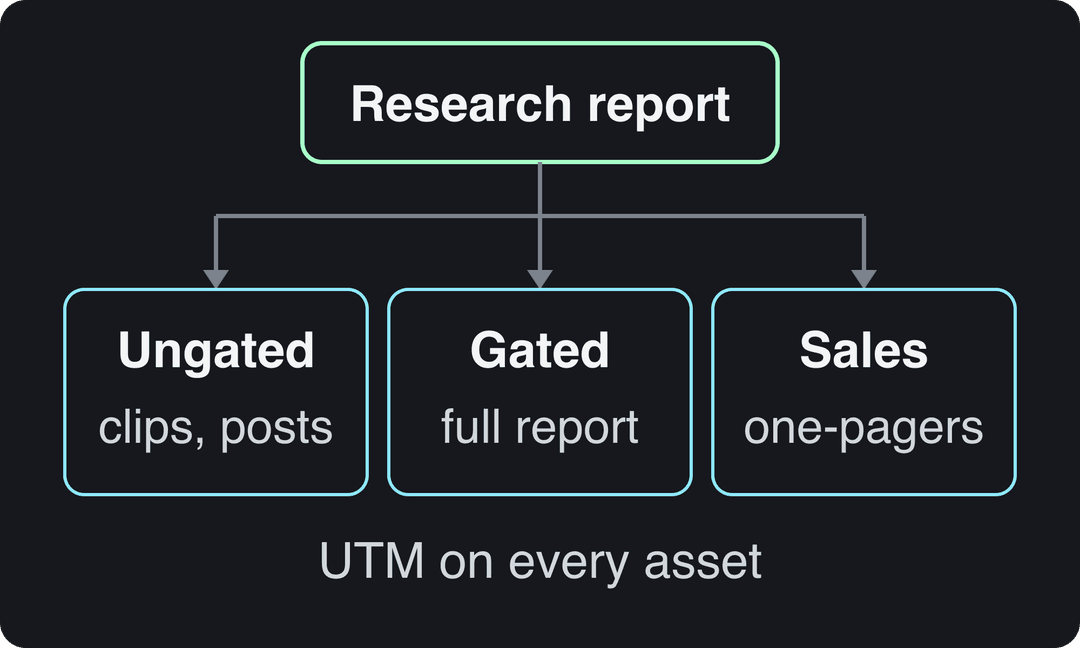
A research report is the richest source you have, because every finding is its own post. Repurposing research reports into demand gen assets works best in three layers: free assets that attract, the full report that captures contact details, and sales material that converts.
- List the strongest findings, one per asset. Each needs a number, a one-line meaning and a chart.
- Ungated layer: one short video and one LinkedIn post per finding, plus a blog post per major theme. Each ends with a link to the full report.
- Gated layer: the full report behind a form, and a webinar that walks through the method and answers questions.
- Sales layer: a one-page summary per customer segment and a follow-up email sequence for everyone who downloaded the report.
- Tag every link so you can see which finding and which platform produced each download.
Decision rule: if a finding surprises you, it goes in the ungated layer as a video. If it needs the method to be believed, keep it for the webinar.
Platform rules to check before you cross-post
Each platform now rewards original work and limits recycled uploads in its own way. Check these rules before you push one file to TikTok, Instagram, YouTube, Facebook and LinkedIn.
| Platform | Limits to know | What to change when repurposing |
|---|---|---|
| TikTok | Uploads up to 60 minutes; 9:16 at 1080x1920 recommended | Creator Rewards only pays on original videos of one minute or more; lightly modified reposts, Duets and Stitches don't count |
| Instagram Reels | Up to 20 minutes, but reels over 3 minutes aren't recommended to non-followers; up to 5 hashtags | Test new angles with trial reels, which are shown to non-followers first |
| YouTube Shorts | Vertical or square videos up to 3 minutes | A Short over one minute with a Content ID claim is blocked; reading out text you didn't write counts as reused content |
| Every video is a reel, with no length limit | Since March 2026, reposts with only borders, captions or speed changes are deprioritized | |
| Up to 15 minutes and 5 GB | Any video can appear in the mobile vertical video feed, so vertical cuts travel further | |
| X | 20 minutes for non-Premium accounts (per X's developer docs) | Up to 4 photos per post, so data findings fit as image sets |
For platform-by-platform formats, see our guide to repurposing content for social media.
Prompt to try
Make a 30-second vertical video that makes one claim from our webinar: "Teams that publish clips the same day get more recommended reach." Open with the hook "Your webinar is dying in a folder." Use bold on-screen text, quick cuts of clean motion graphics, and keep the voice-over to two short lines.
How long should repurposed clips be?
Length matters less than most repurposing guides claim. In Revid's analysis of 176,367 TikToks with 1,000+ likes posted between October 2025 and October 2026, every length bucket from under 15 seconds to 10 minutes had a median between 58K and 76K views. Clips of 61 to 90 seconds had a 70K median, and clips under 15 seconds got the most shares per view (1.41 per 100). The method and every chart are in our study of what makes a TikTok go viral.
Length alone barely moves views: every bucket lands between 58K and 76K median views (the 790 videos over 10 minutes are a small, unusual group). Clips under 15 seconds get shared the most per view.
Source: Revid analysis of 176,367 TikToks with 1,000+ likes posted between Oct 1, 2025 and Oct 16, 2026 (61,203 creators)
Show the data
| Median views | Share that passed 1M views | Shares per 100 views | |
|---|---|---|---|
| Under 15 s | 57.6K | 11.6% | 1 |
| 16 to 30 s | 64.9K | 12.3% | 1 |
| 31 to 60 s | 61.8K | 11.8% | 1 |
| 61 to 90 s | 70.5K | 12.2% | 1 |
| 91 s to 3 min | 63.4K | 11.1% | 1 |
| 3 to 10 min | 76.4K | 12.4% | 1 |
| 10 min+ | 129.6K | 13.8% | 0 |
Decision rule: cut where the idea ends, not at a target duration. A complete point that runs long beats a fragment trimmed to fit a timer.
How much talking you keep matters more. In the same sample, videos with under 40 characters of speech had a 123K median and 20.2% passed 1M views, while videos with talking throughout (300+ characters of speech) had 68K and 11.9%. That is a warning for webinar and podcast clips, which are talk from start to finish: tighten each clip to one claim, add visuals or on-screen text, and cut the setup.
Videos with just a few spoken words (a line or two) beat both silent videos and videos that talk the whole way through, which were the most common and the weakest.
Source: Revid analysis of 176,367 TikToks analyzed by AI, with 1,000+ likes posted between Oct 1, 2025 and Oct 16, 2026 (61,203 creators)
Show the data
| Median views | Share that passed 1M views | |
|---|---|---|
| No speech | 73.3K | 14.3% |
| Under 40 | 122.7K | 20.2% |
| 40 to 120 | 97.2K | 17.6% |
| 120 to 300 | 91.6K | 16.8% |
| 300+ | 67.7K | 11.9% |
Two limits apply. The index only holds TikToks that already reached 1,000+ likes, so the figures show what well-performing videos have in common, not what causes views. And it is TikTok data: use it as a starting hypothesis for Reels and Shorts, then check your own analytics.
Automated content repurposing: what AI should and shouldn't do
AI is good at the mechanical half of repurposing and weak at the editorial half. Netguru's overview of AI content repurposing tools lists the main categories. Split the work like this:
| Let AI do it | Keep a human on it |
|---|---|
| Transcribing webinars and podcasts | Choosing which moments are worth a clip |
| Cutting long videos into vertical clips | Writing the hook for each platform |
| Turning an article into a narrated script draft | Checking facts and numbers against the source |
| Generating captions and voice-overs | Adding your own example, opinion or result |
| Resizing and scheduling | Deciding what not to publish |
The human pass is also a policy issue. YouTube won't monetize AI content made with generic templates that looks mass-produced without your own insight, but it allows AI-assisted videos that show your creative vision. If you use AI drafts for text, some teams run them through tools like those in this roundup of AI-to-human text converters; a real edit that adds your examples does more than any rewording tool.
Label realistic AI visuals. TikTok and YouTube both require disclosure for realistic AI-generated video, and both say the label alone does not reduce distribution.
How to repurpose content into short videos with Revid
Revid handles the video side of repurposing:
- For a webinar, podcast or long YouTube video, use the long video to short video converter to turn it into short clips.
- For a blog post, report summary or article, paste the link into Revid's article to video tool. It writes the script and adds visuals, a voice-over and captions.
- Rewrite the hook and adjust scenes in the timeline editor so each version fits its platform.
- Publish or schedule to TikTok, Instagram and YouTube from one queue. Each post then reports its views, likes and comments.
To repurpose on a schedule, Auto-Mode workers create a fresh video every day from a content source (3 workers on the Growth plan).
What are the key metrics to measure the effectiveness of automated content repurposing?
Measure automated repurposing on two levels: production (is the system making usable assets at a lower cost?) and results (do those assets reach new people and drive business outcomes?). Track these:
| Metric | What it tells you | Where to find it |
|---|---|---|
| Derivatives published per source | Whether the automation is actually producing | Your content calendar |
| Time or cost per derivative | Efficiency compared with creating from scratch | Time tracking, tool invoices |
| Edit rate | Share of automated drafts that needed a heavy human rewrite | Your review log |
| Reach among non-followers | Whether repurposing finds new audiences | TikTok Studio, Instagram insights, YouTube Analytics |
| Retention and average view duration | Whether the format fits the platform | Native platform analytics |
| Click-throughs to the source (UTM sessions) | Whether derivatives send people back to you | Web analytics |
| Leads and pipeline influenced | Business impact | CRM and conversion tracking |
| Conversion rate by format | Which derivatives to make more of | Web analytics and CRM |
Read view counts with care. Since August 24, 2026, YouTube counts a view the moment playback starts, so raw views flatter short clips; YouTube Partner Program earnings still use engaged views. Instagram insights now lead with Views (every play or display) and show Viewers (unique accounts) separately. Retention and click-throughs tell you more than either. For a fuller metric set, see how to measure content performance.
A rising edit rate is the earliest sign that automation is drifting into generic output. Fix the inputs (sources, prompts, templates) before you scale volume.
Which ROI metrics show content repurposing success?
The ROI metrics that show repurposing success are cost per derivative, leads and revenue attributed to derivatives, and the ROI of each source asset:
Repurposing ROI = (value attributed to repurposed assets - cost to produce them) / cost to produce them
Count cost as hours times your hourly rate, plus tools. The efficiency side is simple: if writing a blog post takes four hours and repurposing it for social media takes one hour, the repurposed version costs 75% less time.
To attribute value:
- Tag every link in a derivative with UTM parameters (utm_source for the platform, utm_medium for the channel, utm_campaign for the source asset), then read the results in Google Analytics.
- Pull on-platform results from native dashboards: YouTube Analytics, LinkedIn Page analytics, TikTok Studio and Instagram insights.
- Report by source asset: add up the reach, clicks, leads and revenue of all its derivatives, and compare them with what the original produced alone.
- Compare formats. If clips drive downloads but carousels don't, shift the next month's effort to clips.
FAQ
Is repurposed content duplicate content?
Not if you rebuild it. Turning a blog post into a script, a carousel or a clip creates a new asset; posting the same file with a new border or caption is what Facebook now treats as unoriginal.
How often should you repurpose content?
Repurpose as soon as a piece proves it works, and fast for timely topics: Meta said same-day posts made up more than 30% of recommended Reels in Q1 2026. Evergreen pieces can be repurposed again each time you update them.
What is the best content to repurpose?
Long videos, webinars and original research, because one source holds many standalone ideas. Choose pieces that already drive traffic or leads and are still accurate.
Can content repurposing be fully automated?
Production can be automated; editorial judgment can't. Let AI transcribe, cut, caption and schedule, and keep a person on hooks, facts and your own perspective, which YouTube's monetization policy also expects.
Does labeling AI-generated video reduce reach?
No. TikTok and YouTube both state that the AI label alone does not affect distribution, and YouTube says disclosure does not affect eligibility to earn. Failing to disclose realistic AI content is what carries penalties.
Sources
- Revid analysis of 176,367 TikToks with 1,000+ likes posted between Oct 1, 2025 and Oct 16, 2026 (61,203 creators)
- Revid analysis of 176,367 TikToks analyzed by AI, with 1,000+ likes posted between Oct 1, 2025 and Oct 16, 2026 (61,203 creators)
- Wistia, 2026 State of Video Report (April 2026)
- Think with Google, The YouTube Era's new marketing opportunities (April 2026)
- Meta Platforms, Meta Q1 2026 Results Conference Call transcript (April 2026)
Charts and figures checked on November 6, 2026.