How to Create Engaging Content: A Data-Backed Playbook for 2026
A step-by-step playbook for engaging content: pick one problem, use a format people already watch, hook in the first line and tell a short story, backed by Revid's analysis of 176,367 TikToks.
On this page
To create engaging content, pick one specific audience problem, choose a format people already watch, and open with a hook that promises the payoff in the first line. Deliver one idea as a short story with a clear ending, then judge it by watch time, shares and comments rather than followers.
The tone you choose matters more than most creators assume. In Revid's analysis of 176,367 TikToks with 1,000+ likes posted between October 2025 and October 2026, videos with a dominant mood of outrage had a median of 156K views and humor 121K, while inspirational videos, the default register of most brand content, had a median of 45K. Polite and uplifting is often the weakest option on the table.
- Median views for challenge TikToks, the top format
- 182K
- Revid analysis of 176,367 TikToks
- Median views for TikToks with an outrage mood, vs 45K for inspirational
- 156K
- Revid analysis of 176,367 TikToks
- Median views for TikToks with under 40 characters of speech
- 123K
- Revid analysis of 176,367 TikToks
- Median views for TikToks with 4 hashtags, vs 16K for 9 or more
- 77K
- Revid analysis of 176,367 TikToks
What makes content engaging?
Engaging content passes three tests, in order:
- It earns the first second. The opening line or frame tells a stranger exactly why to stay.
- It holds attention to the end. Every sentence or shot moves toward a payoff.
- It gives people a reason to act: share it with someone, comment, save it or click.
Fail the first test and nothing else matters. Fail the last and you collect views that build nothing.
Most of your audience meets you as strangers. TikTok opens on the personalized For You feed, and Instagram's trial reels are shown first to people who don't follow you, so each post has to make sense to someone who has never heard of you. A simple check before you publish: if you can't state the promise of the piece in one sentence, it isn't ready.
Step 1: Pick one audience and one problem
Vague content ("tips for small businesses") gets vague attention. Write your audience as a person in a situation: "a bakery owner who posts every week and gets no comments", "a SaaS founder whose demo videos get skipped". Then pick one problem that person would type into a search bar.
Where to find those problems:
- Comments on your posts and on your competitors' best posts. Questions that repeat are content briefs.
- Search suggestions in Google, TikTok and YouTube for your topic.
- Support emails, sales calls and DMs: the exact words customers use make the best hooks.
- Reddit threads in your niche, sorted by top.
To find gaps, look at what already performs and ask which angle nobody has covered. Revid's viral video library lets you search about 2.77 million real short-form videos and posts by topic, platform and engagement tier, so you can see what audiences in your niche actually watch before you write a word.
Step 2: Choose a format audiences already watch
Format decides a large share of reach before you write anything. In the same Revid study, challenges had the highest median views (182K, with 25.6% passing 1 million), followed by comedy (155K) and reactions (105K). Storytelling (66K) and tutorials (62K), the formats many brands default to, sat near the middle. The sample only includes TikToks that already passed 1,000 likes, so these figures show what top-performing videos have in common, not what causes views.
Challenges and comedy passed 1M views about twice as often as tutorials and storytelling, which are the most common formats.
Source: Revid analysis of 176,367 TikToks with 1,000+ likes posted between Oct 1, 2025 and Oct 16, 2026 (61,203 creators)
Show the data
| Median views | Share that passed 1M views | |
|---|---|---|
| Challenge | 182.3K | 25.6% |
| Comedy | 154.8K | 22.1% |
| Reaction | 104.8K | 16% |
| Dance | 83.8K | 15.5% |
| Storytelling | 66.1K | 12.2% |
| Lip Sync | 61.7K | 12.3% |
| Tutorial | 61.9K | 12.1% |
Tutorials don't have to lose. Faceless tutorials (screen recordings, hands-on shots, voice-over on b-roll) had a median of 156K views against 52K for tutorials with one person on camera. By shooting style, POV videos led at 107K and screen recordings reached 91K, while selfie-style videos had 48K.
Decision rules:
- If you teach a skill, show the work (screen, hands, before and after) instead of a talking head.
- If your topic is dry, wrap it in a format with built-in tension: a challenge, a reaction, a rating or a myth test.
- If a format keeps appearing among the top videos in your niche, adapt it to your angle rather than inventing a new one.
For broader context on how much people watch, Market.us keeps a roundup of digital content creation statistics; check the date and original source of any figure before you quote it.
Prompt to try
Make a 30-second vertical TikTok for small business owners that opens with the hook "Your bank charges you for this, and it's legal." Explain three common hidden business account fees and how to avoid each one, using fast cuts of stock b-roll, bold captions and a frustrated but honest tone. End by asking viewers which fee they pay without noticing.
High-arousal emotions (outrage, humor, sadness) earned the most views. Calm, inspirational videos earned the least, even though they collect the most likes per view.
Source: Revid analysis of 176,367 TikToks with 1,000+ likes posted between Oct 1, 2025 and Oct 16, 2026 (61,203 creators)
Show the data
| Median views | Share that passed 1M views | |
|---|---|---|
| Outrage | 156K | 23.7% |
| Humor | 121K | 19.3% |
| Sadness | 104.4K | 16.5% |
| Excitement | 92.5K | 15.9% |
| Joy | 89.9K | 18% |
| Informative | 64.1K | 11.2% |
| Neutral | 61.2K | 11.5% |
| Inspirational | 44.6K | 11.3% |
Step 3: Write a hook that earns the next second
The hook is the first line spoken, the first text on screen and the first frame, and all three should say the same thing. Specific beats clever: a concrete result, a named mistake or an open question works better than a greeting or a logo.
Hook templates you can adapt:
- "Stop [common habit] if you want [result]."
- "This is why your [thing] isn't working."
- "Nobody tells you this about [topic] until it's too late."
- "I tried [popular advice] for a month. Here's what happened."
- "Watch this before you buy [product]."
- "[Surprising result], and it took one change."
Pick the emotion on purpose. Outrage works best when it is frustration with a bad practice or an unfair situation, which you can use honestly ("Your bank charges you for this, and it's legal"). Humor and sadness also beat inspiration in the mood data. Rage bait aimed at people or groups is a different thing, and it erodes trust fast.
Back the hook with a caption. In the same study, TikTok captions of 41 to 80 characters had the best median (67K views), and posts with no caption had 36K. For more starting points, browse this library of TikTok hooks and rewrite the best ones for your niche.
Prompt to try
Create a 25-second vertical video for home bakers that follows four beats: hook "Your croissants aren't flaky because your butter is too warm," tension on why warm butter kills the layers, payoff showing how to chill the dough between every fold, and a closing line asking viewers to comment "layers" for the full folding schedule. Use close-up kitchen b-roll, warm lighting and short on-screen captions.
Step 4: Structure it as a story
Facts get skimmed; stories get finished. Almost every engaging piece, from a short video to a long article, follows the same four beats: a hook, tension (why this matters or what goes wrong), a payoff (the answer, the result, the reveal) and a next step for the viewer.
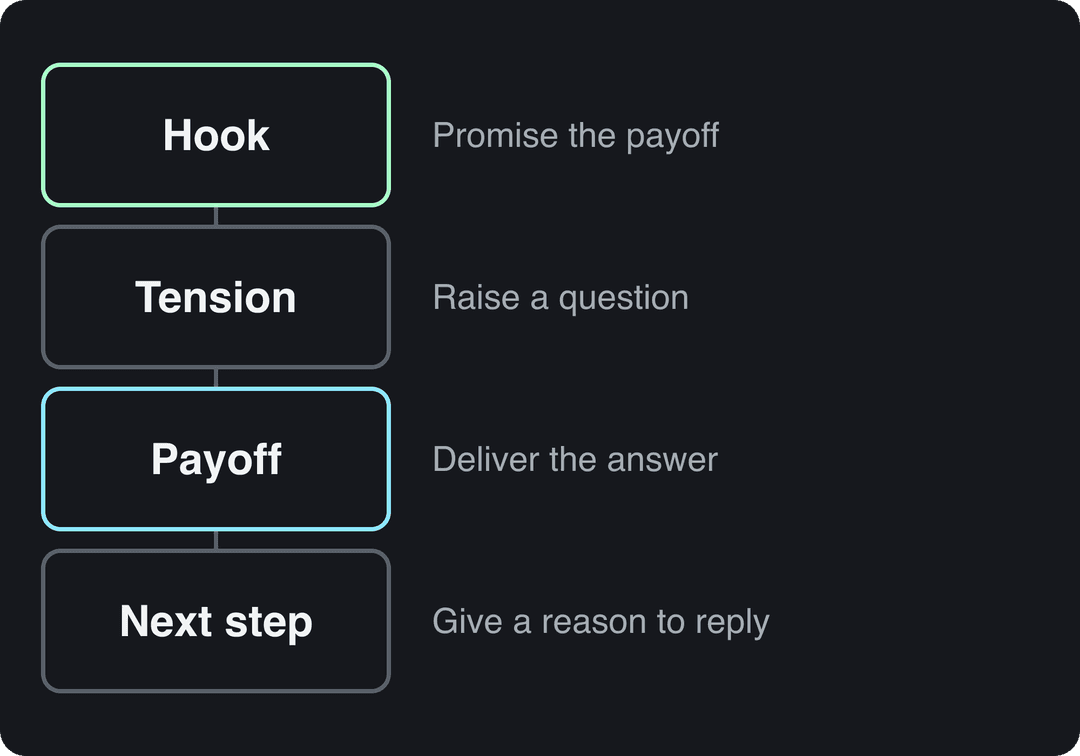
A sample short script for a bakery account:
| Beat | Line |
|---|---|
| Hook | "Your croissants aren't flaky because your butter is too warm." |
| Tension | "Warm butter melts into the dough, so there are no layers to puff up." |
| Payoff | "Chill the dough between every fold, and fold the butter in cold." |
| Next step | "Comment 'layers' and I'll post the full folding schedule." |
The next step is part of the content, not an afterthought. A specific question ("Which step do you skip?") gets more replies than "Let me know what you think."
Step 5: Say less, show more
The best-performing videos in Revid's data talk surprisingly little. TikToks with under 40 characters of speech had a median of 123K views, and 20.2% passed 1 million; videos with speech throughout (300+ characters) had 68K and 11.9%. Silent videos reached 73K.
Practical edits:
- Cut every sentence that doesn't move the story forward, then cut the intro.
- Let visuals carry the explanation and use on-screen text for the one line that matters.
- Show the result before explaining how you got it.
Interactive formats get the audience to do something, which is the point. Try video quizzes and polls, "guess before the reveal" endings, and prompts that invite Duets, Stitches or user submissions. The responses you get double as your next batch of content ideas.
Step 6: Adapt each piece for every platform
One strong idea can feed every channel. A detailed blog post becomes a short video summary, a carousel, a thread and a LinkedIn post; a good video becomes clips, quotes and a written version. The full method is in our guide to repurposing video content.
Keep the voice the same everywhere and change only the packaging:
| Platform | What engages | Specs to respect |
|---|---|---|
| TikTok | Fast hook, one idea, native text and sound | Uploads up to 60 minutes; 9:16 at 1080x1920 recommended |
| Instagram Reels | Strong first frame, short caption, trial reels for tests | Up to 20 minutes, but reels over 3 minutes aren't recommended to non-followers; up to 5 hashtags |
| YouTube Shorts | Payoff-driven loops, searchable titles | Vertical or square up to 3 minutes; titles up to 100 characters |
| Practical lessons, plain-spoken expertise | Video up to 15 minutes; the vertical video feed is mobile-only | |
| X | Short posts and threads with one visual | Up to 4 photos or 1 video per post |
| Blog | Answer first, headings, short paragraphs, tables | Write for the search, then for the skim |
On hashtags, TikTok posts with 4 hashtags had the best median in Revid's data (77K views) and 3 hashtags were close (75K), while 9 or more had just 16K. Instagram caps posts at 5, so 3 to 5 specific tags is a sensible default on both.
How to use AI without making generic content
AI is now standard in content work: HubSpot's 2026 State of Marketing Report found that 80% of marketers use AI for content creation and 75% use it for media production, one of the figures on our short-form video statistics page. Ahrefs' content marketing statistics collects more survey data on which writing tasks marketers hand to AI.
The risk is sameness. A blank prompt gives the model nothing about your audience, so the output drifts toward an average that viewers skip. Split the work:
| Task | AI is good at | You still own |
|---|---|---|
| Research | Summarizing sources, clustering questions | Choosing the problem worth solving |
| Outlines and scripts | First drafts, hook variations | The angle, examples and opinions |
| Visuals and voice | B-roll, AI scenes, voice-over, captions | Taste: what to cut and what to keep |
| Distribution | Titles, descriptions, resizing | Which platform gets which version |
| Measurement | Spotting patterns in analytics | Deciding what to change |
Use an AI script generator for drafts and hook variations, then rewrite with your own examples. Two rules keep AI content safe to publish:
- Label realistic AI. TikTok requires a label on AI-generated content with realistic images, audio or video, and YouTube requires disclosure of realistic altered or synthetic content. Both say the label alone doesn't reduce distribution.
- Add your own insight. YouTube doesn't let template-made, mass-produced AI content monetize, but it allows AI-assisted videos that show the creator's creative vision and give educational or entertainment value.
How to make engaging short videos with Revid
Revid starts from formats audiences have already proven they watch, which covers Steps 1 to 4 in one place:
- Search the viral library for your topic and filter by platform, engagement tier and length.
- Open a video and run a deep analysis (free, up to 60 a day) to see its hook, timed structure and scroll-stopping moment.
- Pick "Make it about your topic" or "Same energy, new script": Revid writes an original script and generates the visuals, voice-over (70+ languages), captions and music.
- Adjust any scene in the timeline editor, export up to 4K, and publish or schedule to TikTok, Instagram and YouTube.
- Check each post's views, likes and comments, and remix the ones that did well.
To start from an idea or a script instead, use the AI video generator. Sign-up is free and new accounts get free credits to try video creation; regular creation then uses the credits of a paid plan, from $39/month (see Revid's plans and credits).
Build a content calendar you can keep
Consistency beats bursts, because an audience learns when to expect you. Choose a cadence you can sustain for months, not weeks, and plan around a few content pillars:
- Teach: how-tos, mistakes, tool walkthroughs.
- Show: behind the scenes, results, before and after.
- Entertain: reactions, challenges, trends adapted to your niche.
- Sell: demos, customer stories and offers, as the smallest share.
Leave open slots for timely topics, and batch production: write several scripts in one session, then film or generate them in the next. Before anything goes out, run a short checklist:
- Does the first line state the promise?
- Is there one idea, not three?
- Does the payoff arrive before viewers lose interest?
- Is the next step specific?
- Is realistic AI content labeled?
How to measure engagement
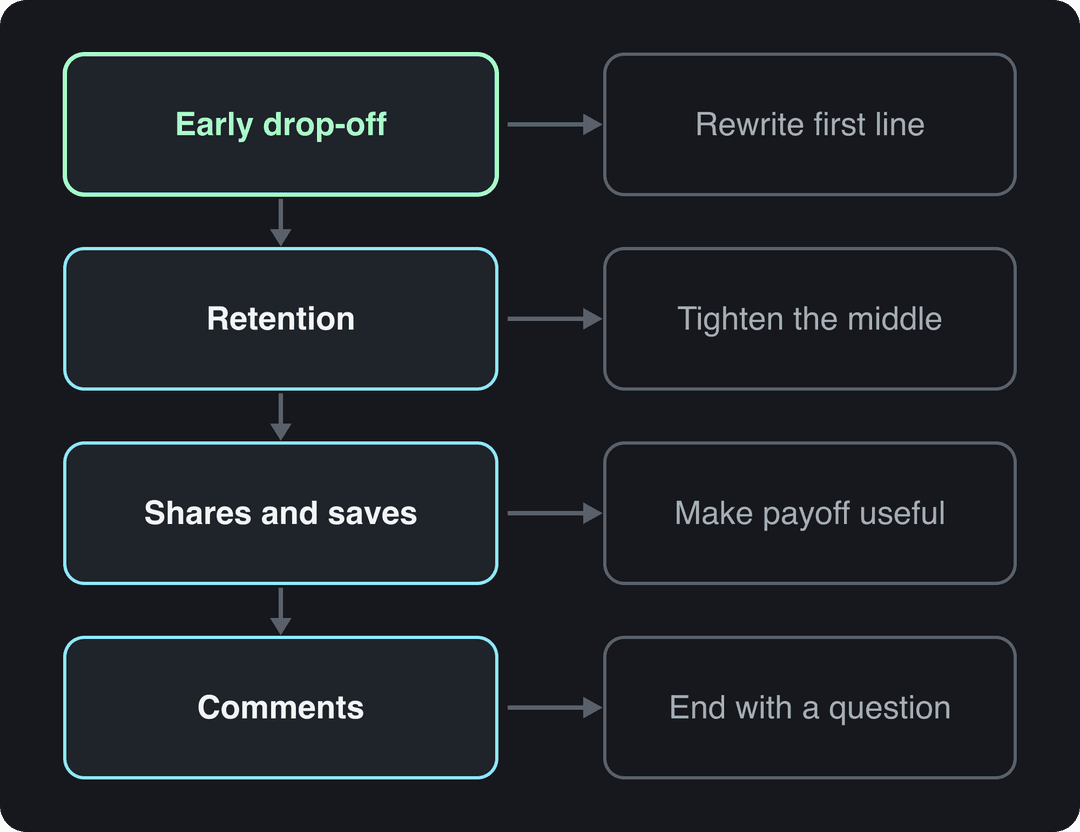
Follower counts and raw likes are easy to inflate and say little about whether content works. Track signals that show attention and intent:
| Metric | What it tells you | If it's weak |
|---|---|---|
| Average watch time and retention | Whether the structure holds | Tighten the middle, show the payoff sooner |
| Drop-off in the first seconds | Whether the hook works | Rewrite the first line and first frame |
| Shares and saves | Whether it's worth passing on | Make the payoff more useful or surprising |
| Comments with substance | Whether it started a conversation | End with a specific question |
| Click-through rate | Whether the title, cover or call to action pulls | Test a clearer promise |
| Time on page and scroll depth | Whether readers finish your articles | Answer first, cut the preamble |
Where to find them: Google Analytics for your website; TikTok Studio analytics, whose Viewers tab shows when your viewers were most active over the last 7 days; Instagram insights, which now lead with Views and show follower activity once you have 100 followers; and YouTube Studio, where views count as soon as playback starts (since August 24, 2026), so engaged views and watch time are the better quality signals. For long YouTube videos, Test & Compare can A/B test up to 3 titles and thumbnails; Shorts aren't eligible.
Run a content audit once a month: rank your posts by retention and shares, list what the top ones have in common (format, hook type, emotion, length), and make more of that. For tactics once posts are live, see these ways to increase social media engagement.
FAQ
How long should an engaging video be?
As long as the payoff needs, and no longer. In Revid's 12-month study of TikToks, every length from under 15 seconds to 10 minutes had a median between 58K and 76K views, with 61 to 90 seconds slightly ahead (70K) and videos under 15 seconds earning the most shares per view.
Is video more engaging than text?
For learning about products, usually yes: in Wyzowl's 2026 survey, 63% of consumers said they would most like to learn about a product or service through a short video, versus 12% for text articles. Text still wins for search answers and detail, so pair the two.
Does labeling AI content hurt reach?
No. TikTok says its AI-generated content setting doesn't affect distribution for videos that follow its Community Guidelines, and YouTube says disclosure alone doesn't limit a video's audience or its eligibility to earn.
How often should you post to keep engagement up?
Post as often as you can keep the quality of every piece, and hold that rhythm. A steady schedule you can sustain beats a burst of daily posts followed by silence.
Sources
- Revid analysis of 176,367 TikToks with 1,000+ likes posted between Oct 1, 2025 and Oct 16, 2026 (61,203 creators)
Charts and figures checked on November 6, 2026.