
On this page
To grow a YouTube channel fast, pick one narrow topic, publish on a fixed weekly schedule, cut every long video into Shorts, and put most of your effort into titles, thumbnails and the first seconds of each video. Then check YouTube Studio every week and make more of whatever beats your channel average.
Shorts are the cheapest reach a small channel can get. Socialinsider's 2026 study of 69 million short-form videos found that accounts with under 5,000 followers averaged 15,160 views per YouTube Short, against 625 per Instagram Reel and 350 per TikTok. Most new channels still post only long videos and wait for search to find them.
- Average views per YouTube Short for accounts under 5,000 followers
- 15,160
- Socialinsider, August 2026
- Share of uploads as Shorts that gave channels the best results
- 25% to 40%
- AIR Media-Tech, May 2026
- YouTube channels publishing Shorts every day as of March 2026
- 10M+
- Alphabet, April 2026
- Gen Z who use short-form apps to discover things they then watch longer
- 59%
- Think with Google, September 2022
How to grow a YouTube channel fast: the 7 moves
- Pick a niche a stranger can describe in one sentence. YouTube recommends videos by matching them to viewers; a channel that jumps between topics gives it nothing to match.
- Commit to a schedule you can keep for months. Steady output beats bursts followed by silence.
- Turn every long video into Shorts. They reach people who would never search for you.
- Win the click. The title and thumbnail decide whether an impression becomes a view.
- Hold the opening seconds. Retention decides whether YouTube shows the video to more people.
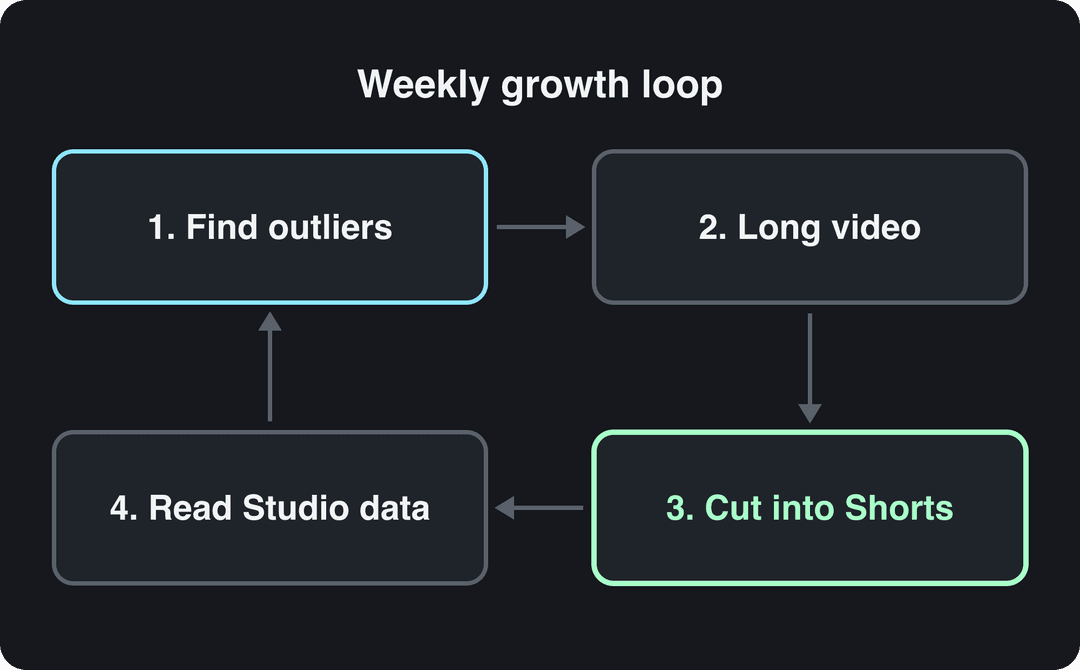
- Read the right numbers. Double down on your outliers and drop what flops.
- Give people a reason to subscribe and come back. Community and cross-posting compound everything else.
What "fast" realistically means on YouTube
There is no guaranteed timeline. Channels rarely grow in a straight line: they sit flat, then one video gets picked up by the home feed or suggested videos and pulls the whole channel up. Growing fast means creating more of those chances and learning from each one sooner.
The competition on YouTube is real. Alphabet said that as of March 2026, over 10 million channels were publishing Shorts every day. For audience-size context, Global Media Insight keeps a roundup of YouTube user statistics, Measure Studio tracks channel and upload counts in its YouTube statistics roundup, and Exploding Topics covers YouTube creator statistics, including the categories the biggest channels come from. Treat those as background, not a forecast for your channel.
A better yardstick than total subscribers: subscribers gained per video, and how many of your videos beat your channel average. Those two numbers move first when something is working.
Pick a niche narrow enough to be recommended
YouTube's recommendations work by showing a video to people who watched similar videos. If your channel covers recipes on Monday and crypto on Friday, each new upload starts from zero.
Use these decision rules:
- If you can't list a year of video ideas, the niche is too narrow.
- If a viewer who loved one video wouldn't click the next one, it is too broad.
- If big channels already own the topic, take a specific slice: "home espresso for beginners" instead of "coffee", "budget electric guitars" instead of "guitar".
- Pick something you can keep making when it stops being new. The schedule lasts months, and interest shows on camera.
Educational, how-to and gaming content have steady demand because people look up skills and games every day. Pure entertainment can grow faster but depends more on the home feed, so it is less predictable.
Prompt to try
Make a 45-second vertical YouTube Short, episode 1 of a series called 'Home espresso for beginners'. Open with the hook 'Your espresso tastes sour for one reason, and it's not the beans.' Explain grind size with close-up shots of a grinder and an espresso shot pulling, upbeat narration and bold captions. End by teasing episode 2 on steaming milk.
How often should you upload to grow faster?
Upload as often as you can sustain at the same quality for months. A sensible starting point for most solo creators is one long video a week, plus Shorts cut from it. More uploads only help if quality holds: a rushed video that viewers abandon early teaches YouTube to show your next one to fewer people.
Three habits make a schedule stick:
- Series. A recurring format gives viewers a reason to come back and makes ideas easy to generate. YouTube began rolling out Shorts series in September 2026, which lets you group Shorts into seasons and episodes across web, mobile and TV.
- Batching. Write and film several videos in one session, then edit through the week.
- An evergreen and timely mix. Evergreen videos (tutorials, comparisons) keep pulling search traffic for years. Timely videos (news, trends) spike and fade but bring bursts of new viewers.
Don't go silent for long: under current rules, YouTube may turn off monetization for channels that have not uploaded or posted to the Posts tab for 6 months or more.
The index leans toward videos that surface in hashtag and keyword searches, so its view counts run high: compare the groups, not the absolute numbers.
Source: Revid TikTok index: 2,377,477 TikToks with AI labels per video, snapshot of Sep 15, 2026. Median views estimated from view buckets.
Show the data
| Median views | Share past 1M views | |
|---|---|---|
| 0-7s | 88.3K | 19.9% |
| 8-15s | 111.1K | 22.6% |
| 16-30s | 141K | 25.1% |
| 31-60s | 120.4K | 22.8% |
| 61-120s | 97K | 19.8% |
| 2-5 min | 89.1K | 18.3% |
| 5 min+ | 90.1K | 17.2% |
Do YouTube Shorts help a channel grow faster?
Yes, for discovery. Alphabet said in April 2023 that channels posting weekly on Shorts saw the majority of their new subscribers come from their Shorts. In a 2022 Ipsos survey for YouTube, 59% of Gen Z said they use short-form video apps to discover things they then watch longer versions of.
The mix matters. AIR Media-Tech's study of 18,000 English-language channels (March 2025 to March 2026) found the best results when Shorts made up 25% to 40% of a channel's uploads. It also found that mixing formats did not win in every niche: in some, long-form-only channels led by a wider margin. More sourced figures are on our YouTube Shorts statistics page.
How to use Shorts to grow the whole channel:
- Clip the strongest moment of each long video: a result, a surprising fact, a before and after.
- Start on the payoff, not the setup.
- Keep Shorts in the same niche as your long videos, so new viewers turn into long-form viewers.
- Link each Short to the full video with YouTube's related video option.
Square or vertical videos up to 3 minutes long count as Shorts (since October 15, 2024). For packaging and posting tactics, see how to get more views on YouTube Shorts.
How to turn one long video into Shorts with Revid
- Paste your YouTube link into Revid's YouTube clip maker. The AI picks the strongest moments and returns short vertical clips.
- Adjust any cut or caption in the timeline editor.
- No long video yet? The AI YouTube Shorts generator turns a script or an idea into a Short with visuals, voice-over, captions and music.
- Schedule the clips to YouTube, TikTok and Instagram from one queue with social media publishing.
How to get more people to click your videos
An impression only becomes a view when the title and thumbnail make a promise the viewer wants kept. This is where most small channels lose the most.
Titles:
- Lead with the outcome or the tension: "Why my sourdough kept failing (and the fix)" beats "Sourdough tips".
- Use the words your viewer would type, once, near the start. YouTube allows up to 100 characters, but phones show far fewer.
- Write several options and pick the most specific one. A free YouTube title generator helps with the first drafts.
Thumbnails:
| Check | Do this | Avoid |
|---|---|---|
| One focal point | One face, object or result, shown large | Collages of small images |
| Readable on a phone | A few words that add to the title | Repeating the title word for word |
| Contrast | Colors that stand out on light and dark mode | Busy backgrounds behind text |
| Consistency | A recognizable color or layout across videos | A new style every upload |
| Honesty | Show what the video actually delivers | A promise the video doesn't pay off |
Specs: YouTube recommends custom thumbnails at 3840x2160 (16:9, minimum width 640 px), with files up to 50 MB on desktop but only 2 MB on mobile. Custom thumbnails require a verified account. For vertical videos, YouTube replaces a 16:9 thumbnail with an auto-generated 4:5 one on the home, explore and subscription pages.
Test instead of guessing. Test & Compare in YouTube Studio on desktop can A/B test up to 3 titles and thumbnails per video. The variant with the highest watch time wins, not the one with the most clicks, which rewards honest packaging. Shorts are not eligible.
How do you get YouTube videos found in search?
Search matters most for tutorials, reviews and comparisons. Write for intent: instead of "guitar", target "how to play beginner guitar chords" or "best electric guitar under $500". The same search-intent thinking behind blog search engine optimization applies to YouTube titles and descriptions.
- Put the main phrase in the title and in the first lines of the description. Descriptions can run to 5,000 characters: use the space for a summary, chapters and links.
- Tags are capped at 500 characters in total and matter far less than the title, thumbnail and retention. Add a few, including common misspellings.
- Don't stuff keywords. It reads as spam and does nothing for rankings.
Our YouTube SEO tips cover descriptions and chapters in detail, and the guide on how to rank YouTube videos covers what moves a video up the results.
How to keep viewers watching
Retention tells YouTube whether the click was worth it. A video that keeps people watching gets shown to more people like them; one they abandon early stalls.
- Open with the payoff or the problem. Skip logo intros and "welcome back".
- Say what viewers will have by the end, then deliver it in that order.
- Cut every tangent. When a point runs long, change the shot or add a graphic.
- Tease something later in the video ("the mistake that cost me the most is last") and keep the promise.
- End on an end screen pointing to the next video in the series, not a long goodbye.
In the audience retention graph, a steep drop in the opening seconds means the title or thumbnail promised something the start didn't show. A dip mid-video points to the exact segment to cut next time.
Which YouTube Studio numbers predict growth?
Since August 24, 2026, YouTube counts a view the moment a video starts playing, across Shorts, long-form and live. Raw view counts are now a weaker signal, so judge each video by what viewers did after the click.
| Metric | What it tells you | What to do |
|---|---|---|
| Impressions click-through rate | Whether your packaging earns the click | If it trails your channel average, test new titles and thumbnails |
| Audience retention | Where viewers leave | Cut the segment before each steep drop in future videos |
| Average view duration | Whether the video kept its promise | Compare against videos of similar length, not all videos |
| Subscribers gained per video | Which topics convert viewers into fans | Make more of the formats at the top of this list |
| Traffic sources | Search, browse, suggested or Shorts | Lean into whichever source is growing |
| Returning viewers | Whether people come back | If it is low, build series and end screens |
Find your outliers: sort your videos by views and look at the ones far above your average. What do they share: topic, format, title pattern, length? Make your next 3 videos variations of that pattern.
Then do the same for channels in your niche. List a handful of competitors, sort their videos by most popular, and note which ones outperform their usual numbers; those are proven topics your audience wants. Revid's channel watcher tracks TikTok and YouTube channels for you (5 on the Growth plan, more on higher plans), syncs them daily and surfaces outlier videos you can turn into original ones.
Do you need to show your face to grow?
No. In Revid's analysis of 176,367 TikToks with 1,000+ likes posted between October 2025 and October 2026, faceless videos had a median of 114K views and 17.4% passed 1 million, against 67K and 12.7% for one person on camera. This is TikTok data, the sample only includes videos that already reached 1,000 likes, and it shows what top videos have in common rather than causes. Still, it supports what successful faceless YouTube channels show: the idea and the edit carry the video. The method is in our study of what makes a TikTok go viral.
Faceless videos earned a median of 114K views, against 67K for videos with one person on camera, and passed 1M views 38% more often.
Source: Revid analysis of 176,367 TikToks with 1,000+ likes posted between Oct 1, 2025 and Oct 16, 2026 (61,203 creators)
Show the data
| Median views | Share that passed 1M views | |
|---|---|---|
| Animals | 147.4K | 24.1% |
| Faceless | 113.9K | 17.4% |
| Groups of people | 96.1K | 16% |
| Objects or products | 70.8K | 13.2% |
| One person on camera | 67.4K | 12.7% |
If you go faceless with AI on YouTube, know the monetization rules. AI and automated tools are allowed when the final video shows your creative vision and gives real educational or entertainment value. Mass-produced template content, stitched AI clips with no narrative, and AI personas posing as experts on health, legal, financial or political topics can't monetize. Disclose realistic AI content with the "AI use" setting in YouTube Studio; disclosure alone does not limit reach.
How to turn viewers into subscribers and regulars
- Ask with a reason, at the moment of value. "Subscribe if you want part 2 on fixing the bridge next week" works better than "like and subscribe" in the first seconds.
- Ask specific questions. "What was your favorite part and why?" gets real answers; "Did you enjoy the video?" gets silence. Reply early and pin the best comment.
- Use the Posts tab between uploads. Polls and questions keep subscribers active, and the answers become video ideas.
- Feature your regulars. Answer their comments in a video or credit their suggestions. People share videos they appear in.
- Build participation formats. Challenges, viewer submissions and Q&A videos turn viewers into contributors.
Our strategic playbook for growing a YouTube channel goes deeper on community and positioning.
Promote your channel on other platforms
Other platforms are a free source of viewers if you reuse what you already made. Pick them by audience: TikTok and Instagram for younger viewers, LinkedIn for professional and B2B topics, and Facebook, where every new video has been shared as a reel since a June 2025 change.
- Post the same vertical clips you cut for Shorts, adapted to each platform (native captions, trending sounds on TikTok).
- End teasers with where to find the full video, and put your channel link in each bio.
- In YouTube Studio, check traffic sources to see which platform actually sends viewers, then spend your time there.
For another take on the basics, Timeskip has a guide on how to grow a YouTube channel.
What slows a channel down
- Buying subscribers or views. They never watch, which drags down every metric YouTube uses to recommend you, and fake engagement breaks YouTube's rules.
- Chasing the Trending page. YouTube's Help Center now describes Trending Charts only for select categories (Movie Trailers, Music Videos, Gaming). Growth comes from the home feed, suggested videos, search and Shorts.
- Switching niches. Every pivot resets the audience YouTube has learned to show you to.
- Mass-producing near-identical videos. YouTube renamed its "repetitious content" monetization policy to "inauthentic content" in July 2025 to make clear it covers repetitive or mass-produced videos.
- Judging a video too early. Evergreen tutorials often keep gaining views through search long after upload, so compare videos over the same time window.
FAQ
What is the fastest way to get YouTube subscribers?
Post Shorts in the same niche as your long videos, link each Short to a related long video, and ask for the subscription right after you deliver something useful. Bought subscribers don't count as growth because they never watch.
How long does it take to grow a YouTube channel?
There is no standard timeline. Most channels grow in steps when one video gets picked up by the home feed or suggested videos, so the fastest path is consistent uploads and learning from each one.
How many subscribers do you need to make money on YouTube?
Today, ad revenue sharing needs 1,000 subscribers plus either 4,000 qualified watch hours in the last 12 months or 10 million qualified Shorts views in the last 90 days. From February 1, 2027, new applicants need 8,000 watch hours in 365 days or 20 million Shorts views in 90 days; channels already in the program are not affected.
How do I improve a YouTube channel that stopped growing?
Start with your best-performing videos, find what they share in topic, format and title, and make variations of them. Then retest packaging on underperformers with Test & Compare and tighten the opening of every new upload.
Can an AI-assisted channel grow on YouTube?
Yes, as long as each video carries your own ideas and gives viewers real value. YouTube allows AI tools for scripts, visuals and editing, but mass-produced template videos can't monetize, and realistic AI content must be disclosed.
Sources
- Revid analysis of 176,367 TikToks with 1,000+ likes posted between Oct 1, 2025 and Oct 16, 2026 (61,203 creators)
- Revid TikTok index: 2,377,477 TikToks with AI labels per video, snapshot of Sep 15, 2026. Median views estimated from view buckets.
- Socialinsider, TikTok vs. Reels vs. Shorts: 2026 Engagement Data (August 2026)
- AIR Media-Tech, Do YouTube Shorts help your long-form videos? Data from 18,000 channels (May 2026)
- Alphabet, Q1 2026 earnings call transcript (April 2026)
- Think with Google, Short and long-form video content (September 2022)
Charts and figures checked on November 6, 2026.