
AI Short Video Statistics: What 756,851 Revid Videos Reveal
Data from 756,851 videos made on Revid shows how creators build AI shorts: mostly vertical, captioned, faceless and longer than you'd expect. Here is how that compares with what audiences actually watch.
On this page
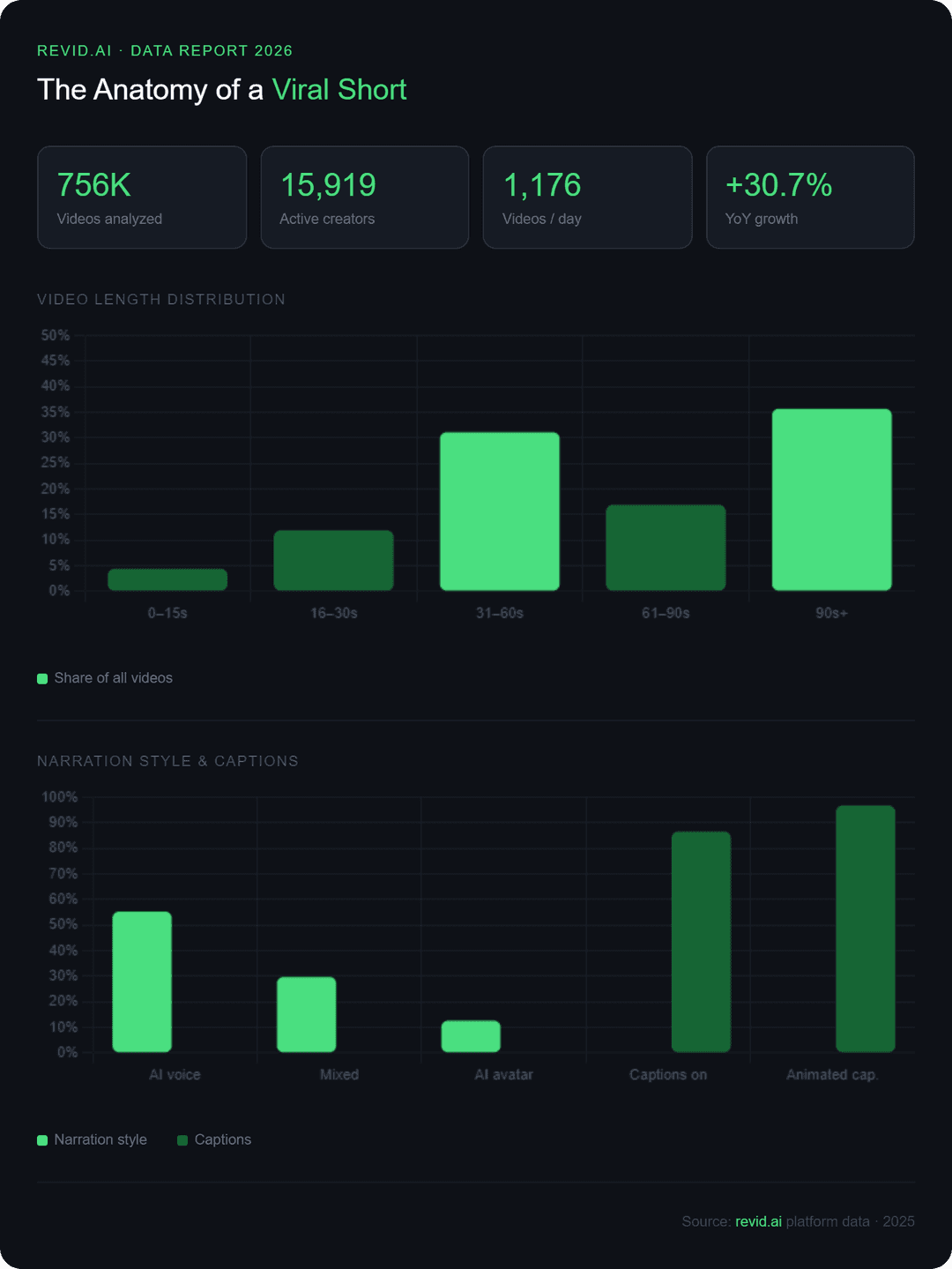
Across 756,851 videos exported from Revid, the typical AI-made short is vertical, captioned and faceless: 77.9% of 2025 exports were 9:16, 86.6% had captions (96.8% of them animated), 55.3% used an AI voiceover with no one on camera, and 35.7% ran longer than 90 seconds.
Read those numbers as what creators choose to make, not what audiences reward. The clearest gap is length: in Revid's index of about 2.39 million TikToks with 1,000+ likes, 16 to 30 second videos had the highest median views (about 141K), yet only 11.9% of Revid exports fall in that range. This report shows both sides so you can tell a habit from a result.
- Share of 2025 Revid exports in vertical 9:16
- 77.9%
- Revid platform data, 2025 exports
- Share of Revid exports with captions turned on
- 86.6%
- Revid platform data, 2025 exports
- Share of 2025 exports using an AI voiceover with no one on camera
- 55.3%
- Revid platform data, 2025 exports
- Share of Revid exports running longer than 90 seconds
- 35.7%
- Revid platform data
What the 756,851 videos are
The dataset is every successful export on Revid up to and including 2025: 756,851 videos made for TikTok, Instagram Reels and YouTube Shorts. The 2025 cohort alone holds 429,105 exported projects from 15,919 unique active creators.
It describes production choices: length, aspect ratio, captions, narration style, hooks, niches and languages. It does not include view counts, so no table below says a format performs better. Where performance matters, each section adds the matching finding from Revid's TikTok engagement data and says so.
How long are AI-generated short videos?
The average Revid export runs 115.5 seconds, just under two minutes. Most creators are not making 15-second clips.
| Duration | Share of Revid exports | Typical use |
|---|---|---|
| 0 to 15 s | 4.4% | Teasers, memes, loops |
| 16 to 30 s | 11.9% | Classic short-form |
| 31 to 60 s | 31.1% | Explainers, tips |
| 61 to 90 s | 16.9% | Stories, longer explainers |
| 90+ s | 35.7% | Story videos, podcast-style shorts, deep explainers |
Together, 31 to 60 seconds and 90+ seconds make up over two-thirds of exports, while everything under 30 seconds is 16.3%. Narrated AI formats (stories, explainers, music videos) naturally run long, which explains much of this.
Audiences have moved in the same direction, but less than creators have. Revid's index of 2.39 million popular TikToks found that 22% of 2023 posts ran over one minute, against 32% of 2025 posts. Across that full index, 16 to 30 second videos still had the highest median views (about 141K), ahead of 31 to 60 seconds (120K), under 15 seconds (106K) and 61 to 90 seconds (102K).
For recent posts the edge of very short videos has faded. In Revid's 12-month study of 176,367 TikToks with 1,000+ likes posted between October 2025 and October 2026, every length bucket from under 15 seconds to 10 minutes had a median between 58K and 76K views, with 61 to 90 seconds slightly ahead at 70K. Videos under 15 seconds had the lowest median (58K) but the most shares per view (1.41 per 100). These are TikTok videos that already cleared 1,000 likes, so they show what successful videos have in common, not causes.
Length alone barely moves views: every bucket lands between 58K and 76K median views (the 790 videos over 10 minutes are a small, unusual group). Clips under 15 seconds get shared the most per view.
Source: Revid analysis of 176,367 TikToks with 1,000+ likes posted between Oct 1, 2025 and Oct 16, 2026 (61,203 creators)
Show the data
| Median views | Share that passed 1M views | Shares per 100 views | |
|---|---|---|---|
| Under 15 s | 57.6K | 11.6% | 1 |
| 16 to 30 s | 64.9K | 12.3% | 1 |
| 31 to 60 s | 61.8K | 11.8% | 1 |
| 61 to 90 s | 70.5K | 12.2% | 1 |
| 91 s to 3 min | 63.4K | 11.1% | 1 |
| 3 to 10 min | 76.4K | 12.4% | 1 |
| 10 min+ | 129.6K | 13.8% | 0 |
Decision rule: if your script works at 30 seconds, do not pad it to 90. If the story genuinely needs 90 seconds, length alone will not sink it. For per-platform limits and sweet spots, see our guide to the best video length for each platform.
Prompt to try
Make a 30-second vertical faceless explainer that opens with the question: "Why does your phone die faster in the cold?" Answer it in plain words with clear b-roll of phones, snow and battery icons, and let the visuals carry the beats so the narration stays short. Use a calm, confident AI voice and word-by-word animated captions.
What hooks do AI video scripts use?
Revid ran a heuristic classifier on the first sentence of 348,346 2025 scripts with usable text. Questions were the most common deliberate hook type.
| Hook type | Share of scripts | Example opener |
|---|---|---|
| Question | 12.2% | "Why does your phone die faster in the cold?" |
| Bold statement | 6.6% | "Most budgeting apps make you worse with money." |
| Storytelling | 5.4% | "I used to post every day and get nothing." |
| Statistic | 2.2% | "9 out of 10 people get this wrong." |
| Other or mixed | 73.5% | Hybrid or unclassified openings |
Two readings matter. First, 73.5% of openings fit none of the four classic types, so most scripts either blend patterns or skip a deliberate hook. Second, questions are nearly twice as common as the next type, but this is a count of usage, not of results.
The average Revid script runs 117.5 words, so the hook is the first 10 to 15 words of a roughly 120-word story. Write it last, after you know the payoff, and make it a question the viewer already has rather than a rhetorical one.
The TikTok data adds a warning about script length: in Revid's study, videos with under 40 characters of speech had a 123K median and 20.2% passed 1M views, against 68K and 11.9% for videos with talking throughout. If a visual can carry a beat, cut the words. For tested openers by type, use the library of TikTok hooks, and for the full method behind these TikTok findings, read what makes a TikTok go viral.
Which aspect ratio do short-form creators export?
| Aspect ratio | Share of 2025 exports | Main use |
|---|---|---|
| 9:16 (vertical) | 77.9% | TikTok, Reels, Shorts |
| 16:9 (landscape) | 20.9% | YouTube long-form, desktop |
| 1:1 (square) | 1.1% | Instagram feed, LinkedIn |
| Other | 0.1% | Custom formats |
Vertical is the default for a reason: TikTok's Creator Academy recommends 9:16 at 1080x1920, YouTube treats square or vertical videos up to 3 minutes as Shorts, and Instagram Reels accept ratios from 1.91:1 to 9:16. The 20.9% landscape share comes mostly from creators making videos for YouTube's main feed. Square has nearly disappeared.
Decision rule: build in 9:16 and crop out to other ratios when needed, never the reverse, because a vertical crop of a landscape video loses most of the frame.
How many short videos use captions?
| Caption metric | Value |
|---|---|
| Videos with captions on | 86.6% |
| Captioned videos using animated captions (word or phrase reveal) | 96.8% |
| Captioned videos using static subtitle blocks | 3.2% |
Captions were on almost every export in the first half of 2025, then settled at 84 to 87% from August onward, as more musicians and entertainment creators (who often prefer clean visuals) joined.
Animated captions do two jobs: they serve viewers who watch muted, and they pace the eye through fast AI narration. Static blocks make viewers read ahead of the voice. If your video has a voiceover, caption it with a word-by-word style; the AI caption generator does this in 100+ languages. The main exception is music or visual-only videos, where on-screen text can compete with the image.
The index leans toward videos that surface in hashtag and keyword searches, so its view counts run high: compare the groups, not the absolute numbers.
Source: Revid TikTok index: 2,377,477 TikToks with AI labels per video, snapshot of Sep 15, 2026. Median views estimated from view buckets.
Show the data
| Median views | Share past 1M views | |
|---|---|---|
| Animal-focused | 273.2K | 36.3% |
| Faceless | 199.4K | 29.7% |
| Object-focused | 143.1K | 24.9% |
| Group-focused | 140.3K | 23.7% |
| Person-focused | 104.8K | 21.8% |
Faceless, AI avatar or on camera: what do creators choose?
| Narration style | Share of 2025 exports | What it is |
|---|---|---|
| AI voiceover | 55.3% | AI voice over visuals, no presenter |
| Mixed | 29.7% | AI voice and visuals combined with the creator's own footage |
| AI avatar | 12.6% | AI-generated presenter on screen |
| Creator's own footage only | ~0% | Creator on camera, own voice |
| Other or unclassified | 2.4% |
More than half of exports are fully faceless. AI talking avatars account for 12.6%; their use peaked in March 2025, then settled among regular users. The 29.7% mixed share is the most practical signal: many creators blend their own clips with AI voice and visuals instead of choosing one side.
Here the audience data supports the choice. In Revid's TikTok study, faceless videos had a 114K median and 17.4% passed 1M views, against 67K and 12.7% for one person on camera. The faceless vs on-camera case study breaks this down across Revid's full index. Again, these are TikToks that already reached 1,000+ likes.
Faceless does not mean anything goes. YouTube allows AI-assisted content to earn when it shows the creator's creative vision and gives real value, but content made from generic templates that looks mass-produced cannot monetize.
What niches do AI video creators make?
A second classifier sorted 2025 exports with usable source text into categories.
| Rank | Category | Videos (2025) | Share of classified |
|---|---|---|---|
| 1 | AI and technology | 104,146 | 48.8% |
| 2 | Education and explainers | 27,112 | 12.7% |
| 3 | Music and art | 23,502 | 11.0% |
| 4 | Business and finance | 20,925 | 9.8% |
| 5 | Mystery, true crime and news | 15,328 | 7.2% |
| 6 | Relationships and lifestyle | 9,612 | 4.5% |
| 7 | Health and fitness | 7,180 | 3.4% |
| 8 | Religion and spirituality | 6,310 | 3.0% |
| 9 | Travel and food | 5,297 | 2.5% |
| 10 | Entertainment and pop culture | 4,209 | 2.0% |
AI and technology at 48.8% partly reflects who uses Revid (founders and tech-minded creators). Music and art at third comes from independent musicians turning tracks into visuals with the AI music video generator.
Busy niches are not the most-watched ones. In Revid's TikTok study, challenges (182K median) and comedy (155K) led, while tutorials sat at 62K. If you make education content, the format that did best there was faceless tutorials, at a 156K median against 52K for on-camera tutorials.
Which countries and languages make the most short videos?
| Country | Videos created | Share of total |
|---|---|---|
| United States | 181,957 | 24.1% |
| United Kingdom | 43,387 | 5.7% |
| India | 42,445 | 5.6% |
| Germany | 42,327 | 5.6% |
| Canada | 31,928 | 4.2% |
| France | 31,623 | 4.2% |
| Spain | 20,692 | 2.7% |
| Philippines | 16,071 | 2.1% |
| Sweden | 13,892 | 1.8% |
| Brazil | 13,616 | 1.8% |
| Language | Share of 2025 videos |
|---|---|
| English | 60.9% |
| Spanish | 4.6% |
| German | 3.0% |
| French | 3.0% |
| Farsi | 2.4% |
| Portuguese | 1.8% |
| Italian | 1.5% |
| Russian | 1.4% |
| Hindi | 1.0% |
| Romanian | 0.6% |
| Unknown or mixed | 17.7% |
The US leads with 24.1% of volume, and English sits below two-thirds of videos. Farsi at 2.4% (fifth) points to an active Persian-speaking creator group. Hindi likely appears undercounted, given India's third place by volume.
These tables measure supply on Revid, not demand on the platforms. A small language share means fewer Revid creators publish in it; check that your target audience watches in that language before switching. If it does, the video translator turns an existing Revid project into another language while keeping the edit and captions.
How to make a short that follows these patterns with Revid
- Open the faceless video generator and enter an idea, a script or a link, or start from a video in Revid's library of about 2.77 million real short-form videos with engagement data.
- Edit the first sentence of the script into a clear hook, and cut lines a visual can carry.
- Pick a voice (1,000+ voices in 70+ languages) and one of 30 caption styles.
- Keep the 9:16 frame, check the length against your story, and fix scenes in the timeline editor.
- Publish or schedule directly to TikTok, Instagram and YouTube, then compare the reported views against your other posts.
How the data was collected
The report covers 756,851 successful export records from Revid up to and including 2025, aggregated at platform level so no user can be identified. Hook types come from a heuristic classifier applied to the first sentence of 348,346 scripts; categories from a separate text classifier. Narration style comes from project settings, duration from tracked render events, country from user metadata and language from project language fields (17.7% unknown or auto-detected).
It reflects creator behavior on Revid and may not represent all short-form video on TikTok, Reels or Shorts. The audience figures come from Revid's TikTok index, limited to videos with 1,000+ likes; they show what well-performing videos share, not what causes views.
FAQ
Are 15-second videos dead?
No. In Revid's full TikTok index, videos under 15 seconds had a median of about 106K views, and in the recent 12-month study they had the most shares per view (1.41 per 100). They are rare on Revid (4.4% of exports) mostly because narrated AI formats run longer.
Can AI-generated shorts be monetized on YouTube?
Yes, if the final video shows your creative vision and gives real educational or entertainment value. YouTube does not let mass-produced content from generic templates, incoherent AI clip compilations, or AI personas giving health, legal, financial or political advice monetize.
Does labeling a video as AI-generated hurt its reach?
No. TikTok says its AI-generated content label does not affect distribution for videos that follow its Community Guidelines, and YouTube says disclosure alone does not limit audience or earnings. Both require labels on realistic AI content.
Is a question the best hook for a short video?
It is the most common deliberate hook in Revid scripts (12.2%), but Revid has no performance data comparing hook types. Use a question when your topic answers one the viewer already has, and test it against a bold statement on the same video idea.
Sources
- Revid analysis of 176,367 TikToks with 1,000+ likes posted between Oct 1, 2025 and Oct 16, 2026 (61,203 creators)
- Revid TikTok index: 2,377,477 TikToks with AI labels per video, snapshot of Sep 15, 2026. Median views estimated from view buckets.
Charts and figures checked on November 6, 2026.