
On this page
The best TikTok video ideas for small businesses are repeatable formats, not one-off trends: behind-the-scenes process clips, customer stories, quick tutorials, FAQ answers, product reveals, day-in-the-life routines, comparisons and challenges, timely takes, team spotlights and limited-time offers. Pick three that fit your goal, film them in batches and end each with one call to action.
How you film matters as much as what you film. In Revid's analysis of 176,367 TikToks with 1,000+ likes posted between October 2025 and October 2026, tutorials with a person talking on camera had a median of 52K views, while tutorials that showed only hands, a screen or the product reached 156K. For a shop owner who hates selfie videos, that is good news.
Each idea below comes with a hook you can say word for word, a caption direction, one CTA and a way to film it with a phone. Before you plan, browse viral small business TikToks to see what already works in your category.
- Median views for TikTok challenges, the highest of any format
- 182K
- Revid analysis of 176,367 TikToks
- Median views for faceless tutorials, against 52K for on-camera tutorials
- 156K
- Revid analysis of 176,367 TikToks
- Median views for faceless TikToks, against 67K for one person on camera
- 114K
- Revid analysis of 176,367 TikToks
- US revenue driven by SMB advertising and marketing on TikTok in 2023
- $14.7B
- Oxford Economics-linked impact assessment
The 10 ideas at a glance
| Idea | Main job | Effort | Best for | Watch out for |
|---|---|---|---|---|
| 1. Behind-the-scenes process | Trust | Low | Makers, food, repair, e-commerce | Pretty footage with no buyer benefit |
| 2. Customer stories | Proof and sales | Medium (permission, scheduling) | Services, SaaS, skincare, fitness | Vague praise instead of a specific problem |
| 3. Quick tutorials | Discovery and saves | Medium | Trades, beauty, fitness, software | Selling before the fix is shown |
| 4. Product reveal on a trending sound | Reach | Low | Fashion, cafés, beauty, retail | Sounds not cleared for Business accounts |
| 5. FAQ and myth answers | Removing doubts | Low | High-ticket, B2B, regulated services | Unqualified legal, health or money advice |
| 6. Day in the life | Familiarity | Medium | Bakeries, florists, gyms, studios | Disconnected B-roll |
| 7. Comparisons and challenges | Decisions and participation | Medium | Retail, fitness, craft, food | Claims you cannot verify |
| 8. Timely takes | Relevance | High (speed plus accuracy) | Consultants, tech, beauty pros | Rushed takes that spread errors |
| 9. Team spotlights | Trust and hiring | Low | Local services, agencies, restaurants | Staff who did not consent |
| 10. Limited-time offers | Sales | Low | Retail, restaurants, SaaS trials | Fake urgency, unclear terms |
Which TikTok video content ideas get the most views?
In Revid's analysis of 176,367 TikToks with 1,000+ likes posted between October 2025 and October 2026, challenges had the highest median views of any format (182K, with 25.6% passing 1 million views), followed by comedy (155K) and reactions (105K). Storytelling (66K) and tutorials (62K), the formats a business usually reaches for first, sat near the bottom.
Challenges and comedy passed 1M views about twice as often as tutorials and storytelling, which are the most common formats.
Source: Revid analysis of 176,367 TikToks with 1,000+ likes posted between Oct 1, 2025 and Oct 16, 2026 (61,203 creators)
Show the data
| Median views | Share that passed 1M views | |
|---|---|---|
| Challenge | 182.3K | 25.6% |
| Comedy | 154.8K | 22.1% |
| Reaction | 104.8K | 16% |
| Dance | 83.8K | 15.5% |
| Storytelling | 66.1K | 12.2% |
| Lip Sync | 61.7K | 12.3% |
| Tutorial | 61.9K | 12.1% |
That does not mean a bakery should only post challenges. It means you should borrow what the top formats do: give viewers something to join, a reason to laugh, or a reaction to a real customer question. Ideas 4, 7 and 8 below are built for that.
Showing your face is optional. Faceless videos had a 114K median and 17.4% passed 1 million views, against 67K and 12.7% for one person on camera. Most small business footage (hands at work, products, screens, a shop floor) is faceless by nature.
Faceless videos earned a median of 114K views, against 67K for videos with one person on camera, and passed 1M views 38% more often.
Source: Revid analysis of 176,367 TikToks with 1,000+ likes posted between Oct 1, 2025 and Oct 16, 2026 (61,203 creators)
Show the data
| Median views | Share that passed 1M views | |
|---|---|---|
| Animals | 147.4K | 24.1% |
| Faceless | 113.9K | 17.4% |
| Groups of people | 96.1K | 16% |
| Objects or products | 70.8K | 13.2% |
| One person on camera | 67.4K | 12.7% |
Two limits to keep in mind. The index only holds TikToks that already reached 1,000+ likes, so these figures show what strong videos have in common, not what causes views, and format and perspective labels come from Revid's AI analysis of each video. The method and every chart are in Revid's study of what makes a TikTok go viral.
1. Behind-the-scenes process videos
A finished product shows what you sell. A process video shows why it is worth the price. Film the path from raw material to packed order: a candle maker pouring, setting and labeling, a bakery shaping dough, a repair shop running its inspection before the reveal.

- Hook: "This is what goes into one handmade order."
- Caption: name the step or material customers never see.
- CTA: "Which step should we show up close next?"
- How to film: in one production session, record wide, close-up and overhead shots. Keep natural sounds (pouring, cutting, taping) when they add texture, then add short on-screen labels.
Pretty footage alone rarely sells. Add one line that connects a step to a buyer benefit: why you chose that material, how you check quality, or what makes the item easier to use. Show the detail a buyer would want to inspect before ordering.
2. Customer stories with a specific problem
"I love this" is praise. "I tried three other options before this one fit my routine" is proof. Build each video around one customer, one problem and one outcome.
- Hook: "She tried three options before finding one that fit her routine."
- Caption: state the problem and the outcome plainly, with the product or service name and no exaggeration.
- CTA: "Same problem? Ask us in the comments."
- How to film: get permission, film vertically in the customer's own setting, and open with their clearest sentence.
When filming a customer is not practical, you can turn written reviews into narrated videos. Label them as customer feedback, keep the customer's own wording, and never present anonymous text as a filmed endorsement. Never invent a review either: the US Federal Trade Commission's 2024 rule bans testimonials attributed to people who do not exist.
Rotate customer types so more viewers see themselves: a cleaning company could feature a homeowner, a landlord and a small office. Run testimonials as a series of single stories rather than one rushed montage, and set up an easy way to collect them (email, a form, a QR code at the till).
3. Quick tutorials and how-tos
One problem, one fix, easy to save. Use the words customers use: a makeup artist on creasing, a flooring company on prepping a subfloor, a software business on removing a repetitive task.
- Say the problem in the first sentence.
- Show the fix in numbered steps with close-ups.
- Point out one common mistake.
- End on the result or a quick test.
- Hook: "If your paint keeps peeling, check this before the next coat."
- Caption: repeat the question in the phrase people search, such as "how to prepare a wall for paint".
- CTA: "What should I fix next?" or a pointer to a fuller guide.
- How to film: show your hands, the tool or the screen, and add captions with a TikTok subtitle generator for viewers watching on mute.
The camera angle matters most in this format. Faceless tutorials had a 156K median in Revid's data against 52K for on-camera ones, and across shooting styles, screen recordings (91K) beat selfie-style videos (48K). A software business should screen-record; a trade business should film the work, not a talking head.
Mention your product only when it really solves the problem. Tutorial viewers are often still researching, so turn one topic into a short series: a beginner lesson, a common mistake, a tool comparison and a reply to a viewer's question. For the filming and editing basics on a phone, this beginner walkthrough covers CapCut, voice-overs and color:
Prompt to try
Make a 30-second faceless TikTok tutorial for a small painting business on how to prepare a wall before repainting. Open with the hook "If your paint keeps peeling, check this before the next coat." Show close-ups of hands sanding, cleaning and priming in three numbered steps, point out one common mistake, and end on the smooth finished wall. Use a calm, practical voiceover and bold captions.
4. Product reveals on a trending sound
Trending sounds can earn reach, but the product has to carry the idea. If the video makes no sense with the sound off, the trend is doing too much of the work. A clothing shop syncs outfit changes to the beat, a café reveals a drink on the drop, a beauty studio cuts from bare skin to the finished look.
- Hook: open on the reveal itself, then show the setup.
- Caption: name the moment or occasion ("a work-to-dinner outfit", "our iced oat latte").
- CTA: ask viewers to pick a color, flavor or version.
- How to film: check which TikTok songs are trending, storyboard the beat points, and shoot several variations in one session. Keep approvals short, because a trend can fade before a long sign-off ends.
5. FAQ and myth-busting answers
Your inbox is a ready-made content plan. Every repeated question shows what buyers misunderstand or worry about before they pay.
- Hook: put the real question on screen ("Does the quote include materials?") and answer it in the first sentence.
- Caption: use the wording customers would type into search.
- CTA: "Ask your question below" or "Full details are in our bio link."
- How to film: question on screen, direct answer, supporting footage, one honest qualification. Record several questions in one session, one decision per video.
Openers like "People always ask me..." or "A common myth is..." work, but a simple answer does not need a dramatic reveal. Judge these videos by profile visits, qualified comments and inquiries, not reach alone. Keep legal, medical, financial and safety answers precise and within what your business is qualified to say, then turn the comments into your next round of questions.
6. Day-in-the-life videos
Day-in-the-life videos place your product inside a routine customers recognize. The subject is the change it brings: a calmer morning, a better meal, a job done on time.
- Hook: "A real morning at our bakery before the first customer walks in."
- Caption: describe the routine and the benefit viewers can picture.
- CTA: "Which part of the day should we film next?"
- How to film: several short moments, a clear voice-over, and an ending on the customer's visible result.
One routine per video keeps the story easy to follow, and every clip should move it forward. Good framing and clean audio help, but leave in a few real details (a messy workbench, a late delivery, a genuine customer moment). Service businesses should film what changes for the customer, not only what the team does behind the counter.
Prompt to try
Create a 40-second vertical day-in-the-life video for a neighborhood bakery. Hook: "A real morning at our bakery before the first customer walks in." Follow one routine from 4 a.m. dough shaping to filling the display case, with warm, natural visuals and a friendly voiceover. End on the first customer's order and the question "Which part of the day should we film next?"
7. Comparisons and trending challenges
Comparisons help people decide; challenges get them to take part. Both need to be understood within seconds.
For a comparison, start from a customer question and judge options on criteria buyers care about: ease of use, upkeep, speed, fit. A camera shop matches devices to use cases instead of naming one winner; a coffee shop compares brew methods.
- Hook: "Small kitchen: compact model or the larger one?"
- Caption: name the criteria and who each option suits.
- CTA: "Which would you pick?"
- How to film: test both under the same conditions, state the trade-off, end with a recommendation by use case.
A fair comparison earns more trust than knocking a competitor. Cut any claim you cannot verify.
How do you start a trending challenge on TikTok?
Challenges were the strongest format in Revid's data, with a 182K median and a quarter of them passing 1 million views. For a business, a challenge works when the action is simple, safe and tied to how people use what you sell.
- Pick one action linked to your product: a gym asks for a safe modification of one move, a craft store asks how customers use one material.
- Film your own example first so the rules are obvious.
- Give it a short, memorable hashtag and spell out exactly what to film.
- Ask staff and regular customers to post the first entries so the challenge does not start empty.
- Reply to entries and feature the best ones, with permission.
To join a trending challenge instead of starting one, add your product angle quickly and skip any trend with no honest link to your business. Reward participants with recognition, useful feedback or a relevant offer rather than an unrelated prize, and never prompt anything risky.
8. Timely takes on news and trends
A timely opinion earns attention only when it changes how your customer sees an issue. Repeating a headline does not. A tech consultant explains what a new tool means for a five-person team; a beauty pro flags who should avoid a viral technique; a local service addresses the seasonal worry customers already talk about.
- Hook: "This trend matters to local retailers for a reason most posts miss."
- Caption: name the topic, state your angle, add the context viewers need.
- CTA: "How is this affecting your business?"
- How to film: verify the original source, state your position, show one practical implication.
Speed helps only if accuracy survives it: separate confirmed facts from your opinion, and skip topics you have no credible link to. Plan moderation before posting, answer reasonable pushback, and never use a sensitive event as a sales hook.
9. Team spotlights
An employee video builds trust when it shows useful work, not recruitment slogans. Choose one person and one story: the technician who cracked a tricky diagnosis, the chef behind a signature dish, the designer explaining a recent project.
- Hook: "Meet the person who keeps every custom order on schedule."
- Caption: the role, its impact on customers, one personal detail.
- CTA: "Leave a question for her below."
- How to film: three prompts, a conversational answer, footage of the work in progress, edited around one story.
Let employees decide what they share, explain where the video will appear, and keep customer data, documents and security-sensitive areas out of frame. Batch several short interviews in one session. If your team would not recognize the workplace in the video, it will hurt trust instead of building it.
10. Limited-time offers
Urgency turns interest into action only when the terms are clear. State what the offer is, who qualifies, when it ends and what to do next before asking anyone to buy.
- Hook: "This week's offer ends Sunday, and it covers these three services."
- Caption: repeat the offer, eligibility, deadline and key terms.
- CTA: one action: claim, book, order or visit.
- How to film: show the product, display the offer in large high-contrast text away from TikTok's buttons, explain the condition, finish on the action.
Use a countdown only when the deadline is real; fake scarcity costs trust. Give TikTok its own code or landing page if you want to track sales, and test different openings (customer problem, demo, deadline) with the same offer. For wording, adapt a structure from these call-to-action examples for marketing videos.
Turn the ideas into a weekly rotation
The ten formats work better as a rotation than as a menu. Process videos, customer stories, day-in-the-life clips and team spotlights build trust. Tutorials and FAQ answers catch people searching for help. Trending sounds, challenges and timely takes earn reach. Comparisons and offers help viewers decide and act.
Do not try all ten at once. Start with three that match your goal:
| Your situation | Start with |
|---|---|
| New local service | Tutorials, FAQ answers, team spotlights |
| Online product brand | Process videos, customer stories, day in the life |
| Upcoming launch | Process videos, comparisons, a limited-time offer |
| Need more reach fast | Product reveals on sounds, a challenge, timely takes |
Then film in batches. One customer question can become a direct answer, a demo, a myth-busting video and a reply to a comment. One afternoon in the workshop can produce process footage, a tutorial, a team intro and a promo clip.
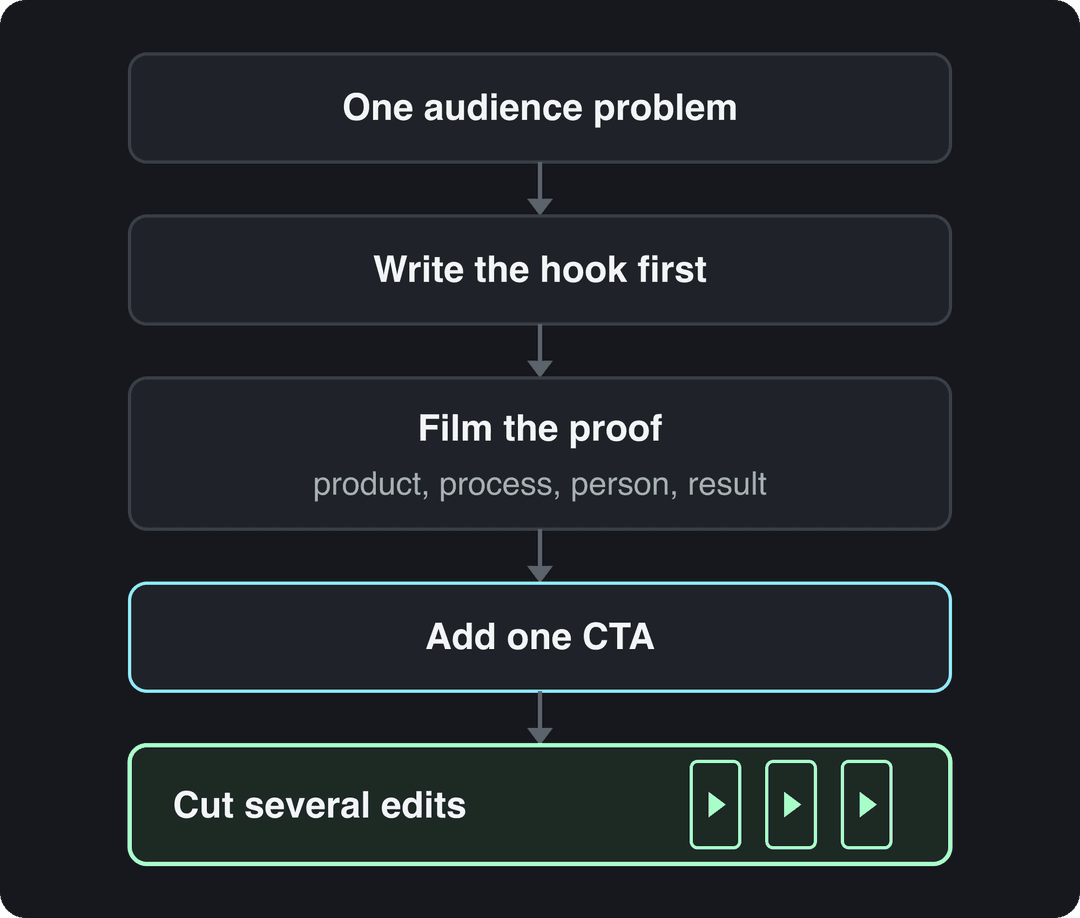
- Choose one audience problem.
- Write the opening line first, using a library of proven TikTok hooks as a starting point.
- Film the proof: the product, process, person or result.
- Add one CTA that matches the goal.
- Cut several different edits from the same footage instead of reposting one video.
Measure quality, not just views. In TikTok Studio analytics, track saves, shares, profile visits and comments that ask about price or availability, and match them against inquiries and sales. A video with fewer views that brings the right buyers is worth more than a broad trend that brings nobody.
TikTok is a sales channel, not only an awareness one. A 2025 US impact assessment linked to Oxford Economics estimated that small and medium businesses' paid advertising and marketing on TikTok drove $14.7 billion in revenue across 12 selected sectors in 2023 and was tied to 224,000 jobs. The figures are US-specific, but the Oxford Economics-linked impact assessment shows why each format should connect to a business result.
Organic posting does not have to carry everything. In Oxford Economics' 2024 study, 77% of SMEs posted mainly to their own TikTok accounts, 45% had used creator marketing and 42% had used TikTok's paid advertising features, as the Small Business and Entrepreneurship Council's summary reports. A sensible mix: post your own videos, work with creators, and put ad spend behind posts that have already proved they work.
TikTok also works best when it feeds the rest of your marketing: product pages, email, search and customer service. For that wider plan, see our guide to video marketing for small businesses and Alpha Omega Digital's overview of social media marketing services for eCommerce.
Do these TikTok video ideas work for UK businesses?
Yes. The formats are the same for UK small businesses; what changes is the detail. Use local references, spellings and prices in hooks and captions, and film places your customers recognize, from the high street to the local market.
Three practical differences:
- Posting times: Revid's timing data is in US Eastern time and includes English-language creators worldwide, so the strong early-morning US window also covers UK daytime. Check your own audience in TikTok Studio before fixing a schedule.
- Promotions: UK offers must follow the CAP Code enforced by the Advertising Standards Authority, so state terms and end dates clearly and label paid partnerships.
- Market data: the economic figures above are US studies; treat them as direction, not a UK forecast.
How to make these videos faster with Revid
Revid helps when the bottleneck is editing time, not ideas.
- For product videos, paste a product page URL into Revid's AI product video generator. It reads the page, keeps your real photos, writes the script and generates the video with a voice-over, captions and music.
- For format ideas, search Revid's library of about 2.77 million real short-form videos with their engagement data, open one that performs in your niche and choose "Make it about your topic" to apply its hook style and pacing to your business. This is how Revid lets you repurpose viral videos into original ones.
- Adjust any scene in the timeline editor, then publish or schedule directly to TikTok, Instagram and YouTube from one queue.
If a video uses realistic AI-generated images or footage, turn on TikTok's AI-generated content label; TikTok says the label does not affect distribution for videos that follow its Community Guidelines. Keep customer stories and facts real: use AI to speed up production, not to invent proof.
FAQ
How often should a small business post on TikTok?
As often as you can keep quality up, ideally several times a week. A 2024 Capterra survey of small and midsize retailers and restaurants marketing on TikTok found that 65% posted at least once a day. Batch filming is what makes that pace realistic.
What is the best time for a small business to post on TikTok?
Start early in the day, then check your own data. In Revid's analysis of English-language TikToks (times in US Eastern), posts at 3 to 6 a.m. had the best median views and 5 to 9 p.m. the weakest, and Saturday had the best median of any day (70K). TikTok Studio's Viewers tab shows when your own viewers were most active over the last 7 days.
How long should a small business TikTok be?
Length matters less than the first seconds. In Revid's 12-month sample of 176,367 TikToks, every length from under 15 seconds to 10 minutes had a median between 58K and 76K views, and videos under 15 seconds got the most shares per view (1.41 per 100). Make the video as long as the idea needs and no longer.
Can a business account earn money from TikTok's Creator Rewards Program?
No. The Creator Rewards Program requires a Personal account, and Business accounts are not eligible; it also requires 10,000 followers and 100,000 video views in the last 30 days. For a small business, TikTok pays off through sales, bookings and leads, which is why every video above ends with one clear action.
Sources
- Revid analysis of 176,367 TikToks with 1,000+ likes posted between Oct 1, 2025 and Oct 16, 2026 (61,203 creators)
Charts and figures checked on November 6, 2026.