10 Trending Social Media Topics in 2026, With a Video Idea Each
Ten social media trends shaping 2026, from AI content and Shorts series to social commerce and private communities, each with Revid data, platform rules and three video ideas.
On this page
The trending social media topics for 2026 are AI-generated content, short-form video (including serialized shorts), raw authentic posts, social commerce, mental health content, micro-influencers, audio turned into video, sustainability, interactive content and private communities. Each works best as a short vertical video built on a format audiences already watch.
The format you pick matters as much as the topic. In Revid's analysis of 176,367 TikToks with 1,000+ likes posted between October 2025 and October 2026, challenges had a median of 182K views and comedy 155K, while tutorials sat at 62K. The sample only holds videos that already passed 1,000 likes, so it shows what top performers share rather than proven causes; the full study of what makes a TikTok go viral explains the method.
Challenges and comedy passed 1M views about twice as often as tutorials and storytelling, which are the most common formats.
Source: Revid analysis of 176,367 TikToks with 1,000+ likes posted between Oct 1, 2025 and Oct 16, 2026 (61,203 creators)
Show the data
| Median views | Share that passed 1M views | |
|---|---|---|
| Challenge | 182.3K | 25.6% |
| Comedy | 154.8K | 22.1% |
| Reaction | 104.8K | 16% |
| Dance | 83.8K | 15.5% |
| Storytelling | 66.1K | 12.2% |
| Lip Sync | 61.7K | 12.3% |
| Tutorial | 61.9K | 12.1% |
Below, each trend gets what changed in 2026, the platform rules that apply, and three videos you can make this week. If your bigger problem is getting replies and shares on what you already post, SupGrowth's guide to strategies to increase social media engagement covers the basics.
- Median views for TikTok challenges, the top format (tutorials: 62K)
- 182K
- Revid analysis of 176,367 TikToks
- Gen Z who blocked, muted or unfollowed a brand or creator over AI slop
- 50%
- Sprout Social, March 2026
- Daily YouTube Shorts views
- 200B+
- YouTube Official Blog, August 2026
- US social commerce sales expected to pass this mark for the first time in 2026
- $100B
- EMARKETER, December 2025
The 10 trends at a glance
| Trend | Effort | What it gets you | First video to make |
|---|---|---|---|
| AI-generated content | Low to medium | More output, faster tests | "I let AI write this video" breakdown |
| Short-form video in series | Medium | Followers, not just views | A three-part series on one question |
| Authentic, low-polish posts | Low | Trust | Handheld behind-the-scenes tour |
| Social commerce and live shopping | High | Direct sales | Problem-to-product demo |
| Mental health and wellness | Low to medium | Saves and loyal followers | Animated grounding technique |
| Micro and nano influencers | Medium | Cheaper, trusted reach | Honest pros-and-cons review |
| Social audio and voice | Low | Personal connection | Podcast clip over a waveform |
| Sustainability and responsibility | Medium | Brand loyalty | Packaging or sourcing tour |
| Interactive content | Medium | Comments and audience research | "You decide" episode ending |
| Private communities | Medium, ongoing | Retention, less algorithm dependence | Teaser from a members-only session |
1. AI-generated content, and the backlash against AI slop
AI now writes scripts, captions and content calendars, and generates images and full video scenes. The 2026 version of this trend is not adopting AI; it is using AI without your feed looking mass-produced.
Audiences notice. Sprout Social research published in March 2026 found that 50% of Gen Z have already blocked, muted or unfollowed a brand or creator because their content felt like "AI slop", and 56% of consumers see AI slop often or very often in their feeds.
The platform changes the math. Revid's study of AI videos vs real footage found AI-generated TikToks averaged twice the views of real footage, while on X, Instagram and Threads AI visuals cluster in the lowest engagement tier. Decision rule: on TikTok, AI visuals carried by a strong idea can win; on Instagram, X and Threads, lead with real footage and use AI for scripting, editing and captions.
On YouTube, monetization is the bigger risk: AI content made with generic templates that looks mass-produced, without your own insight, is not allowed to monetize, while AI used to edit scripts or build background visuals is fine when the final video shows your creative vision. For the workflow side, Monetized Profiles has a practical piece on automating content creation for scale.
Posts with AI visuals
Source: Revid social index: 388,379 posts from X, Instagram, Threads, Reddit and LinkedIn with AI labels per post, snapshot of Sep 15, 2026.
Show the data
| Posts with AI visuals | |
|---|---|
| High engagement | 1.6% |
| Medium engagement | 2.9% |
| Low engagement | 6.7% |
Videos to make
- "I let AI write this video": show the prompt on screen, then the result, then your verdict on what it got wrong. The critique is the content.
- AI or real: put an AI-generated clip next to real footage, keep the AI label on, and ask viewers which side looks more convincing and why.
- The workflow screen recording: record yourself turning one idea into a week of posts with AI tools. In the same TikTok study, screen recordings had a 91K median, ahead of handheld (80K) and tripod (77K) footage.
2. Short-form video, now made in series
Short vertical video is still the default way people watch on social platforms. YouTube said in August 2026 that it sees over 200 billion daily Shorts views. Maximum lengths have stretched, but the reach rules have not:
| Platform | Maximum length | What to know |
|---|---|---|
| TikTok | 60 minutes uploaded (10 minutes with the in-app camera) | TikTok Studio shows when your viewers and followers are most active |
| YouTube Shorts | 3 minutes, square or vertical | Shorts over one minute with an active Content ID claim are blocked |
| Instagram Reels | 20 minutes | Reels over 3 minutes are not recommended to non-followers |
What is new is the series. In September 2026, YouTube began rolling out Shorts series, which organize Shorts into seasons and episodes across web, mobile and TV. Deloitte predicts in-app revenue from micro-series (serialized short video, also called micro-dramas) will more than double to $7.8 billion in 2026. A series gives viewers a reason to follow instead of watching once and scrolling on.
Speed matters too. Meta said same-day posts made up more than 30% of recommended Reels on both Instagram and Facebook in Q1 2026, more than double the level a year earlier. If a trend fits your niche, post while it is fresh instead of polishing for a week.
Input
A waitress discovers her fiance is secretly the heir to the empire that ruined her family. Episode 1 of a vertical drama series.
Output
Videos to make
- A three-part series on one question: episode one asks it, episode two tests it, episode three answers it. End each episode on the hook for the next.
- A micro-drama: a short scripted story with recurring characters. Revid's AI short drama generator turns a story idea into a vertical episode with consistent characters and voiced dialogue.
- The best moment of a long video: cut the strongest segment from a podcast or YouTube video, add captions, and post it as a standalone Short.
3. Authentic, low-polish content
BeReal's breakout in 2022 crystallized a reaction against curated feeds. The app's moment passed; the taste for unfiltered, real-life content stayed. Behind-the-scenes clips, honest mistakes and unscripted moments build trust faster than polished ads.
Authentic does not have to mean talking into your selfie camera. In the same Revid TikTok study, faceless videos had a median of 114K views against 67K for one person on camera, and by shooting style, POV footage (107K) and handheld (80K) far outperformed selfie videos (48K). Real beats posed, and the camera can point at the work, the place or the product rather than your face.
Videos to make
- A handheld behind-the-scenes tour of your workspace, kitchen or stockroom, with one short story about one object.
- A POV day in the life: film from your own eye line, including the unglamorous parts.
- A "what went wrong" post: a recent mistake and what you changed, told in on-screen text over footage of the actual work.
4. Social commerce and live shopping
Shopping now happens inside the feed: TikTok Shop, Instagram Shopping and live streams where a creator demos products in real time. EMARKETER forecast in December 2025 that US social commerce sales would surpass $100 billion for the first time in 2026. In Bazaarvoice's Shopper Preference Report 2025, nearly 46% of shoppers said short-form videos (TikTok, Reels and YouTube Shorts) are the most influential format for purchase decisions, one of the sourced UGC statistics Revid tracks.
Check eligibility before you plan a live event:
- TikTok LIVE requires being at least 18 with 1,000 followers (the follower threshold may vary by region).
- TikTok Shop affiliates in the US must self-apply, be at least 18 and have at least 1,000 followers; creators under 5,000 followers start in a pilot program for at least 30 days.
Videos to make
- A problem-to-product demo: open on the problem, show the product solving it, end with one call to action ("tap the shopping bag to get yours").
- A live try-on or get-ready-with-me stream, with a discount code only for people watching live.
- A customer montage: real customer clips, used with permission, with their review text on screen and the products tagged.
If you sell online, Revid can draft the first demo: paste a product page into the AI product video generator and it keeps the real photos, writes the script and generates the video.
5. Mental health and wellness content
Therapists explaining psychological concepts, guided breathing clips and creators speaking honestly about burnout have made wellness one of the most-watched categories. It also attracts the most misinformation. Revid's fact-check of 3,000 viral health TikToks found that mental health was the biggest claim category (18% of claims), and that 66% of claims cited no evidence or only a personal story.
The rules are simple: share general wellness practices, never diagnosis or treatment advice, and point viewers to professional resources. On YouTube, channels using AI-generated personas presented as human experts giving health advice are not allowed to monetize.
Prompt to try
Create a 45-second vertical video explaining the 5-4-3-2-1 grounding exercise. Open with the hook "Feeling overwhelmed? Try this in under a minute." Use calm nature visuals, soft music and large on-screen text for each step, and end with a reminder to save the video and seek professional help if needed.
Videos to make
- A one-minute reset: calm visuals and a breathing pattern on screen, with a line like "Take 60 seconds to reset your day."
- A routine you actually follow: a morning stretch, a journaling habit or an end-of-workday ritual.
- An animated technique: the 5-4-3-2-1 grounding exercise explained step by step in on-screen text, made to be saved.
6. Micro and nano influencer marketing
Brands are spreading budgets across many smaller creators: micro-influencers (10K to 100K followers) and nano-influencers (1K to 10K). Collabstr's 2026 report found UGC campaigns more than doubled in 2025, rising from 15% to 35% of all influencer campaigns on its marketplace, and in Influencer Marketing Hub's 2026 benchmark roughly 80% of responses put UGC creator costs under $500.
Trust comes from honesty. In Bazaarvoice's Shopper Preference Report 2025, 43% of shoppers said they trust creators who share both the pros and cons of a product, and at least 44% said they lose trust when creators refuse to mention flaws.
If you are a brand, pick creators by audience fit and engagement rather than follower count, through marketplaces such as Aspire, Grin or Collabstr. If you are a creator, your niche is the pitch.
Videos to make
- An honest review that names one real downside next to the strengths.
- A collab with an adjacent niche (a trainer and a meal-prep cook), each posting their own cut and tagging the other.
- A day running a brand deal: the brief, the unboxing, the filming and the edit.
7. Social audio and voice content
Live audio peaked with Clubhouse in 2021, and X Spaces kept the format going, while voice notes keep conversations personal in Instagram DMs. Its best use in 2026 is as raw material: one good conversation becomes a week of short videos.
Cut hard. In Revid's TikTok study, videos with under 40 characters of speech had a 123K median, while videos talking throughout had 68K. Pull the single strongest line, not the whole answer.
Videos to make
- A podcast or Spaces clip over a waveform animation or a scrolling transcript with the keywords highlighted.
- A behind-the-mic clip of your setup, with one quote from the session on screen and a pointer to the full episode.
- One question per video: turn the best answers from a live Q&A into separate shorts, with the question as on-screen text.
8. Sustainability and social responsibility content
Audiences expect brands to show their values, not announce them. Patagonia's long-running environmental activism is the usual reference point. Specific, checkable facts (what you changed, by how much, since when) beat vague words like "eco-friendly", which invite skepticism.
Videos to make
- A sourcing or packaging tour that shows the actual material and where it comes from.
- A nonprofit partnership told from the cause's side: let the organization's work lead and keep your logo small.
- A practical how-to: easy ways to cut plastic at home, or how to upcycle an old T-shirt.
9. Personalized and interactive content
Polls, quizzes, question stickers, AR try-on filters and comment-driven follow-ups turn viewers into participants. You get comments plus free audience research: the poll tells you what to make next.
Challenges, the top format in Revid's TikTok study, are interactive by design: viewers copy the idea and tag you.
Videos to make
- "You decide": end with a clear choice and make the winning option next. Revid's "Post the Part 2" remix creates a sequel that answers the question a video leaves open.
- A quiz video: a multiple-choice question on screen, a countdown, then the answer and a prompt to comment whether they got it.
- Your own challenge: set a simple prompt with a sound or filter, then compile the best entries and tag every creator.
10. Community building and private social groups
The shift from public broadcasting to private spaces (Facebook Groups, Discord servers, Patreon memberships) keeps growing. Public platforms rent you an audience; a private group lets you reach members without the algorithm, and their questions become your content plan.
Videos to make
- A pinned welcome video that explains the rules, the benefits and asks new members to introduce themselves.
- A public teaser of a members-only Q&A or event, with the link in your bio.
- Member results: a compilation of wins and comments from the group, shared with permission.
How to turn a trend into a video with Revid
The flow is the same for every trend above: find a version that already works, adapt it to your niche, and post it while the trend is fresh.
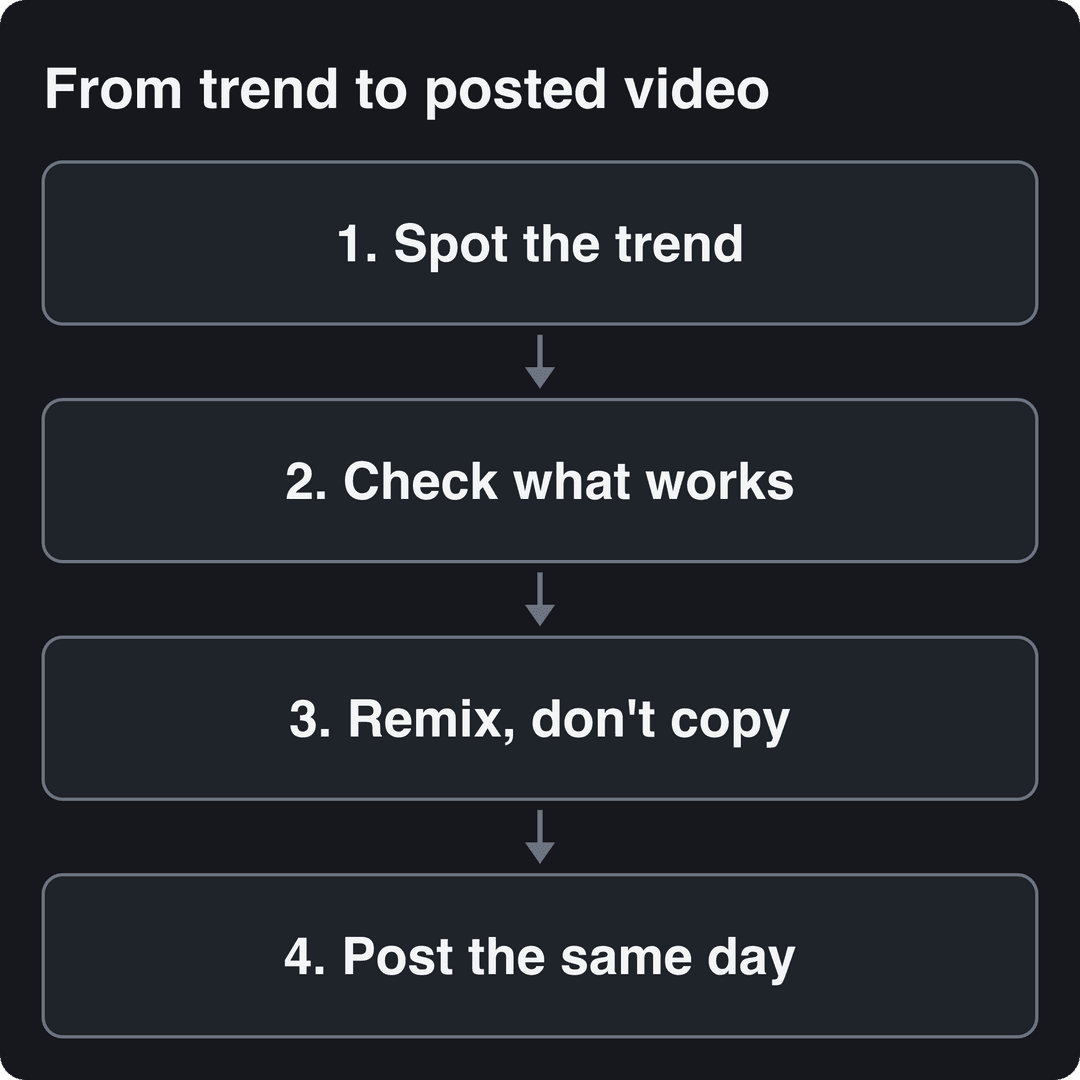
- Search Revid's library of about 2.77 million real short-form videos by topic, platform and engagement tier to find viral videos to repurpose for the trend.
- Run a Deep analysis (free, up to 60 a day) on the best match. It breaks down the hook, the timed structure and three ways to adapt the video to another niche.
- Choose "Make it about your topic" or "Same energy, new script". Revid writes a new script, visuals, voice-over, captions and music direction instead of copying the original.
- Fix anything in the timeline editor, then publish or schedule to TikTok, Instagram and YouTube from one queue.
Visuals can come from stock footage, AI images or AI video models (Seedance 2.5, MiniMax Hailuo H3, Wan 3.0 and Google Veo 3), chosen scene by scene.
How to choose which trends to cover
Two or three trends done every week beat ten done once. Match them to your situation:
- If you sell physical products: social commerce plus micro-influencer and customer videos.
- If you post solo with little time: AI-assisted video and audio repurposing.
- If you would rather not show your face: POV and handheld footage, AI visuals and interactive formats.
- If you work in health or finance: wellness and education with sources, never personal advice.
- If you already have a loyal core audience: a private community fed by a recurring series.
For day-to-day movement inside these trends, track trending TikTok hashtags by niche, and use this guide to finding trending topics that drive results to decide which ones deserve a video.
FAQ
How often do social media trends change?
Daily trends such as sounds, hashtags and memes turn over in days, while broad shifts like AI content, series, social commerce and private communities hold for the year. Build your strategy on the broad shifts and use daily trends as hooks.
Does labeling a video as AI-generated reduce its reach?
No. TikTok says its AI-generated label does not affect distribution for videos that follow its Community Guidelines, and YouTube says disclosure alone does not limit a video's audience or its eligibility to earn.
How many hashtags should a trending post use?
On TikTok, 3 to 4: in Revid's study, 4 hashtags had the best median (77K views) while 9 or more had only 16K. Instagram allows up to 5 hashtags per post, and a caption with more will not post.
What is the best social media trend for small businesses?
Social commerce, paired with short product demos and customer videos. It connects a video to a sale in one tap, and demos and customer clips are cheap to produce.
Can I follow trends without showing my face?
Yes. POV footage, screen recordings, voice-over on product or B-roll footage and AI visuals all work, and faceless TikToks outperformed one person on camera in Revid's data.
Sources
- Revid analysis of 176,367 TikToks with 1,000+ likes posted between Oct 1, 2025 and Oct 16, 2026 (61,203 creators)
- Revid social index: 388,379 posts from X, Instagram, Threads, Reddit and LinkedIn with AI labels per post, snapshot of Sep 15, 2026.
- Sprout Social, Social Media is Now the Top Source for Breaking News, New Sprout Social Research Finds (press release) (March 2026)
- YouTube Official Blog, New opportunities to earn and changes to the YouTube Partner Program (August 2026)
- EMARKETER, TikTok Shop Makes Up Nearly 20% of Social Commerce in 2025 (press release) (December 2025)
Charts and figures checked on November 6, 2026.