Voice Over Script Examples: Copy-Ready Scripts for Every Format
Copy-ready voice over script examples for commercials, short-form videos, documentaries, e-learning, audiobooks, video games and podcasts, with the markup pros use and how to time each one.
On this page
A voice over script is the exact words a narrator says, written for the ear, matched line by line to the visuals and cut to fit the runtime. The examples below cover commercials, short-form social videos, documentaries, e-learning, audiobooks, video games and podcasts, each with a copy-ready sample and the markup pros use.
Most scripts fail by saying too much. In Revid's study of 176,367 TikToks with 1,000+ likes, videos with only a line or two of speech had nearly double the median views of videos narrated from start to finish (123K vs 68K). Write less, and make every line do a job the picture can't.
- Median TikTok views when the video has under 40 characters of speech
- 123K
- Revid analysis of 176,367 TikToks
- Median TikTok views when speech runs throughout (300+ characters)
- 68K
- Revid analysis of 176,367 TikToks
- Share of TikToks with under 40 characters of speech that passed 1M views
- 20.2%
- Revid analysis of 176,367 TikToks
- AI voices available in Revid's voiceover video maker, in 70+ languages
- 1,000+
- Revid
How to format a voice over script
A voice over script tells the narrator three things: what to say, how to say it, and when. Use the same markup in every script so any voice actor (or AI voice) can read it cold.
| Element | How to write it | Example |
|---|---|---|
| Speaker label | Caps, before the line | VO: / HOST: |
| Delivery note | Parentheses, before the line | (warm, unhurried) |
| Pause | On its own line | (PAUSE) or (BEAT) |
| Emphasis | Caps on the one word that carries the meaning | the FIRST cup |
| Pronunciation | Phonetic spelling in brackets | Nguyen [WIN] |
| Sound or visual cue | Square brackets | [SFX: grinder whir] |
| Numbers and URLs | Written the way they are spoken | morningside dot com |
For any script tied to video, use the two-column AV format: visuals on the left, audio on the right, one row per beat. It shows at a glance whether a line is fighting the picture or filling a silence that should stay silent.
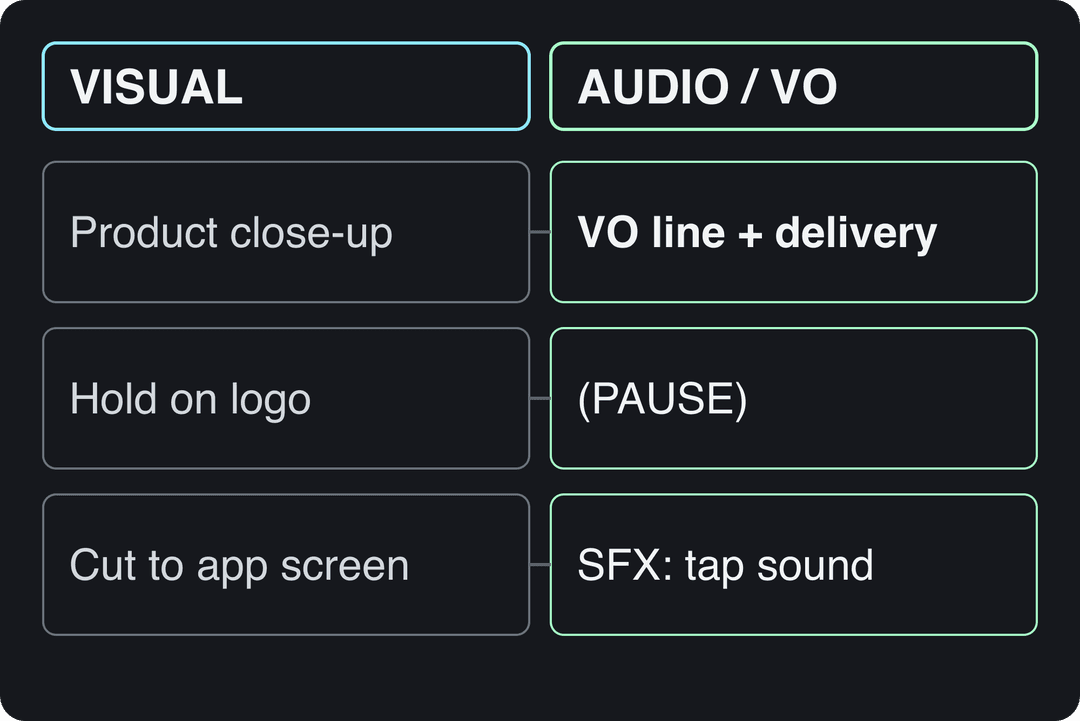
Commercial voice over script example
Commercial scripts sell one benefit in 15, 30 or 60 seconds and end with a single next step. The classic structure is problem, solution, proof, call to action. Here is a 30-second spot for a fictional coffee subscription:
[SFX: alarm buzzing]
VO (dry, a little tired): Your alarm goes off. Again.
VO: And the coffee tastes like yesterday.
[SFX: grinder whir]
VO (brighter): Morningside beans are roasted the week they ship,
so the FIRST cup actually wakes you up.
VO: Pick your roast. Pick your schedule. Skip anytime.
(PAUSE)
VO (slow, clear): Morningside. Coffee worth getting up for.
VO: Start your first bag at morningside dot com.Why it works
It opens on a feeling the listener had this morning, turns the feature (fresh roasting) into a benefit (you actually wake up), and gives one instruction. The brand name lands after a pause, when the listener is paying attention.
Tips for commercial scripts
- Hook in the first three seconds. Open with a statement of the problem rather than a slow setup. Among TikToks with over 100 million views in Revid's index, 51% of those with a transcript open with a statement and 16% with a question, according to Revid's 100M Club analysis.
- One message per spot. If you have three benefits, you have three ads.
- Write the CTA as spoken words. Say the URL the way a person would say it, and keep it to one action.
- Read it aloud against a stopwatch. If you have to rush to fit, cut a line instead of speeding up.
If you start from a product page rather than a blank page, an AI ad generator can draft the script and visuals, which you then tighten with the rules above.
Prompt to try
Make a 30-second vertical ad for a fresh-roasted coffee subscription. Open with the hook "Your alarm goes off. Again." over a tired morning scene, then show beans being ground and a first cup steaming. Keep the voice over to a few short lines, warm and dry in tone, and end with one spoken call to action.
Short-form video voice over script (TikTok, Reels, Shorts)
Short-form scripts are the opposite of documentary narration: the hook is spoken in the first breath, and the voice over stops the moment the visuals can carry the story.
In Revid's analysis of 176,367 TikToks with 1,000+ likes posted between October 2025 and October 2026, videos with under 40 characters of speech had a median of 123K views and 20.2% passed 1M views. Videos with speech running throughout (300+ characters) had a 68K median and 11.9% past 1M, and silent videos sat in between at 73K and 14.3%. The sample only includes TikToks that already reached 1,000+ likes, so this shows what strong videos have in common, not a guaranteed cause. The full method is in the study what makes a TikTok go viral.
Videos with just a few spoken words (a line or two) beat both silent videos and videos that talk the whole way through, which were the most common and the weakest.
Source: Revid analysis of 176,367 TikToks analyzed by AI, with 1,000+ likes posted between Oct 1, 2025 and Oct 16, 2026 (61,203 creators)
Show the data
| Median views | Share that passed 1M views | |
|---|---|---|
| No speech | 73.3K | 14.3% |
| Under 40 | 122.7K | 20.2% |
| 40 to 120 | 97.2K | 17.6% |
| 120 to 300 | 91.6K | 16.8% |
| 300+ | 67.7K | 11.9% |
The decision rule: if the visuals tell the story, keep the voice over to the hook and the payoff. If the video teaches, keep narration but cut every line that describes the screen. Here is a faceless cooking tip written that way:
[ON SCREEN: Stop rinsing your pasta]
VO (direct, quick): Stop rinsing your pasta.
VO: That cloudy water is starch, and it's what makes sauce stick.
VO: Scoop out a mug of it before you drain.
[VISUAL: pasta tossed in pan, water splashed in, stirred hard]
(no VO: let the sauce turn glossy on screen)
VO: Glossy sauce, no cream. Follow for the next kitchen fix.The first line works as both the spoken hook and the on-screen text, so viewers watching on mute get it too. For more opening lines in this style, browse these copy-and-paste TikTok hooks.
Prompt to try
Create a 25-second faceless cooking tip video titled "Stop rinsing your pasta." Speak the hook in the first breath and show it as on-screen text, explain in one line that the cloudy water is starch that helps sauce stick, then let the glossy sauce play with no narration. Close with "Follow for the next kitchen fix."
The index leans toward videos that surface in hashtag and keyword searches, so its view counts run high: compare the groups, not the absolute numbers.
Source: Revid TikTok index: 2,377,477 TikToks with AI labels per video, snapshot of Sep 15, 2026. Median views estimated from view buckets.
Show the data
| Median views | Share past 1M views | |
|---|---|---|
| Animal-focused | 273.2K | 36.3% |
| Faceless | 199.4K | 29.7% |
| Object-focused | 143.1K | 24.9% |
| Group-focused | 140.3K | 23.7% |
| Person-focused | 104.8K | 21.8% |
Documentary narration script example
Documentary narration builds trust. It explains why what's on screen matters, then gets out of the way so the footage can land. Think of David Attenborough on Planet Earth: long silences, short lines.
[VISUAL: dawn over a dry riverbed]
VO (measured, low): For most of the year, this river is a road of cracked mud.
(PAUSE)
VO: Then the rains arrive upstream, and everything here starts a countdown.
[VISUAL: herd moving across the plain]
VO: The herds don't wait for the water. They walk toward it.
(PAUSE: let the crossing play without narration)
VO (quieter): Not all of them will reach the other side.Tips for documentary scripts
- Verify every fact. One wrong number undoes the authority the narration depends on.
- Write cause and consequence, not labels. Not "the lion is hunting" but why this hunt matters to the pride.
- Script the silences. Mark (PAUSE) wherever a shot needs room; the editor and narrator will thank you.
- Give the film an arc. A question at the start, tension in the middle, a resolution at the end.
E-learning voice over script example
E-learning scripts exist to make a learner able to do something by the end. State the objective, teach one idea at a time, and signpost every transition so the learner always knows where they are.
VO (friendly, clear): By the end of this lesson, you'll be able to spot
a phishing email before you click anything.
(PAUSE)
VO: First, check the sender. Not the name: the address.
[VISUAL: cursor highlights the sender address]
VO: Next, hover over the link without clicking. Does the address match the company?
(PAUSE)
VO: Finally, watch for urgency. Real IT teams rarely say act NOW.
VO: To review: sender, link, urgency. Let's try one together.The video above shows how a narrator reads an e-learning script: slower than a commercial, with clear stops after each key term.
Tips for e-learning scripts
- Plain words over polish. Cut jargon, or define it the first time it appears.
- Pause after every key concept. Learners need a beat to process before the next idea.
- Signpost out loud. First, next, to review: these phrases are the learner's map.
- Don't read the slides. The voice over explains; the screen shows.
The same structure works for product walkthroughs; see how to script an explainer video for the marketing version.
Audiobook narration: how to mark up the script
In audiobooks the script is the book, so the work is preparation, not writing. A narrator may hold a single voice for 10, 20 or even 40-plus hours, and a minor character in chapter three has to sound the same in chapter thirty. Jim Dale's Harry Potter recordings and Roy Dotrice's A Game of Thrones are famous precisely for that consistency.
Mark up a passage like this before recording:
The door opened before she knocked. (BEAT)
MARTA (dry, clipped, older): You're late.
NARRATION (neutral, slightly slower): Eli didn't answer. He was looking past her,
at the light still on in the kitchen.
ELI (soft, younger, hesitant): Is he awake?Then keep a character voice log so every choice is recorded:
| Character | Pitch | Pace | Texture or accent | Reference line |
|---|---|---|---|---|
| Marta | Low | Clipped | Dry, slight rasp | You're late. |
| Eli | Higher | Hesitant | Soft, breathy | Is he awake? |
| Narration | Your natural voice | Steady | Neutral | The door opened... |
Attach a short audio sample to each row. Read the whole book before the first session, and choose character voices you can sustain for hours without strain.
Video game voice over script example
Game scripts are spreadsheets, not pages. Every line has a trigger, a context and a file name, because the engine plays it when the player does something. Repeated actions need several variations or players hear the same line until they hate the character.
| File name | Trigger | Line | Direction |
|---|---|---|---|
| Mara_Combat_Reload_A | Reloading in combat | Cover me, I'm dry. | (shouting over gunfire) |
| Mara_Combat_Reload_B | Reloading in combat | Reloading, keep their heads down. | (breathless) |
| Mara_Combat_Reload_C | Reloading in combat | Hold on, hold on. | (muttered, focused) |
| Mara_Explore_Idle_A | Player idle while exploring | We can't stay here all day. | (impatient, quiet) |
| Mara_Story_Ch3_Goodbye | Story cutscene | Don't make me say it twice. | (holding back tears) |
Tips for game scripts
- Write a character bible first. Backstory, personality and vocal description keep thousands of lines consistent across many sessions.
- Name files by character, context and action. The original convention CharacterName_Combat_Attack_01 lets developers find any line fast.
- Put direction on every line. Actors often record out of order and without visuals; the note is their only context.
Podcast intro and outro script example
Intros and outros are a show's audio branding: the same music, tone and wording every episode. Keep the intro under 60 seconds and the outro under 30 seconds. They sit inside a bigger plan for the show, which Fame's guide to planning a podcast covers well.
INTRO
[THEME MUSIC: up, then under]
HOST (upbeat, relaxed): Welcome to Small Shop Talk, the show where independent
owners share what actually moved their sales. I'm Dana Reyes.
HOST: Today: how a family bakery built a waitlist without paid ads.
[SPONSOR SLOT: recorded separately, swappable]
[THEME MUSIC: out]

OUTRO
HOST (warm): That's the episode. If it helped, follow Small Shop Talk
wherever you listen, and send it to a friend who runs a shop.
HOST: See you next week.
[THEME MUSIC: up to end]Record sponsor reads and date-specific lines as separate files so you can swap them without re-recording the whole intro. To tease the episode on social, cut a short clip with a podcast clip generator.
Voice over script types compared
| Script type | Typical length | Tone and pace | Markup that matters | Common mistake |
|---|---|---|---|---|
| Commercial | 15, 30 or 60 seconds | Warm or urgent, tight | Timing per line, one CTA | Listing features instead of one benefit |
| Short-form social | A hook plus a few short lines | Conversational, fast | On-screen text cues | Narrating what's already on screen |
| Documentary | Minutes to feature length | Measured, authoritative | Pauses for visuals | Talking over the best shots |
| E-learning | Short modules | Clear, patient | Signposts, pauses after key terms | Reading the slides word for word |
| Audiobook | 10 to 40+ hours | Sustained, varied by character | Character voice log | Drifting character voices |
| Video game | Thousands of short lines | Varies by trigger | File names, triggers, direction | Too few variations for repeated actions |
| Podcast intro and outro | Intro under 60 s, outro under 30 s | Matches the show | Separate sponsor slot | Long intros that delay the episode |
How to write a voice over script, step by step
- Write the one message in a sentence. If you can't, the script isn't ready to draft.
- Map the visuals first. Fill the left column of the AV table, then write only the audio each shot needs.
- Write for the ear. Short sentences, contractions, one idea per sentence, numbers and URLs spelled as spoken.
- Mark delivery. Add delivery notes, (PAUSE) cues, emphasis in caps and phonetic spellings.
- Read it aloud with a stopwatch. Cut lines until it fits the runtime at a relaxed pace, with room for a pause before the CTA.
- Record or generate the voice. For a human read, the microphone matters more than the room suggests; Gear Supply's microphone guide explains the main types.
If you draft with an AI writer, edit for rhythm by ear. A rewriting tool such as Smartstudi's AI text humanizer can smooth robotic phrasing, but reading the script aloud is still the real test. For structure beyond voice over, see this guide on how to write video scripts.
Turn your script into a voice over video with Revid
When the script is for a short-form or explainer video, Revid turns it into a finished, voiced video:
- Draft the script yourself or with the AI script generator. In several Revid tools, the script writer first pulls transcripts of related TikToks with more than 10,000 likes and uses them as references for style and story.
- Paste it into the voiceover video maker and choose from 1,000+ AI voices in 70+ languages (voice cloning is available on Elite and above).
- Add pauses where your (PAUSE) cues are, following how to add a pause in a Revid voice.
- Revid generates scene visuals, synced captions and music; adjust any scene in the timeline editor.
- Export in 720p, 1080p or 4K, or publish directly to TikTok, Instagram and YouTube.
FAQ
How long should a 30-second voice over script be?
As long as you can read aloud at a relaxed pace inside the runtime, with room for a pause before the call to action. Time it with a stopwatch rather than counting words, because pace varies by voice, language and tone.
What is the difference between a voice over script and a screenplay?
A screenplay describes scenes and dialogue for actors on camera; a voice over script contains only what the narrator says, with delivery notes, pauses and cues tied to visuals. For video work, the two-column AV format keeps the visuals and narration side by side.
Can AI write a voice over script?
Yes, AI can draft a solid first version, especially from a reference or outline. Edit it by reading aloud: cut lines that describe the screen, shorten sentences and check every fact.
Do I have to label an AI voice over?
It depends on the platform and how realistic it is. TikTok requires a label on content with realistic AI-generated images, audio or video; YouTube does not require disclosure for AI-written scripts or cloning your own voice for voiceovers, but does for making a real person appear to say something. Both say the label alone does not reduce a video's reach.
Sources
- Revid analysis of 176,367 TikToks analyzed by AI, with 1,000+ likes posted between Oct 1, 2025 and Oct 16, 2026 (61,203 creators)
- Revid TikTok index: 2,377,477 TikToks with AI labels per video, snapshot of Sep 15, 2026. Median views estimated from view buckets.
Charts and figures checked on November 6, 2026.