What Makes a Video Go Viral? 9 Factors Backed by 176K TikToks
A video goes viral when it hooks fast, triggers a strong emotion and gives people a reason to share. Here are the 9 factors, with Revid's data on 176,367 TikToks.
On this page
A video goes viral when it stops the scroll in the first seconds, triggers a strong emotion (humor, outrage, awe), makes sense instantly without sound or context, and gives people a reason to share it. Platforms show every video to a small test audience first, then keep widening its reach while watch time and shares hold up.
What matters less is just as useful to know. In Revid's analysis of 176,367 TikToks with 1,000+ likes posted between October 2025 and October 2026, every length bucket from under 15 seconds to 10 minutes landed between 58K and 76K median views, while challenge videos reached 182K and outrage-driven videos 156K. Format and emotion moved views far more than length or polish. The full method and every chart are in our study of what makes a TikTok go viral.
- Median views of challenge TikToks, the top format
- 182K
- Revid analysis of 176,367 TikToks
- Median views of TikToks with outrage as the dominant mood
- 156K
- Revid analysis of 176,367 TikToks
- Median views of faceless TikToks, vs 67K for one person on camera
- 114K
- Revid analysis of 176,367 TikToks
- Share of TikToks with 1,000+ likes that passed 1 million views
- 11.9%
- Revid 12-month TikTok study
The 9 factors that make a video go viral
| Factor | What it means | What to do |
|---|---|---|
| 1. Hook | Viewers decide in the opening seconds | Show the payoff or the problem in the first 3 seconds |
| 2. Strong emotion | Humor, outrage and awe get shared; mild inspiration much less | Pick one emotion per video and build to it |
| 3. Proven format | Challenges, comedy and reactions outperform other formats | Start from a format already working in your niche |
| 4. Visual storytelling | The video works with the sound off | One subject per shot, on-screen text, captions |
| 5. Shareability | A reason to send it to someone | Make it useful, surprising or about a specific kind of person |
| 6. Relatability | Viewers see themselves in it | Specific everyday situations, honest tone |
| 7. Timing and trends | It joins a conversation already happening | Act on rising trends early, post when your viewers are active |
| 8. Participation | Viewers can copy it or reply to it | A simple, repeatable format with a clear prompt |
| 9. Distribution | Someone with an audience passes it on | Collaborations, duets and stitches, cross-posting |
A note on the data below: Revid's index only holds TikToks that already reached 1,000+ likes, so the figures compare videos that did reasonably well and show what the best performers have in common, not proven causes. Format, shooting style and mood come from Revid's AI analysis of each video. The patterns are TikTok data, but they line up with what works on Instagram Reels and YouTube Shorts.
1. A hook that works in the first 3 seconds
On a swipe feed, the first frame and first line are the whole pitch. If a viewer can't tell within 3 seconds what they will get or why it matters, they swipe, and the platform reads that as a weak video.
Strong hooks do one of four things: show the end result first, make a bold claim, open a loop the viewer needs closed, or break the visual pattern of the feed. Sample openers you can adapt:
- "Stop doing this if you want your plants to survive the winter."
- "Nobody tells you this before you sign your first lease."
- "Watch the left side of the screen."
- "I changed one thing in my morning routine and my coworkers noticed."
Hook types and when to use them:
| Hook type | Example opener | Best for |
|---|---|---|
| Result first | "This is the same room, one weekend later." | Makeovers, recipes, before-and-after |
| Bold claim | "Most people stretch the wrong way before running." | Tips, myths, expert takes |
| Open loop | "The last one is the reason I quit." | Lists, stories, rankings |
| Pattern break | An unexpected object, sound or angle in the first frame | Comedy, visual tricks |
| Direct callout | "If you work night shifts, watch this." | Niche advice, relatable content |
The hooks that fail are predictable: a logo intro, "hey guys, welcome back", a slow pan before anything happens, or an explanation before the viewer has seen why they should care. Cut straight to the moment that makes the video worth watching, then fill in context.
For more, browse a library of copy-and-paste TikTok hooks sorted by type.
Prompt to try
Make a 30-second vertical video about winter houseplant care that opens with the hook "Stop doing this if you want your plants to survive the winter." Show the common mistake first, then three quick fixes with close-up shots of hands and soil, short on-screen text for each tip, and end on a thriving plant.
2. A strong emotion: why humor and outrage spread
People share what makes them feel something strongly, and the data shows which feelings travel. In Revid's 12-month TikTok study, videos with outrage as the dominant mood had a 156K median and 23.7% passed 1 million views. Humor came next at 121K (19.3% past 1M), then sadness at 104K. Inspirational videos had a 45K median, and only 11.3% passed 1M.
High-arousal emotions (outrage, humor, sadness) earned the most views. Calm, inspirational videos earned the least, even though they collect the most likes per view.
Source: Revid analysis of 176,367 TikToks with 1,000+ likes posted between Oct 1, 2025 and Oct 16, 2026 (61,203 creators)
Show the data
| Median views | Share that passed 1M views | |
|---|---|---|
| Outrage | 156K | 23.7% |
| Humor | 121K | 19.3% |
| Sadness | 104.4K | 16.5% |
| Excitement | 92.5K | 15.9% |
| Joy | 89.9K | 18% |
| Informative | 64.1K | 11.2% |
| Neutral | 61.2K | 11.5% |
| Inspirational | 44.6K | 11.3% |
The lesson: high-arousal emotions (laughing, being annoyed, being shocked) push people to comment and share; gentle uplift gets a like and a scroll. Pick one emotion per video and build every shot toward it. If you make inspirational content, add tension first (a problem, a setback, a stake) so the payoff lands.
The brand videos that spread followed the same rule. Old Spice's "The Man Your Man Could Smell Like" was built on absurd humor, Dollar Shave Club's launch video on deadpan self-mockery, and Dove's Real Beauty Sketches and Thai Life Insurance's ads on sadness followed by surprise. None of them tried to make viewers feel everything at once.
A simple structure for an emotional video:
- Open on the trigger: the joke setup, the injustice, the problem.
- Raise the stakes once with a twist, a complication or a worse outcome.
- Release it with the punchline, the reveal or the resolution.
- End fast. The last beat should be the strongest one, not a recap.
3. A format audiences already watch
Some formats start with an advantage. In the same study, challenges had a 182K median (25.6% past 1M), comedy 155K (22%), reactions 105K (16%) and dance 84K. Storytelling (66K, 12.2%) and tutorials (62K, 12.1%) sat near the overall median of 64.4K.
Challenges and comedy passed 1M views about twice as often as tutorials and storytelling, which are the most common formats.
Source: Revid analysis of 176,367 TikToks with 1,000+ likes posted between Oct 1, 2025 and Oct 16, 2026 (61,203 creators)
Show the data
| Median views | Share that passed 1M views | |
|---|---|---|
| Challenge | 182.3K | 25.6% |
| Comedy | 154.8K | 22.1% |
| Reaction | 104.8K | 16% |
| Dance | 83.8K | 15.5% |
| Storytelling | 66.1K | 12.2% |
| Lip Sync | 61.7K | 12.3% |
| Tutorial | 61.9K | 12.1% |
That does not mean tutorials can't go viral. Faceless tutorials (hands, screen recordings, animations) had a 156K median, three times the 52K of tutorials with a person talking on camera. If you teach, show the thing being done rather than a face explaining it. The same gap shows up in comedy: faceless comedy had a 327K median against 136K for comedy with a person on camera.
To find the formats already working in your niche:
- Search your topic on TikTok, Reels and Shorts, and note videos with far more views than the account usually gets.
- Write down the format of each one (challenge, reaction, POV, list, before-and-after), not the topic.
- Pick the format that shows up most often and make your own version with your angle.
- Post several videos in that format before judging it. One upload is not a test.
4. What visual elements make a video go viral?
Viral videos are built to be understood with the sound off and at a glance. The visual storytelling patterns in Revid's data are consistent:
- Perspective: POV videos had a 107K median (19% past 1M), screen recordings 91K, handheld 80K, tripod 77K. Selfie-style videos were lowest at 48K (9.2%).
- Speech: videos with almost no speech (under 40 characters) had a 123K median and 20.2% passed 1M. Silent videos reached 73K; videos talking throughout, 68K.
- Clarity: the best performers show the action instead of describing it.
Turn that into a shot checklist:
- One clear subject per shot, filling the frame.
- Change something on screen often: a cut, a zoom, a new angle, a reveal.
- Put the key line in on-screen text, and add captions to anything spoken with a caption generator.
- Keep text and faces away from the edges, where app buttons cover them.
- End on the payoff, or on a frame that loops smoothly back to the start.
Illusion videos show how far pure visuals carry. Zach King's Hogwarts trick, an 18-second clip with 2.1B views, sits at the top of Revid's list of the most viewed TikTok videos, and it needs no words to work.
The aesthetic video elements that go viral are less about polish than legibility on a small screen:
| Element | What works | What hurts |
|---|---|---|
| Lighting | Soft, even light on the subject, natural daylight | Backlit faces, dim rooms |
| Color | High contrast between subject and background | Busy backgrounds that compete with the subject |
| On-screen text | Short lines, large type, high contrast | Paragraphs of text, small fonts near the edges |
| Pacing | A visual change whenever attention could drop | Long static shots with no new information |
| Sound | A clear voice or a sound that matches the action | Music that drowns out speech |
When big production does go viral, it is because the spectacle is the story. Red Bull's stunt films and OK Go's one-take music videos spread because viewers wanted to show someone what they had just seen, not because of the camera behind them.
5. A reason to share it
Shares are the scarcest signal and the one that spreads a video to new people. Across the TikToks in Revid's study, viewers liked at a rate of 7.1% of views but shared at only 0.88%, so a video that earns shares stands out.
People share for a few reasons: it's useful ("save this for later"), it says something about them or a friend ("this is so you"), it's surprising enough to pass on, or it supports a cause they care about. Short clips get passed around most: videos under 15 seconds had the most shares per view, 1.41 per 100 views.
To invite shares, end with a prompt aimed at a specific person, not a generic "share this": "Send this to the friend who still hasn't replied to the group chat."
| Share trigger | What the viewer thinks | Example |
|---|---|---|
| Usefulness | "I'll need this later." | A packing checklist, a shortcut, a recipe |
| Identity | "This is so me" or "this is so you." | Niche jokes about a job, a hobby, a city |
| Surprise | "Nobody will believe this." | A reveal, an odd fact, an illusion |
| Values | "People need to see this." | A cause, an injustice, a good deed |
If you tie a video to a cause, give viewers one concrete action and show what it achieves. Charity: Water's videos show exactly where donations go; vague support with no action reads as a marketing move.
6. Relatability and authenticity
Viewers share videos where they recognize themselves. Specific beats general: "when your manager says 'quick call'" lands harder than "work is stressful". Use plain words, real situations and a little self-awareness.
Authentic does not have to mean showing your face. In Revid's data, faceless videos had a 114K median (17.4% past 1M) against 67K (12.7%) for one person on camera. What viewers reward is an honest, specific take, delivered in whatever form fits it. If you prefer not to appear, here is how to make faceless AI videos.
Ways to make any video more relatable:
- Name the exact situation in the first line ("the mid-afternoon slump", not "being tired").
- Show the mess before the fix: the failed attempt, the cluttered desk, the first draft.
- Talk the way you would text a friend, not the way a brand writes a press release.
- Answer comments with new videos, so viewers see their own questions on screen.
7. Timing and trends
A video that joins a conversation already happening starts with an audience. Watch rising TikTok trends, hashtags and sounds, and act while a trend is rising, not after everyone has posted it. Skip any trend you can't connect to your niche honestly; forced trend-jacking reads as opportunistic.
Posting time matters less than the content, but it isn't nothing. Among English TikToks in Revid's study, posts at 3 to 6 a.m. US Eastern did best and 5 to 9 p.m. was the weakest window. Those early US hours also cover daytime in the UK, Europe, India and Asia, so check your own audience: in TikTok Studio, the Viewers tab shows when your viewers were most active over the last 7 days.
By day, Saturday had the best median (70K) and Sunday the highest share of videos past 1 million views (13.6%), while weekdays were all within a few percent of each other. Treat day and hour as a tiebreaker, not a strategy.
Speed matters more than the clock. Oreo's "Dunk in the Dark" post during the Super Bowl blackout spread because it appeared while the blackout was still happening. A trend video posted after the moment has passed joins a conversation that has already moved on.
8. Participation: challenges, duets and UGC
The biggest viral moments spread because people could join them. The Ice Bucket Challenge and Coca-Cola's Share a Coke worked the same way: a simple action anyone could copy, plus a reason to tag someone else. Challenges also top Revid's format data at a 182K median.
Design for participation: one easy action, a clear prompt ("duet this with your answer"), and a reason to pass it on. Brands that run user-generated campaigns can see the evidence on how shoppers trust peers in these sourced UGC statistics.
A participation checklist:
- Make the action doable in one take with a phone.
- Post your own attempt first, so viewers see exactly what to copy.
- Give the format a short name or hashtag people can search.
- Duet, stitch or feature the best replies to reward the people who join.
9. Distribution: collaborations and existing audiences
A video spreads faster when someone with an audience passes it on. Collaborate with creators whose viewers overlap with yours, invite duets and stitches, and post the same vertical video on TikTok, Instagram Reels and YouTube Shorts. Keep cross-posted cuts within each platform's reach limits: YouTube treats vertical videos up to 3 minutes as Shorts, and Instagram does not recommend reels over 3 minutes to non-followers.
Pick partners for fit, not follower count. A forced partnership costs credibility for both sides.
Collaboration options, from least to most effort:
- End a video with a question other creators can stitch or duet.
- Reply to a bigger creator's video in your niche with a useful or funny answer.
- Make one video together and post it on both accounts.
- Run a short series with a guest, so each audience follows the other.
A viral video script template
This structure fits most short-form videos, whatever the niche:
| Beat | Job | Example (home organizing) |
|---|---|---|
| Hook | Show the payoff or the problem | "This drawer used to ruin my mornings." |
| Setup | Give just enough context | A quick shot of the messy drawer |
| Tension | Show the attempt, the twist or the stakes | The usual fix, failing |
| Payoff | Deliver what the hook promised | The drawer sorted, with the trick named |
| Prompt or loop | Send viewers into the comments or back to the start | "Which drawer should I do next?" |
Two rules apply to every beat: cut anything that doesn't move toward the payoff, and check that each beat makes sense with the sound off.
Prompt to try
Create a 25-second vertical home organizing video that opens on the hook "This drawer used to ruin my mornings." Show the messy kitchen drawer, the usual fix failing, then the drawer sorted with dividers and the trick named in bold on-screen text. End with the question "Which drawer should I do next?" in a bright, clean, handheld style.
How does a video go viral?
Short-form platforms broadly work the same way. A new video goes to a small test audience. If those viewers watch to the end, rewatch, share and comment, the platform shows it to a larger group, then a larger one. When the signals drop, distribution stalls. A viral video is one that keeps passing that test, round after round.
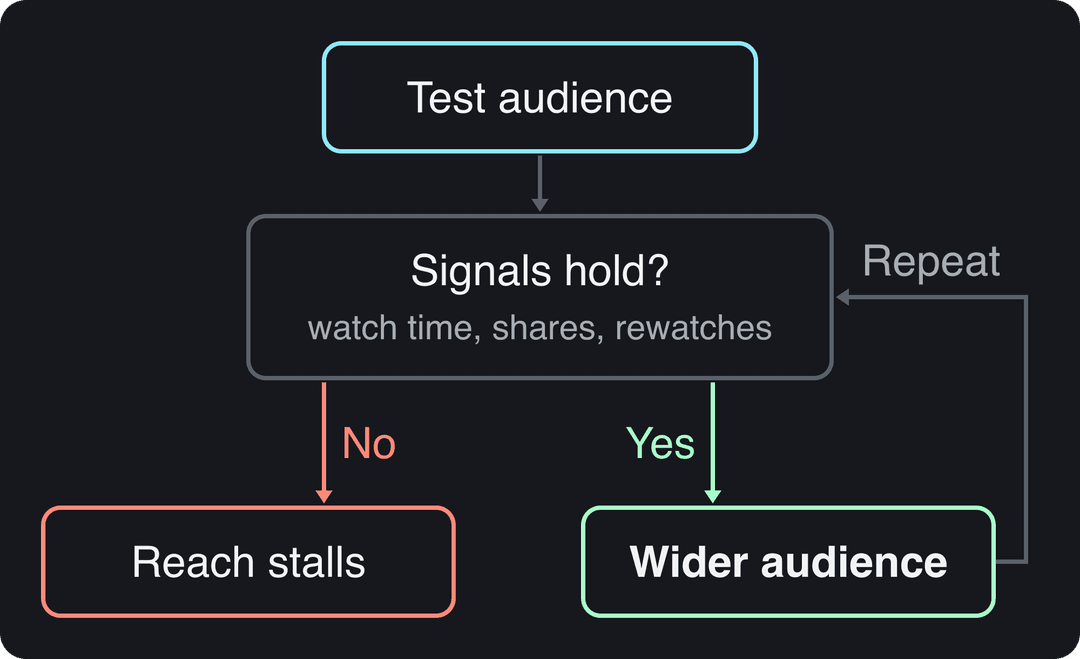
Two practical consequences. First, your follower count matters less than the first viewers' reaction, which is why small accounts can go viral. Second, a weak opening kills a video early: if the test audience swipes away, the later rounds never happen.
What makes a video viral on YouTube?
YouTube has two paths, and they reward different things.
- YouTube Shorts behave like TikTok: viewers swipe, so the hook, emotion and format factors above apply directly. Vertical or square videos up to 3 minutes count as Shorts.
- Long-form videos win or lose on the click first. The title and thumbnail have to promise something specific, and the first minute has to deliver it. YouTube Studio on desktop can A/B test up to 3 titles and thumbnails and keep the one with the most watch time (Shorts aren't eligible).
One change to keep in mind: since August 24, 2026, YouTube counts a view the moment a video starts to play, so a high view count with low watch time is not a viral video. Watch time and returning viewers are the numbers to track.
If your Shorts use music or clips, check the copyright rules before posting: any Short longer than one minute with an active Content ID claim is blocked globally and can't be monetized, and most Shorts Audio Library songs can be used for up to 90 seconds. For a YouTube-specific workflow, read how to make viral videos on YouTube.
How many views does a video need to go viral?
There is no official threshold. Revid's library uses these tiers: viral at 1 million+ views, high at 100,000+, medium at 10,000+ and low below 10,000. A useful personal rule: a video has gone viral for you when it reaches far beyond your followers and keeps getting shared days after posting.
For context, the median TikTok in Revid's 12-month study (all of which already had 1,000+ likes) had 64.4K views, and 11.9% passed 1 million.
What are the chances of a video going viral?
Low for any single upload, but measurable. Among TikToks that already cleared 1,000 likes, 11.9% passed 1 million views in Revid's study. In Revid's full index on September 15, 2026, 523,274 of 2,377,477 TikToks had passed 1 million views. Most uploads never reach 1,000 likes, so the odds for an average video are far lower. You improve them by posting often and building each video on the factors above, not by waiting for one lucky hit.
Common mistakes that stop a video from going viral
- A slow start. Logos, greetings and context before the point lose the test audience.
- Two ideas in one video. Split them; each idea gets its own test.
- Talking over everything. In Revid's data, videos that talked throughout had a lower median than videos with almost no speech.
- Copying a trend with no angle. Yet another identical version gives viewers no reason to watch yours.
- Judging a video in the first hour. Look at watch time and shares before deleting or reposting.
- Ignoring the comments. Replies, especially video replies, keep a video that's gaining traction in front of people.
What matters less than people think
- Length. Every length bucket in the 12-month study landed between 58K and 76K median views (61 to 90 seconds was slightly ahead at 70K). In Revid's full index across all posting dates, 16 to 30 seconds led at about 141K, but that edge has faded for recent posts. Make the video as long as the idea needs.
- Production budget. Handheld (80K) and tripod (77K) footage performed almost the same, and screen recordings beat both at 91K. Clarity beats polish.
- Piling on hashtags. TikToks with 4 hashtags had the best median (77K); 9 or more hashtags dropped to 16K, below using none (51K).
- Skipping the caption. Captions of 41 to 80 characters had the best median (67K); no caption at all, 36K.
How to build a video on a proven viral format with Revid
Revid starts from videos audiences have already shown they watch, which covers factors 1 to 3 before you write a word.
- Search Revid's library of about 2.77 million short-form videos with their engagement data by topic, platform, engagement tier and length, then remix a viral video that fits your niche.
- Run Deep analysis (free, up to 60 a day) to see why it worked: the hook and its formula, the timed structure, the scroll-stopping moment, and three ways to adapt it.
- Choose "Make it about your topic" or "Same energy, new script": Revid writes an original script and new visuals with the same hook style and pacing, plus voice-over, captions and music.
- Fix anything in the timeline editor, then publish to TikTok, Instagram and YouTube from one queue and track views, likes and comments.
To start from your own idea instead of a reference, use the AI video generator.
FAQ
Why do videos go viral?
Videos go viral because the first viewers watch to the end, rewatch, comment and share, which tells the platform to show the video to more and more people. The videos that pass those rounds usually combine a fast hook, a strong emotion and a format people already enjoy.
What makes a viral video successful?
A viral video is successful when the views turn into something lasting: followers, sales or a series. Pin a comment pointing to your next video, post a Part 2 while attention is high, and keep the same format for the next few uploads.
Can you predict if a video will go viral?
No one can predict a single video, but you can raise the odds. Build on formats and emotions that already perform in your niche, test several hooks, and post consistently so more videos get a fair test.
Does video length matter for going viral?
Less than most advice suggests. In Revid's study of recent TikToks, median views varied only between 58K and 76K across all lengths, so pacing and the hook matter far more than the duration.
Is going viral just luck?
Partly, since timing and who sees a video first are out of your control. The rest is pattern: videos with a clear hook, a strong emotion and a shareable format pass the platform's test rounds far more often.
Do you need a lot of followers to go viral?
No. Short-form platforms show new videos to a test audience that includes non-followers, so a small account can go viral if those first viewers watch, rewatch and share.
Sources
- Revid analysis of 176,367 TikToks with 1,000+ likes posted between Oct 1, 2025 and Oct 16, 2026 (61,203 creators)
Charts and figures checked on November 6, 2026.