What Makes a Video Viral? The 5 Factors That Matter (With Data)
Viral videos share five traits: a hook, retention, a shareable emotion, a proven format and clear packaging. Here is how each works, with Revid's data on 176,367 TikToks.

On this page
A video goes viral when its first seconds stop the scroll, it keeps viewers watching to the end, and it gives them an emotional reason to share it. Those early signals tell the platform to show it to a wider audience, and the loop repeats. Hook, retention and emotion matter far more than length or polish.
The setting most creators fiddle with barely moves the result. In Revid's analysis of 176,367 TikToks with 1,000+ likes posted between October 2025 and October 2026, every length from under 15 seconds to 10 minutes landed between 58K and 76K median views. The video's dominant emotion, by contrast, swung the median from 45K (inspirational) to 156K (outrage).
- Median views for outrage-driven TikToks, the top-performing emotion
- 156K
- Revid analysis of 176,367 TikToks
- Median views for challenge videos, the best-performing TikTok format
- 182K
- Revid analysis of 176,367 TikToks
- Median views for TikToks with under 40 characters of speech
- 123K
- Revid analysis of 176,367 TikToks
- Range of median views across every video length bucket
- 58K-76K
- Revid analysis of 176,367 TikToks
The 5 things viral videos have in common
| Factor | What it does | What to do |
|---|---|---|
| Hook | Stops the scroll in the first seconds | Open on the result, the conflict or the question, never a greeting |
| Retention | Shows the platform that viewers are satisfied | Add a new development every few beats and deliver the payoff you promised |
| Emotion | Gives viewers a reason to share | Aim for surprise, humor or justified outrage over gentle inspiration |
| Format | Uses a container audiences already watch | Challenges, comedy and reactions outperform plain tutorials and storytelling |
| Packaging | Tells people and the algorithm who the video is for | Make the first frame, title, caption and hashtags express one promise |
Luck decides who sees a video first. These five decide whether those first viewers keep watching and pass it on.
How do platforms decide which videos to spread?
Every platform runs some version of the same test. A new video goes to a small group of viewers, the system watches what they do, and strong behavior earns a bigger audience. A 2025 overview of viral content signals lists early engagement, completion rate, watch time, shares and saves as the indicators most associated with wider reach on short-form platforms.
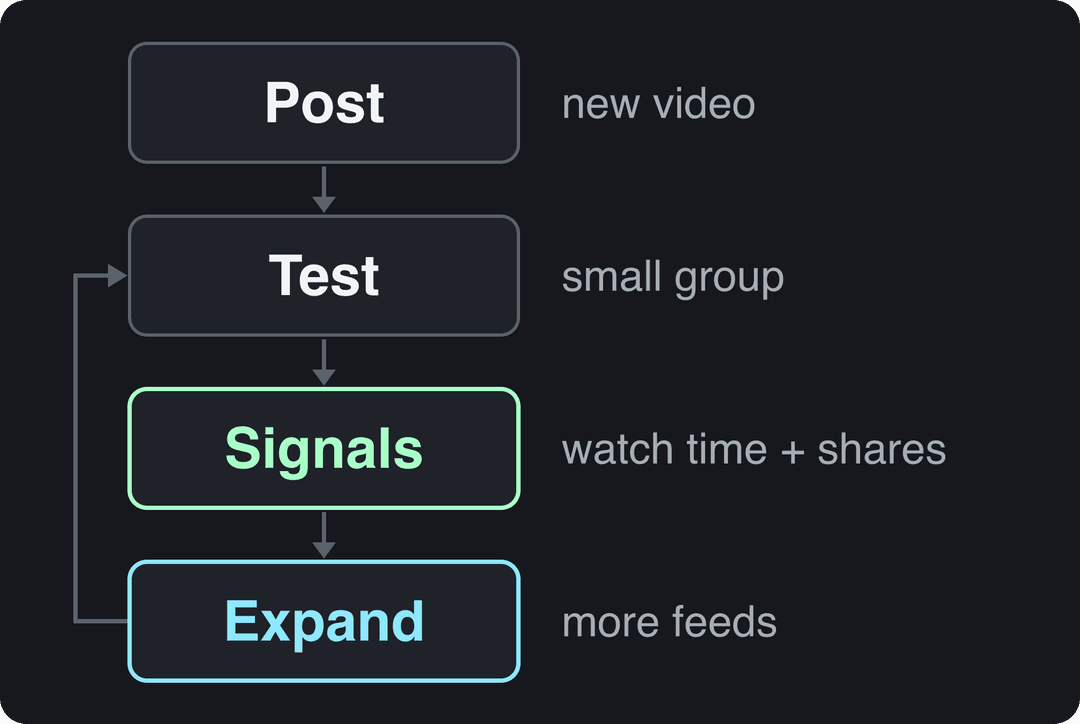
That loop explains why two similar clips can end up worlds apart: one held its first viewers and the other lost them. It also tells you where to work. You can't control who sees the video first. You can control whether the opening states the premise, whether the middle gives people reasons to stay, and whether the packaging attracts the audience the video was made for.
The wrong audience is worse than a small one. A clickbait title that pulls in viewers who don't care about the topic makes them leave early, and the test reads as a failure. For how one platform weighs these signals, see how the YouTube Shorts algorithm ranks videos.
The hook: what the first 3 seconds have to do
Autoplay feeds remove the introduction. Viewers meet your first frame mid-scroll, often with the sound off. "Hey guys, so today we're going to..." spends the most valuable seconds announcing the video instead of giving a reason to watch it.
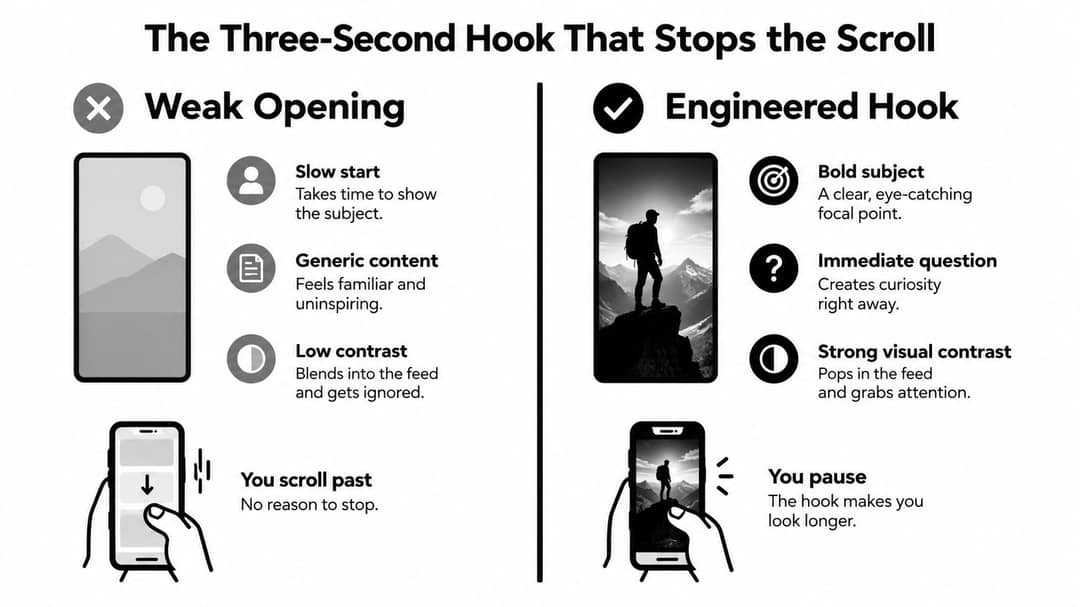
Start inside the action: show the unusual result, reveal the problem or ask a question the viewer can only answer by staying. Compare two openings:
- Generic: "Today I'm testing a few budget microphones for beginners."
- Hook: "This cheap microphone made my voice sound worse than my phone."
The second line gives a conflict, a specific object and an implied test. The viewer wants to know which microphone it was, and whether the claim holds up.
Five hook patterns that work in almost any niche (more in this list of 130+ TikTok hooks):
- Unexpected result: open on the finished transformation, then show how you got there.
- Specific challenge: "I tried to edit a complete short using only one sound effect."
- Open question: "Why does this thumbnail get clicks while the cleaner one fails?"
- Immediate demonstration: put the product, mistake or visual proof on screen before you explain it.
- Contrarian claim: challenge familiar advice, but make the claim precise enough to test.
Statements beat questions more often than hook templates suggest. Among the 1,588 TikToks in Revid's 100M Club, 51% of the videos with a transcript open with a statement, 16% with a question and 14% by addressing the viewer directly.
Show more, say less. In the same TikTok study, videos with under 40 characters of speech had a 123K median and 20.2% passed 1 million views, against 68K and 11.9% for videos that talk throughout. A visual hook that needs no explanation travels further than a spoken setup.
Prompt to try
Create a 30-second vertical faceless video that opens on the result, with the hook "This cheap microphone made my voice sound worse than my phone." Show a $20 microphone tested against a phone recording in three quick rounds, adding a new comparison each round. End by revealing which one actually sounded better. Punchy voiceover, bold captions, clean stock visuals, no intro.
Make the hook match the payoff
If you open with a result, show how you got it. If you ask a question, answer it, ideally with something more surprising than the viewer expected. A hook the video never pays off wins the first second and loses the rest, which is exactly the behavior the platform reads as a bad video. The same rule applies to the opening minute of longer YouTube videos: lead with the moment that represents the video's value, then add context.
Why people share a video: the emotion behind virality
A view is private; a share is social. When someone sends a video, they attach it to their own identity: it makes them look funny, informed, helpful or rightly angry. That is a high bar, which is why shares are rare. Across Revid's TikTok sample, shares ran at 0.88 per 100 views, against 7.1 likes per 100 views.
Research points to surprise as the strongest lever. A study of 750 YouTube videos covered by MIT Sloan Management Review found that emotionally surprising content drew more likes and views than any other content element it examined. Novelty, incongruity and hyperbole were among the strongest triggers.
| Trigger | Why it works | How to use it |
|---|---|---|
| Novelty | Breaks a familiar pattern and gives viewers something new to show others | An uncommon angle, constraint, comparison or visual reveal |
| Incongruity | Creates a gap between expectation and reality that begs to be explained | An unexpected image paired with a clear question or reversal |
| Hyperbole | Raises emotional intensity and makes the moment memorable | A strong claim the video can actually prove or qualify |
Revid's data points the same way. In the study of what makes a TikTok go viral, outrage-driven videos had a 156K median and 23.7% passed 1 million views. Humor reached 121K (19.3%) and sadness 104K, while inspirational videos sat at 45K (11.3%). These are TikToks that already cleared 1,000 likes, so the figures show what the winners have in common, not proof that an emotion causes views.
High-arousal emotions (outrage, humor, sadness) earned the most views. Calm, inspirational videos earned the least, even though they collect the most likes per view.
Source: Revid analysis of 176,367 TikToks with 1,000+ likes posted between Oct 1, 2025 and Oct 16, 2026 (61,203 creators)
Show the data
| Median views | Share that passed 1M views | |
|---|---|---|
| Outrage | 156K | 23.7% |
| Humor | 121K | 19.3% |
| Sadness | 104.4K | 16.5% |
| Excitement | 92.5K | 15.9% |
| Joy | 89.9K | 18% |
| Informative | 64.1K | 11.2% |
| Neutral | 61.2K | 11.5% |
| Inspirational | 44.6K | 11.3% |
Format follows the same logic. Challenges (182K median, 25.6% past 1 million) and comedy (155K, 22%) led, reactions followed at 105K, and storytelling (66K) and tutorials (62K) trailed. Tutorials can still travel: in the same data, faceless tutorials, such as screen recordings and hands-only demos, hit a 156K median against 52K for tutorials with a person on camera.
Use outrage with care. It works when it is aimed at a real problem the video solves, and it burns trust when it is manufactured. Before you film, answer three questions: what is new here, what expectation does the video break, and who would the viewer send it to? If you can't name that person, rewrite the angle. These tips for creating shareable content go further on that last question.
Retention: why viewers stay to the end
A hook earns the first moment; retention earns the next recommendation. Audience retention measures how long viewers stay across a clip, which says more than a view count. Research on YouTube audience retention treats it as a measure of a video's potential to spread, with average retention showing how well a video holds attention across its full length.
The goal is a curve without cliffs. Use re-hooks: a new obstacle, a changed camera angle, an intermediate result or a sharper question. In a cooking clip, showing the finished dish first grabs attention, but the middle still needs progression: a texture test, a mistake, a comparison of two methods. "Keep watching to see what happens" adds nothing. "The first version looked right, but the texture failed, so I changed one step" gives a specific reason to stay.
After you publish, find where viewers leave and tie each drop to an edit:
- Early drop: replace greetings and setup with the central visual or claim.
- Middle decline: cut repeated explanations and introduce a new development.
- Drop before the ending: move the useful conclusion earlier, then add a deeper comparison.
- Final abandonment: end on the payoff, not a long sign-off.
This video shows how visual pacing works alongside an opening promise. Watch for the moments that add a new action instead of repeating the setup.
Prompt to try
Make a 12-second vertical video built on one surprising reveal: open on a full glass of water flipped upside down with only a card holding it, with the on-screen hook "This should not work." Explain in one short line that air pressure keeps the card in place. Fast cuts, bold captions, no greeting and no sign-off.
Length alone barely moves views: every bucket lands between 58K and 76K median views (the 790 videos over 10 minutes are a small, unusual group). Clips under 15 seconds get shared the most per view.
Source: Revid analysis of 176,367 TikToks with 1,000+ likes posted between Oct 1, 2025 and Oct 16, 2026 (61,203 creators)
Show the data
| Median views | Share that passed 1M views | Shares per 100 views | |
|---|---|---|---|
| Under 15 s | 57.6K | 11.6% | 1 |
| 16 to 30 s | 64.9K | 12.3% | 1 |
| 31 to 60 s | 61.8K | 11.8% | 1 |
| 61 to 90 s | 70.5K | 12.2% | 1 |
| 91 s to 3 min | 63.4K | 11.1% | 1 |
| 3 to 10 min | 76.4K | 12.4% | 1 |
| 10 min+ | 129.6K | 13.8% | 0 |
Does video length matter for going viral?
Less than most creators think, as long as the video is the shortest complete version of its idea. Shorter videos are finished more often: in Vidyard's business video benchmarks, 65% of viewers stayed engaged to the end of videos under 1 minute, against 20% for videos over 20 minutes. Klap's roundup of video completion-rate benchmarks shows the same pattern across formats.
Higher completion does not automatically mean more views. In Revid's 12-month TikTok study, every length bucket fell between 58K and 76K median views, with 61 to 90 seconds slightly ahead at 70K. Videos under 15 seconds had the lowest median (58K) but the most shares per view, at 1.41 per 100 views.
The decision rule: if the idea is one punchline, reveal or reaction, keep it under 15 seconds so it gets shared and replayed. If it needs proof, a test or a story, take the time, and cut anything that doesn't create tension. Then check the platform's limits:
| Platform | Maximum length | What to know |
|---|---|---|
| TikTok | Uploads up to 60 minutes (10 minutes in the in-app camera) | Creator Rewards only pays on videos of at least one minute |
| YouTube Shorts | Up to 3 minutes, square or vertical | A Short over 1 minute with an active Content ID claim is blocked |
| Instagram Reels | Up to 20 minutes | Reels over 3 minutes are not recommended to non-followers |
Packaging: first frame, title, caption and hashtags
A strong video can fail before anyone watches it. The first frame, title, thumbnail, caption and hashtags tell people and recommendation systems what the video is and who it's for. A creator's packaging analysis of viral YouTube videos shared on X found that title length, thumbnail composition and the use of numbers performed differently by niche and between entertainment and educational videos. There is no universal viral package; copy the conventions of your niche, not an unrelated creator's.
Match the package to the platform. On TikTok and Reels, the first frame, on-screen text, spoken opening and caption work together before the viewer decides to stay. On YouTube, the title and thumbnail must win a deliberate click without promising more than the video delivers (titles can be up to 100 characters, but the start does the work).
On TikTok, captions and hashtags still show up in the numbers. In Revid's data, posts with 4 hashtags had the best median (77K views), 3 hashtags 75K, no hashtags 51K, and 9 or more only 16K. Captions of 41 to 80 characters did best (67K median) and posts with no caption worst (36K). On Instagram, the cap is 5 hashtags per post, and a caption with more won't post.
Consistency compounds. Keep a coherent topic, repeat visual cues viewers can recognize, and vary the idea inside that frame. When every upload targets a different audience, even a strong video struggles to build a following.
How to build on a proven viral format with Revid
Revid is built on the idea behind this article: start from a format audiences have already shown they watch, then make it your own.
- Search Revid's library of about 2.77 million real short-form videos by topic, platform and engagement tier with the viral video remix feature.
- Run the free Deep analysis (up to 60 a day) on a video you like. It breaks down the hook, the timed structure, the scroll-stopping moment and three ways to adapt it to your niche.
- Choose "Make it about your topic" or "Same energy, new script". Revid keeps the structure and pacing and writes a new script, new visuals and an original music direction.
- Fix any scene in the timeline editor, then publish to TikTok, Instagram and YouTube from one queue. Each post reports its views, likes and comments, so you can remix the ones that worked.
Starting from a blank idea instead? The AI video generator turns a prompt, script or link into a finished short.
Your pre-publish checklist and first-hour plan
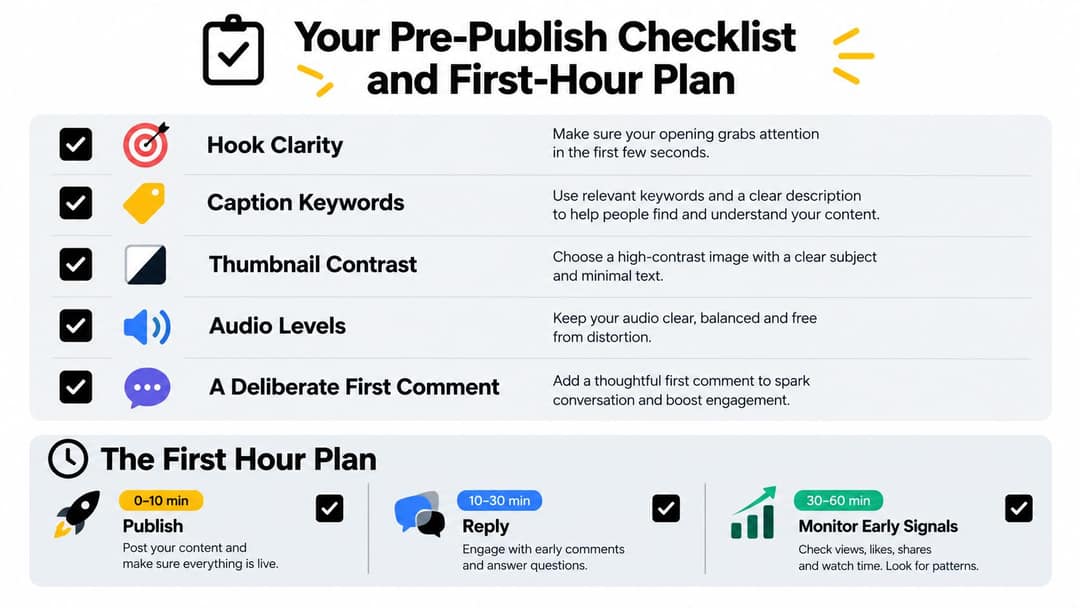
Before you post, watch the opening with the sound off and check:
- Hook clarity: can a new viewer tell the subject, the tension or the promised result immediately?
- Payoff: does the ending resolve the question the opening raised?
- Caption keywords: does the caption use the words your audience would search for?
- Thumbnail or first frame: is the subject recognizable at a small size, with one focal point?
- Audio levels: is the voice easy to understand over music and effects?
- Platform fit: do the aspect ratio, text placement and pacing suit the destination?
- First comment: does it invite a real answer ("Which method would you try?") rather than vague engagement?
The first hour is not a magic deadline, but it is when your first viewers react. Use it well:
- Reply to early comments with useful follow-ups, and note requests as future video ideas.
- Share with people who already care about the topic (a community, a newsletter), not every contact you have.
- Read signals together. High views with weak retention means the promise isn't sustained; strong retention with weak reach points to a packaging or audience problem. On YouTube, a view counts the moment playback starts (since August 24, 2026), so judge by retention, not the view count.
- Log the result: hook type, topic, format, title approach and audience response. Compare it with your own earlier uploads and pick one input to test next.
FAQ
Is going viral just luck?
Partly, but less than it looks. Luck affects who sees a video first; the hook, retention, emotion, format and packaging decide whether those viewers keep watching and share, which is what earns wider distribution.
How many views count as viral?
There is no official threshold. Revid's library tiers cross-platform posts as viral at 1 million+ views, high at 100,000+ and medium at 10,000+, but for a small account, a video that reaches far beyond its follower count is viral in the way that matters.
Does posting time affect whether a video goes viral?
A little, on TikTok at least. In Revid's TikTok data, English-language posts at 3 to 6 a.m. US Eastern had the highest median views and 5 to 9 p.m. the weakest, but those creators post from around the world, so check your own audience's active hours in TikTok Studio analytics.
Do you need to show your face to go viral?
No. In Revid's TikTok study, faceless videos had a 114K median and 17.4% passed 1 million views, against 67K and 12.7% for one person on camera; animal videos did even better at 147K.
Can AI-generated videos go viral?
Yes, especially on TikTok. Revid's analysis of AI videos vs real footage found AI-generated TikToks averaged twice the views of real footage, while on X, Instagram and Threads AI visuals clustered in the lowest engagement tier. Label realistic AI content: TikTok and YouTube both say the label alone does not reduce reach.
Sources
- Revid analysis of 176,367 TikToks with 1,000+ likes posted between Oct 1, 2025 and Oct 16, 2026 (61,203 creators)
Charts and figures checked on November 6, 2026.