Video-First Social Media Content Strategy: The 2026 Framework
A seven-step video-first framework for social media: give each platform one job, turn pillars into series, and measure what earns attention, with Revid data on what actually moves TikTok views.

On this page
A video-first social media content strategy builds every important idea as a short vertical video first. It then gives each platform one job: TikTok tests hooks, Instagram Reels earns shares and saves, YouTube Shorts captures search, and LinkedIn builds B2B trust. You set it up in seven steps and review results weekly to scale what works.
Most teams try to fix the wrong variable. In Revid's analysis of 176,367 TikToks with 1,000+ likes posted between October 2025 and October 2026, video length barely changed median views. Format changed them a lot: challenges reached a 182K median, tutorials 62K. The full viral TikTok study explains the method. What you make and how it opens matters more than shaving seconds off the edit.
- Median views for TikTok challenges, the top format (tutorials: 62K)
- 182K
- Revid study of 176,367 TikToks
- Median views for faceless tutorials, versus 52K for on-camera tutorials
- 156K
- Revid study of 176,367 TikToks
- Businesses that use video as a marketing tool
- 91%
- Wyzowl, December 2025
- Marketers who rate 30 seconds to 2 minutes as the most effective video length
- 71%
- Wyzowl, December 2025
What is a video-first social media content strategy?
A video-first strategy is an operating rule, not a format preference. Every idea that matters to your business is first built as something people can watch, with captions, so it can be clipped and distributed. It is then turned into posts, emails and pages. Not every piece of content becomes a video, but video is the default way ideas enter the world.
The demand is there. Wyzowl's 2026 survey found 91% of businesses use video as a marketing tool. In the same survey, 63% of consumers said a short video is how they would most like to learn about a product, against 12% for text articles.
A video-first strategy answers five questions:
- Who are we trying to reach?
- What should they understand, believe, feel or do after watching?
- Which platform plays which role?
- Which repeatable formats will we produce?
- How will we learn from results and scale what works?
The word that matters is repeatable. Random videos are not a strategy. Reusable decisions are: pillars, hooks, formats, editing rules, a cadence and a feedback loop.
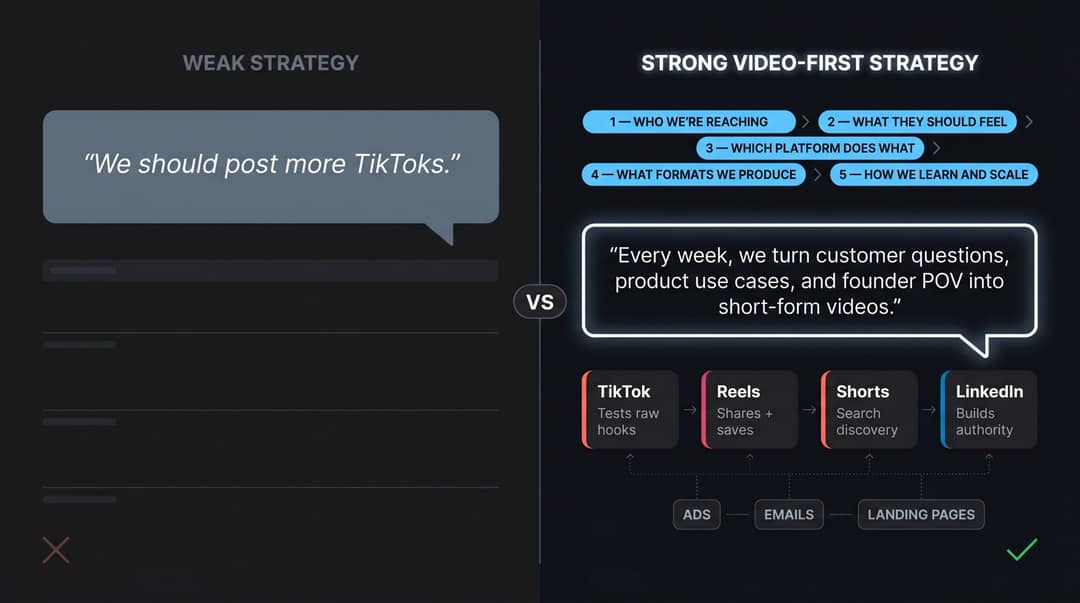
Weak: "We should post more TikToks." Strong: "Every week we turn customer questions, product use cases and founder POV into short videos. TikTok tests raw hooks, Reels earns shares and saves, Shorts captures search, LinkedIn builds authority, and the winners become ads, emails and landing pages."
How does video-first work with your blog, podcast and newsletter?
Video-first does not replace your written content. It feeds on it and feeds it back: each video produces material for posts, and each post can become several videos.
| Source asset | Video output | Secondary assets |
|---|---|---|
| Blog post | 5 short educational videos | Carousel, newsletter, LinkedIn post |
| Podcast episode | 8 clips, quote videos, audio-to-video explainers | Blog recap, quote cards, YouTube chapters |
| Webinar | 10 Shorts or Reels, 3 objection clips, 1 demo clip | Sales follow-up email, FAQ page |
| Customer story | 3 proof videos, 2 testimonial clips, 1 founder breakdown | Case study, ads, landing page proof block |
| Product feature | 15-second teaser, 45-second tutorial, 90-second use case | Help doc, onboarding email, sales deck slide |
| Support question | How-to video, myth-busting clip, reply video | FAQ article, chatbot answer |
On Instagram, Reels and carousels do different jobs. Reels reach new people, while carousels deepen engagement with people you already reached. To make this table a weekly habit, follow a content repurposing workflow with a clear owner for each step.
What changed: six social media rules that no longer hold
Every video has to work for a stranger
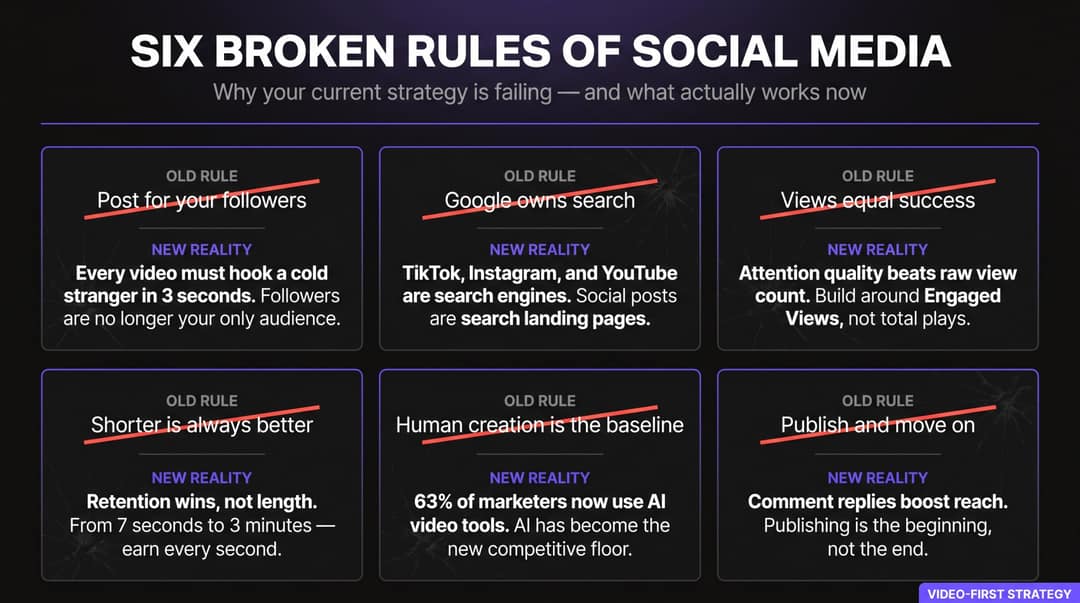
Your followers are no longer your only audience. TikTok's For You feed, Reels, Shorts and LinkedIn recommendations all show videos to people who have never heard of you. Each video must make sense to a cold viewer in its first seconds. TikTok's creative best practices put the hook in the first 3 seconds and the core proposition in the first 6.
People search on TikTok, Instagram and YouTube
People look up software reviews on TikTok, routines on Instagram and tutorials on YouTube. TikTok Creator Search Insights, launched in March 2024, shows creators the topics people search for that have few videos. TikTok calls these content gaps.
Plan search-led videos next to trend-led ones. A video titled "How to turn a podcast into Shorts" or "Why your demo video has low retention" works like a landing page inside the app.
A view no longer means attention
Since March 31, 2025, YouTube counts a Shorts view the moment a Short starts to play or replay. Since August 24, 2026, it counts views on play across every format. Earnings still use engaged views.
YouTube's Shorts analytics separates "Shown in feed" from "Chose to view". That gap tells you far more about your opening than the view count does. Build your strategy around attention quality, not raw plays.
How long should social media videos be in 2026?
Short-form length limits went up. YouTube Shorts can run up to 3 minutes for square or vertical videos uploaded since October 15, 2024. Instagram Reels can be up to 20 minutes, but reels over 3 minutes are not recommended to non-followers.
Within those limits, length is a weak lever. In Revid's 12-month TikTok study, every length bucket from under 15 seconds to 10 minutes had a median between 58K and 76K views, with 61 to 90 seconds slightly ahead at 70K. Videos under 15 seconds had the lowest median (58K) but the most shares per view, at 1.41 per 100 views.
Length alone barely moves views: every bucket lands between 58K and 76K median views (the 790 videos over 10 minutes are a small, unusual group). Clips under 15 seconds get shared the most per view.
Source: Revid analysis of 176,367 TikToks with 1,000+ likes posted between Oct 1, 2025 and Oct 16, 2026 (61,203 creators)
Show the data
| Median views | Share that passed 1M views | Shares per 100 views | |
|---|---|---|---|
| Under 15 s | 57.6K | 11.6% | 1 |
| 16 to 30 s | 64.9K | 12.3% | 1 |
| 31 to 60 s | 61.8K | 11.8% | 1 |
| 61 to 90 s | 70.5K | 12.2% | 1 |
| 91 s to 3 min | 63.4K | 11.1% | 1 |
| 3 to 10 min | 76.4K | 12.4% | 1 |
| 10 min+ | 129.6K | 13.8% | 0 |
Revid's full index of about 2.39 million TikToks across all posting dates favored 16 to 30 seconds (about 141K median). The very short edge has faded for recent posts. Both samples only include videos that reached 1,000+ likes, so they show what successful videos share, not what causes success.
A practical rule:
- 7 to 20 seconds: one idea, one punch, one proof point
- 30 to 60 seconds: tutorials, frameworks, myths, mini-stories, product use cases
- 60 to 120 seconds: deeper explanations, case studies, comparisons
- 2 to 3 minutes: only when the story earns every extra second
Wyzowl's 2026 survey found 71% of marketers rate 30 seconds to 2 minutes as the most effective length. Pick the length the idea needs, then cut anything that does not hold attention.
AI raised the floor, not the ceiling
In Wyzowl's 2026 survey, 63% of video marketers had used AI video tools, up from 51% a year earlier. Scripts, voice-overs, captions and repurposed clips now take minutes, so speed alone is no longer an advantage.
AI scales whatever strategy you feed it. A generic input becomes generic content, only faster. Sprout Social reported in March 2026 that 50% of Gen Z had blocked, muted or unfollowed a brand or creator whose content felt like "AI slop".
TikTok, YouTube and Meta require you to label realistic AI-generated video. TikTok and YouTube both state that the label alone does not reduce distribution.
Publishing is the start, not the end
Comments show you objections, customer language and your next video ideas. Reply to them, turn the best questions into reply videos, and note which topics keep drawing questions. A strategy that ends at "publish" throws away its best research.
How to build a video-first social media content strategy in 7 steps
Step 1: Decide what each video should achieve
Start with the result, not the platform. Every video supports one of five outcomes:
| Outcome | What the viewer does next | Best video types |
|---|---|---|
| Awareness | Notices the problem, brand or POV | Hot takes, stories, myths, trend adaptations |
| Education | Understands how to solve a problem | Tutorials, checklists, frameworks, explainers |
| Trust | Believes you know what you're talking about | Case studies, behind-the-scenes, founder insights |
| Conversion | Takes action | Product demos, UGC ads, objection handling, comparisons |
| Retention | Uses the product better | Onboarding clips, feature education, FAQ videos |
Before producing anything, ask: after watching, what should the viewer understand, believe, feel or do? If the answer is vague, the video will be vague. A thousand views from the right buyers is worth more than a million from the wrong people.
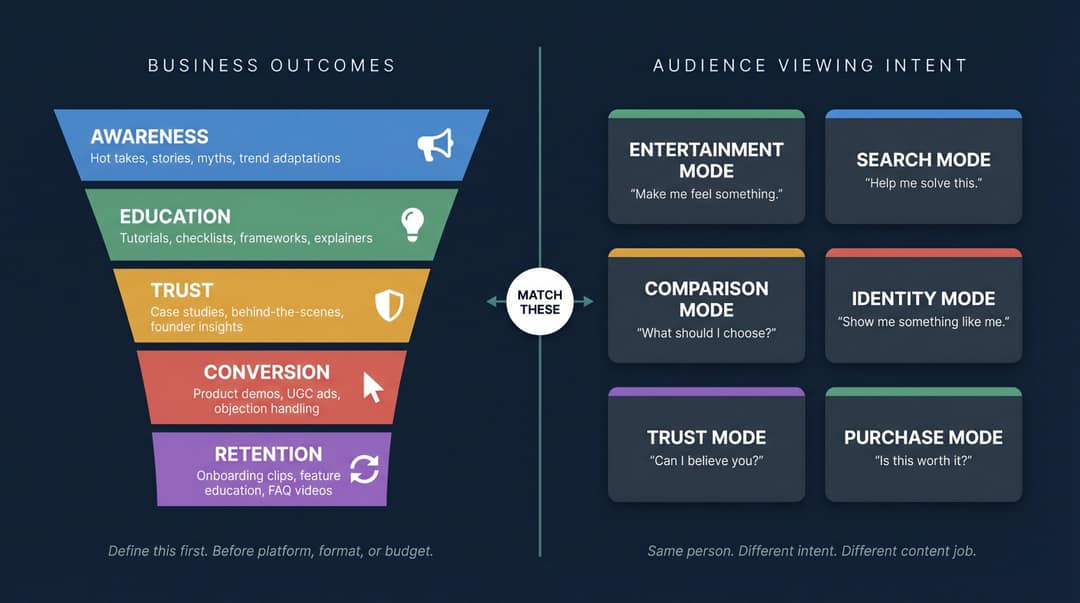
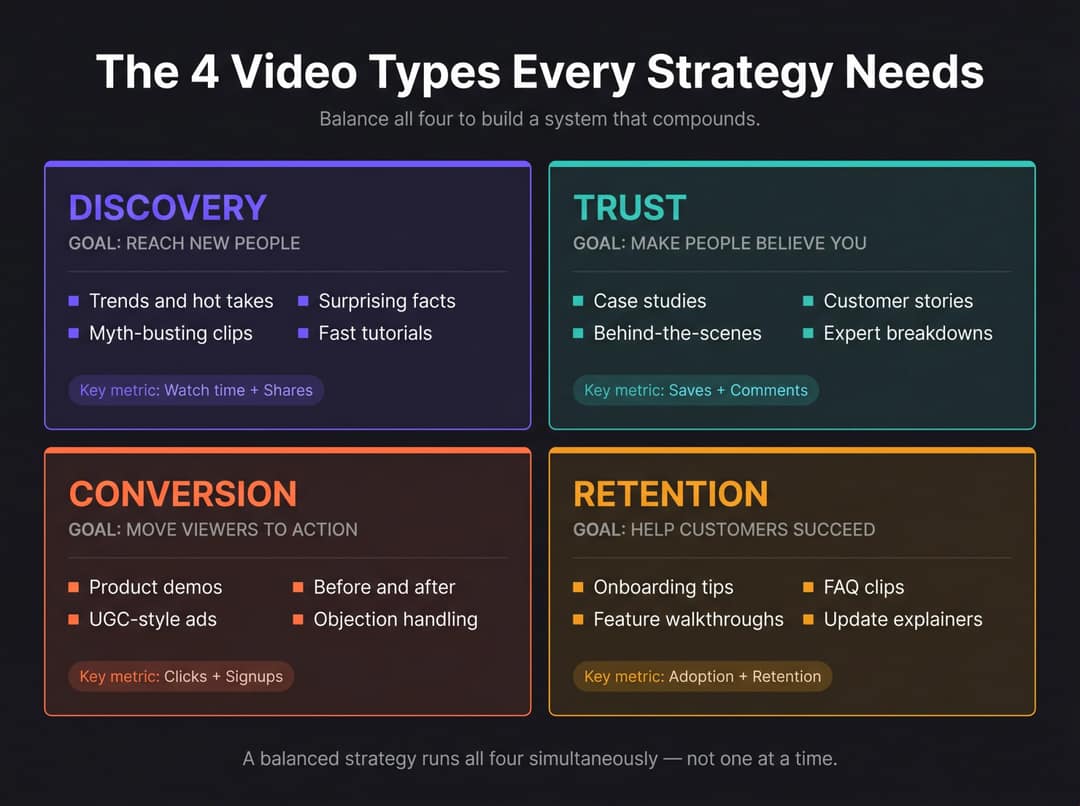
If five outcomes is too many to manage, group them into four video types and run all four at the same time. Track discovery by watch time and shares, trust by saves and comments, conversion by clicks and sign-ups, and retention by product adoption.
Step 2: Match your audience's viewing intent
Demographics are not enough. The same person uses social apps differently depending on the moment.
| Viewing mode | What they want | Your content job |
|---|---|---|
| Entertainment | "Make me feel something." | Story, humor, surprise, tension, personality |
| Search | "Help me solve this." | Answer clearly, put the query in the title and caption |
| Comparison | "What should I choose?" | Pros and cons, tradeoffs, proof |
| Identity | "Show me something like me." | Relatable POVs, shared frustrations, community language |
| Trust | "Can I believe you?" | Proof, process, customers, expertise |
| Purchase | "Is this worth it?" | Demo, objection handling, outcomes |
Write your audience as a situation, not a demographic. "Marketing managers aged 25 to 44" gives you nothing to film. This does: "A solo founder who knows short-form video matters but is stuck because every clip takes too long to script, edit, caption and publish."
Step 3: Give each platform one job
Do not post everywhere because you can. Assign roles.
| Platform | Role | Best use | Primary metrics |
|---|---|---|---|
| TikTok | Fast creative testing, trends, social search | Raw hooks, edutainment, search-led answers | Watch time, completion, shares, saves |
| Instagram Reels | Discovery plus private sharing | Polished short-form, shareable ideas | Sends per reach, saves, follows |
| YouTube Shorts | Discovery into a long-term channel | Searchable tutorials, clips from long-form | Chose to view, engaged views, subscribers |
| B2B trust and demand creation | Founder POV, customer proof | Comments, profile visits, leads | |
| Community reinforcement | Adapted videos, local content, groups | Comments, shares | |
| Evergreen discovery | How-to clips, visual tutorials | Saves, outbound clicks |
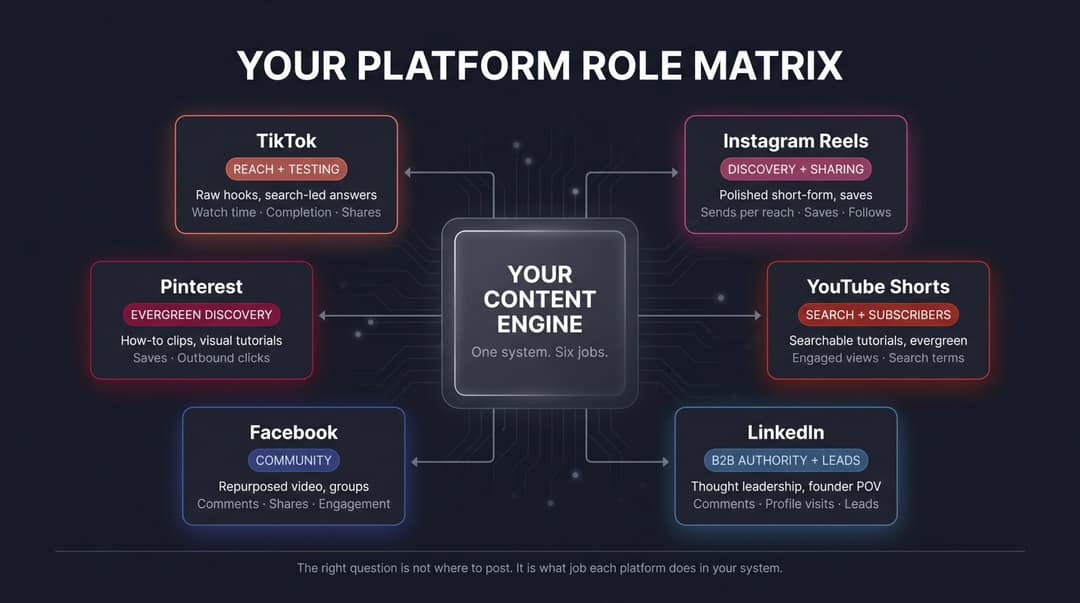
The useful question is not "where should we post?" but "what job does each platform do in our system?"
Prompt to try
Make a 45-second faceless tutorial for solo founders titled "Turn one blog post into five short videos". Open with the hook "You don't need more content ideas. You need fewer dead-end ideas." Walk through three numbered steps with screen-style visuals, a calm voice-over and bold captions, and end with "Save this before your next batch day."
The index leans toward videos that surface in hashtag and keyword searches, so its view counts run high: compare the groups, not the absolute numbers.
Source: Revid TikTok index: 2,377,477 TikToks with AI labels per video, snapshot of Sep 15, 2026. Median views estimated from view buckets.
Show the data
| Median views | Share past 1M views | |
|---|---|---|
| Challenge | 226.9K | 32% |
| Comedy | 194.6K | 29.9% |
| Dance | 121K | 23.4% |
| Reaction | 117.4K | 23.4% |
| Tutorial | 111.5K | 22.2% |
| Storytelling | 107.7K | 21.5% |
| Lip Sync | 90.7K | 21.4% |
Step 4: Turn content pillars into video series
"Education" or "behind the scenes" is too vague to guide a week of production. A useful pillar has four parts: an audience problem, a repeatable angle, a video format and a business connection.
- Weak pillar: "Tips and tricks."
- Strong pillar: "Production bottlenecks for solo creators: 30 to 60 second tutorials showing how to turn one blog post, podcast clip or product page into several platform-native videos."
The strong version can become a show. These seven pillar types cover most brands:
| Pillar type | Purpose | Example formats |
|---|---|---|
| Search-led education | Capture high-intent questions | "How to...", "Best way to..." |
| Myth busting | Create contrast and authority | "Stop doing X", "Most people get Y wrong" |
| Proof and results | Build trust | Before/after, teardown, customer quote |
| Product education | Move viewers toward action | Feature demo, use case, comparison |
| Founder or creator POV | Build personality | Opinion, story, decision breakdown |
| Community response | Turn comments into content | Reply videos, FAQ clips |
| Trend adaptation | Borrow attention without losing relevance | Trend format applied to your niche |
The format inside a pillar matters. In Revid's TikTok study, challenges (182K median views) and comedy (155K) far outperformed storytelling (66K) and tutorials (62K). Yet faceless tutorials reached a 156K median, against 52K for on-camera tutorials.
If education is your pillar, test a faceless version (screen recording, voice-over, captions) before deciding tutorials don't work for you. This is TikTok data on videos that already passed 1,000 likes, so treat it as a test idea, not a law.
Series names that make production easier:
- "One Blog, Five Videos" (repurposing)
- "Hook Fix Friday" (teardowns)
- "Before You Publish" (checklists that get saved)
- "Comment to Clip" (community)
- "AI Video Mistakes" (myth busting)
Step 5: Write a brief for every video
A five-line brief prevents the most common short-form mistake: saying too much.
- Working title: what the video is about
- Audience: who it is for, specifically
- Viewer state: what they believe, struggle with or misunderstand now
- Promise: what they get by watching
- Hook: what happens in the first 1 to 3 seconds
- Core idea: the one thing the video must communicate
- Proof: the example, demo, story or visual that makes it believable
- CTA: what they should do next
- Platform: where it goes first
- Success metric: the signal that tells you it worked
One video, one viewer, one promise, one action.
Step 6: Structure each video as hook, hold, payoff, action
Short-form video is not a compressed blog post. It has its own structure.
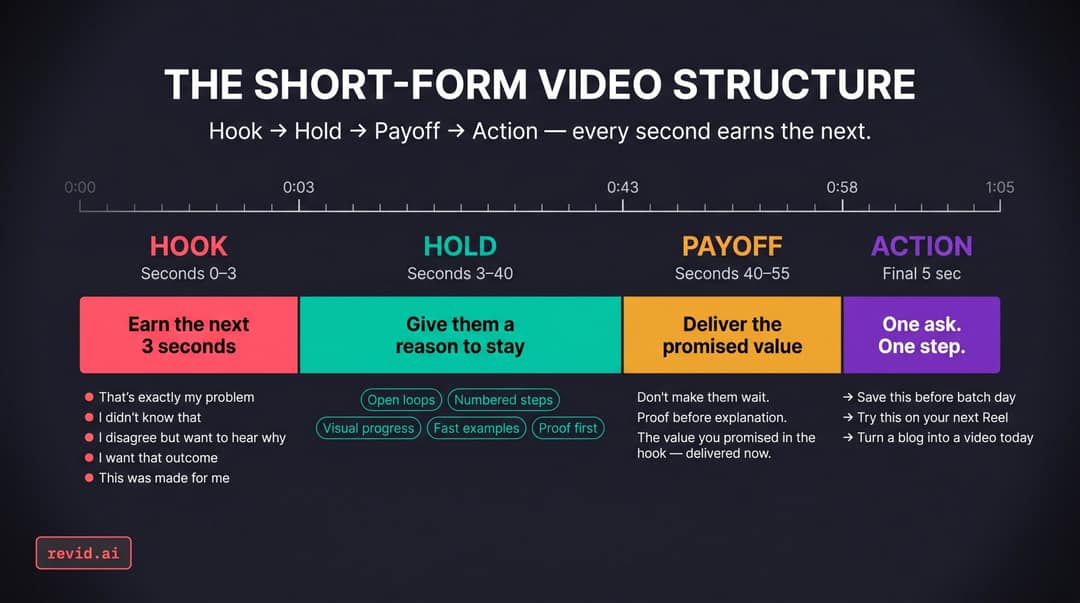
Hook. Earn the next three seconds. A good hook triggers one of five reactions: "that's exactly my problem", "I didn't know that", "I disagree but want to hear why", "I want that outcome" or "this was made for me". Examples:
- "You don't need more content ideas. You need fewer dead-end ideas."
- "This is why your Reels get views but no customers."
- "One blog post can become 12 short videos. Here's the system."
For more patterns, start from a library of copy-ready TikTok hooks and adapt them to your niche.
Hold. Give a reason to keep watching: open loops, numbered steps, visible progress, fast examples, scene changes. Showing the proof before the explanation often holds better than the reverse.
Payoff. Deliver what the hook promised, quickly. A short video should never feel like a webinar intro.
Action. Ask for one specific step: "Save this before your next batch day" or "Try this on your next Reel." One CTA beats three.
Step 7: Set specs for mobile, sound-off viewing
People watch on phones, often muted, often while doing something else.
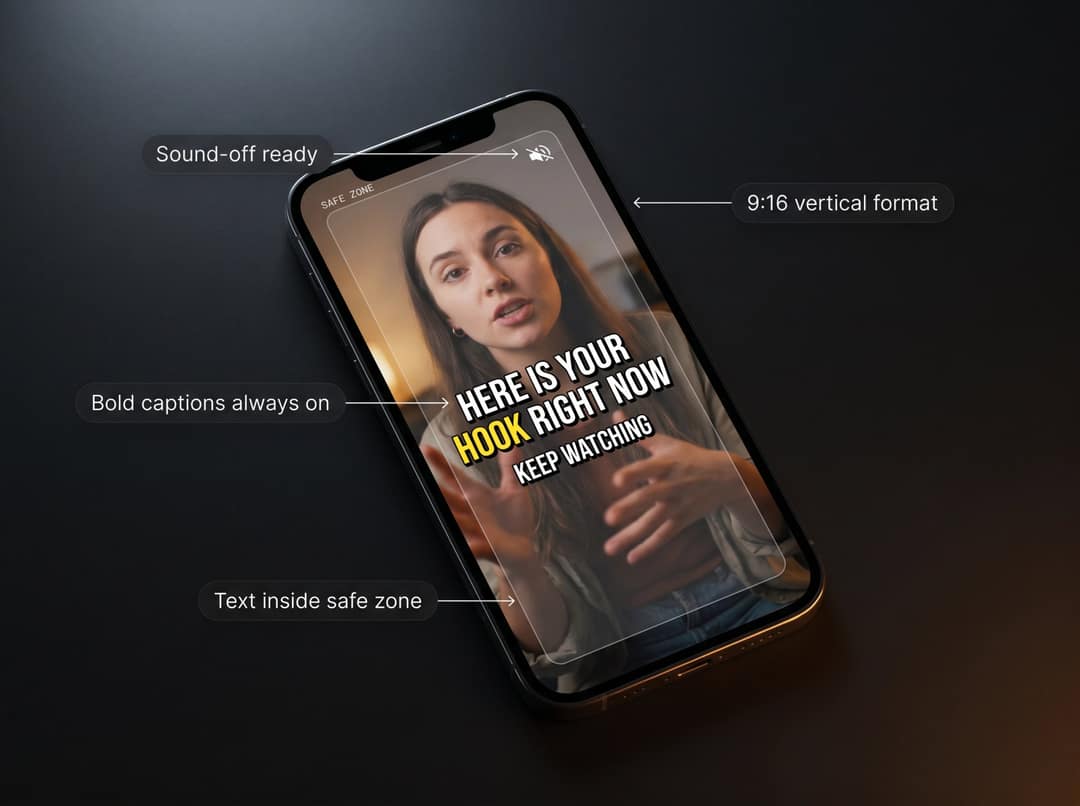
- Shoot or export vertical 9:16 for TikTok, Reels and Shorts.
- Keep text inside the safe zone, away from buttons and captions. Check yours with a TikTok safe zone overlay.
- Add captions or on-screen text so the video works without sound.
- Skip logo intros and open on the most interesting moment.
TikTok recommends 9:16 at 1080x1920. Instagram Reels accept aspect ratios from 1.91:1 to 9:16, at a minimum of 30 FPS and 720 pixels. LinkedIn's organic posts accept 1:2.4 to 2.4:1 at 10 to 60 fps. For paid placements, check LinkedIn's video ad specs.
| Use case | Export |
|---|---|
| TikTok, Reels, Shorts | 1080x1920, 9:16, 30 FPS, captions on |
| Cross-platform master | 1080x1920 with all text in the safe zone |
| LinkedIn feed | 9:16 or 4:5 depending on placement |
| Paid social test | Several hooks, same core message, platform-native CTA |
How to run a weekly video production system
Build an idea bank
Your best ideas are already inside your business: customer questions, support tickets, sales objections, blog posts, podcast transcripts, product launches, customer wins, founder notes, competitor misconceptions, comments, DMs and search queries. Log them in one table:
| Idea | Source | Audience | Pillar | Platform | Format | Status | Result |
|---|
The goal is to never ask "what should we post today?" again.
Get several videos out of one idea
Take one idea: "AI helps creators make videos faster, but it can't replace strategy." It yields at least five angles:
- "AI won't fix a weak content strategy."
- "The right way to use AI video tools."
- "3 things to decide before generating videos with AI."
- "What to automate and what to keep human."
- "A real workflow for AI short-form production."
Then package each angle for the platform:
| Platform | Adaptation |
|---|---|
| TikTok | Raw and opinionated: "AI video tools are not your strategy. They're your assembly line." |
| Instagram Reels | Saveable: "Before your next AI video, answer these 5 questions." |
| YouTube Shorts | Search-led: "How to use AI for short-form video without making generic content." |
| B2B POV: "The teams winning with AI video aren't replacing strategy. They're compressing production time." |
Batch by task, not by video
Treating every video as its own creative project is what breaks most video-first plans. Group the work instead:
| Day | Task |
|---|---|
| Monday | Review metrics, choose 10 ideas, write briefs |
| Tuesday | Write hooks and scripts |
| Wednesday | Generate or record videos |
| Thursday | Edit, caption, format, QA |
| Friday | Schedule, publish, reply to comments, log new ideas |
Put the output into a social media content calendar so consistency comes from the schedule, not willpower.
Use templates for structure, not substance
| Template | Structure |
|---|---|
| Mistake | "You're doing X. That causes Y. Do this instead." |
| Checklist | "Before you publish, check these 5 things." |
| Teardown | "Here's why this video works." |
| Before/after | "Before: X. After: Y. The change: Z." |
| Myth | "Most people think X. The truth is Y." |
| Tutorial | "Here's how to do X in 3 steps." |
| Proof | "We tried X. Here's what happened." |
| Story | "I used to think X. Then Y happened. Now I do Z." |
Check every video before it goes out
- Is the hook clear in the first three seconds?
- Does it make sense with the sound off?
- Does it deliver the promise, with one main idea?
- Is the CTA specific?
- Are captions readable and inside the safe zone?
- Do the visuals match what is being said?
- Would someone save, share, comment or click?
- Does it serve the outcome you chose in step 1?
How to run this system with Revid
Revid covers the production side of this framework (research, creation, publishing and results) in one place. A simple setup:
- Start from a proven format. Search Revid's library of about 2.77 million short-form videos with their engagement data. Open one that fits your pillar and remix a viral video into an original script that keeps its hook and pacing.
- Repurpose what you already have. Paste a blog post into the article to video converter, turn a long YouTube video into Shorts, or turn an audio recording into a captioned video.
- Generate and edit. Choose stock footage, AI images or AI video (Seedance 2.5, MiniMax Hailuo, Wan 3.0 or Google Veo 3). Pick one of 1,000+ voices in 70+ languages, add synced captions, then fix any scene in the timeline editor.
- Publish and read results. Export in 720p, 1080p or 4K, or publish directly to TikTok, Instagram and YouTube. Every post published through Revid reports its views, likes and comments.
- Automate the winners. Auto-Mode workers create a fresh video every day from a prompt or content source. The Growth plan ($39/month, 2,000 credits) includes 3 workers and Ultra includes 10. Check current plans and credits before you build around them.
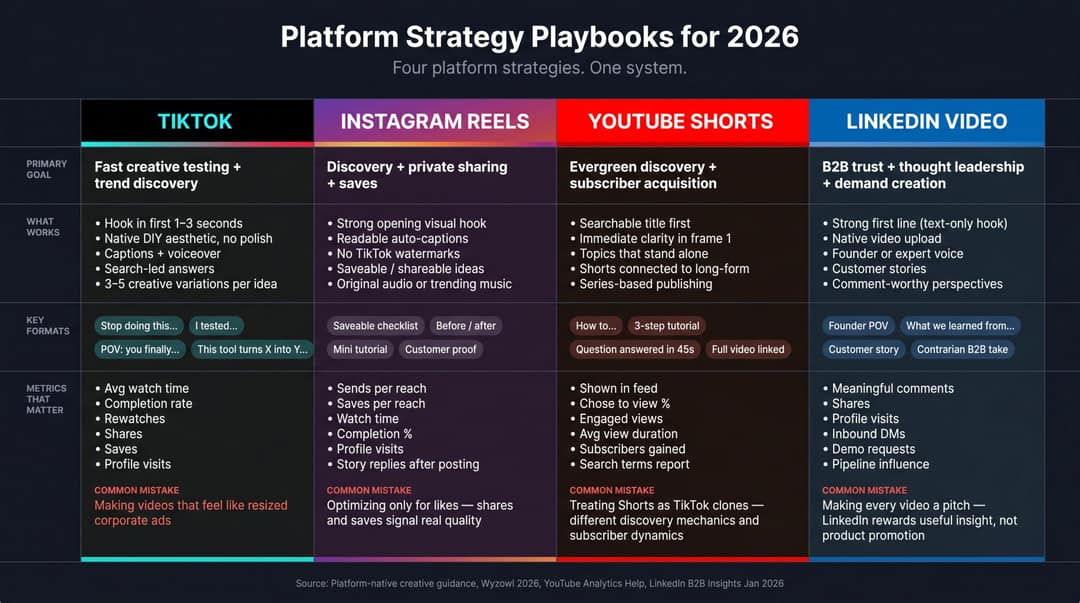
Platform playbooks for 2026
TikTok content strategy
Use TikTok for fast creative testing, trends and social search.
What works:
- A hook in the first 1 to 3 seconds and a clear premise before the viewer scrolls.
- A native, unpolished look with faces, voice or POV, plus captions and sound.
- Search-led answers, and 3 to 5 creative variations to rotate, as TikTok's guidance suggests.
In Revid's TikTok study, POV shots had a 107K median, against 48K for selfie-style videos.
Formats: "Stop doing this...", "I tested...", "Nobody tells you...", "POV: you finally...", "This tool turns X into Y..."
Metrics: average watch time, completion, rewatches, shares, saves, profile visits, search traffic.
Biggest mistake: videos that look like resized corporate ads.
Prompt to try
Create a 30-second saveable Instagram Reel called "Before your next AI video, answer these 5 questions". Hook in the first second with "Most AI videos fail before they're generated." List the five questions as big on-screen text over clean, modern visuals with an upbeat voice-over, and close with "Save this for your next batch."
Instagram Reels strategy
Use Reels for discovery, private sharing and product education.
What works:
- A strong opening visual, readable captions and saveable ideas.
- Original content with no other app's watermark.
- Reels of 3 minutes or less if you want non-follower reach.
Instagram allows up to 5 hashtags per post.
To test hooks safely, use trial reels. They are shown first to non-followers, insights arrive within 24 hours, and they don't affect the ranking of your standard reels. You need a public account with at least 200 followers on a professional account.
Formats: saveable checklist, before/after, mini tutorial, customer proof, shareable opinion.
Metrics: sends per reach, saves per reach, watch time, profile visits, follows.
Biggest mistake: optimizing for likes when shares and saves say more about quality.
YouTube Shorts strategy
Use Shorts for evergreen discovery and subscriber growth.
What works:
- A searchable title (up to 100 characters) and a clear first frame.
- Topics that stand alone, and Shorts linked to longer videos.
- Series: since September 2026, YouTube has been rolling out Shorts series, which group Shorts into seasons and episodes.
YouTube's guide to creating Shorts covers uploading from a phone or a computer.
Treat Shorts as a funnel, not a paycheck. AIR Media-Tech's September 2026 analysis of 274 channels found Shorts RPM was 3% to 14% of long-form RPM in almost every niche. Its 18,000-channel study found the best results when Shorts made up 25% to 40% of uploads.
From February 1, 2027, earning Shorts ad revenue in a month requires 10 million qualified Shorts views in the last 90 days. Our YouTube channel growth strategy shows how to connect Shorts to long-form.
Metrics: shown in feed, chose to view, engaged views, average view duration, subscribers gained, search terms.
Biggest mistake: treating Shorts as TikTok clones. Discovery and analytics work differently.
LinkedIn video strategy
Use LinkedIn for B2B trust, founder-led distribution and customer proof.
What works: a strong first line, a native upload, captions, a founder or expert voice, customer stories and comment-worthy opinions.
LinkedIn videos can run up to 15 minutes and 5 GB. Its full-screen vertical video feed is mobile-only, and you can't post to it directly, but any video you post may appear there. LinkedIn's B2B video insights treat video as central to B2B marketing.
Metrics: meaningful comments, shares, profile visits, inbound DMs, demo requests.
Biggest mistake: making every video a pitch. Attach product content to a problem, an opinion or proof.
How to measure social media video performance without vanity metrics
Most teams track views and likes, call it a win or a loss, and miss the signal that would improve the next batch. Use five layers instead.
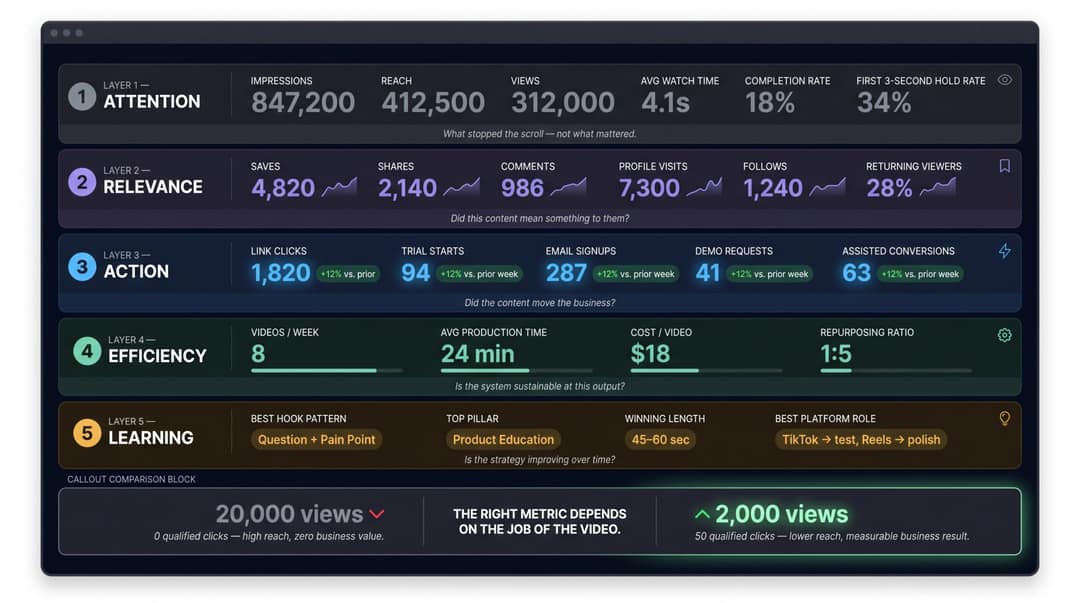
- Attention: did people stop and watch? Shown in feed, chose to view, average watch time, completion, first 3-second hold rate.
- Relevance: did it matter to them? Saves, shares, sends, comment quality, profile visits, follows.
- Action: did it move the business? Clicks, sign-ups, trial starts, demo requests, purchases.
- Efficiency: is the system sustainable? Videos per week, production time and cost per video, repurposing ratio.
- Learning: is the strategy improving? Winning hooks, pillars, lengths, CTAs and platform fit.
A video with 20,000 views and no clicks can be weaker than one with 2,000 views and 50 qualified clicks. The right metric depends on the job of the video.
Why your social media videos aren't performing
| Symptom | Likely issue | Fix |
|---|---|---|
| Low views, low retention | Weak hook or unclear first frame | Open on the result, tension or strongest visual |
| High views, low retention | Curiosity gap without payoff | Deliver value faster, cut the intro |
| High retention, low shares | Useful but not remarkable | Add a stronger POV, emotion or novelty |
| High saves, low comments | Helpful but not conversational | Ask a specific question or invite examples |
| High comments, low conversion | Engaged audience, wrong buyer fit | Adjust topic, CTA or targeting |
| High clicks, low conversion | Offer or landing page mismatch | Align the video's promise with the page |
| Good organic, poor paid | Not built for cold traffic | Write more direct hooks and lead with proof |
| Lots of output, no learning | No tagging | Tag by pillar, hook, format, platform, CTA |
| Automation burns credits | Scaling before validation | Pause, test by hand, restart with winners |
30-day social media content strategy launch plan
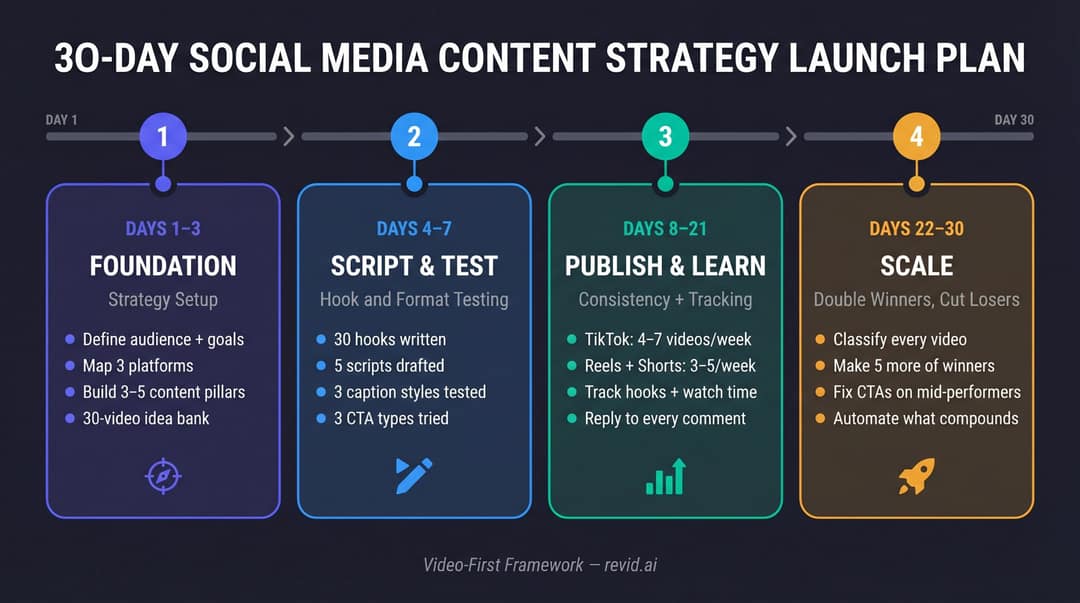
Days 1 to 3: set the foundation
Define:
- Your primary audience, with its viewing mode.
- The outcome you will prioritize first.
- 3 to 5 pillars with the four-part structure.
- 3 priority platforms, each with a distinct role.
- 5 repeatable formats, and baseline metrics from your existing content.
Output: a one-page strategy, a platform role matrix, an idea bank and your first 30 video ideas.
Days 4 to 7: write and test scripts
Write 30 hooks, 10 briefs and 5 scripts. Then pick 3 caption styles and 3 CTA types to test.
Days 8 to 21: publish and track
A starting cadence to adjust to your capacity:
- TikTok: 4 to 7 videos a week
- Instagram Reels: 3 to 5 a week
- YouTube Shorts: 3 to 5 a week
- LinkedIn: 2 to 4 a week
Track hook performance, watch time, completion, shares, saves, comments, follows and any conversion signal. Reply to comments: your best next video is often sitting under the last one.
Days 22 to 30: scale what works, cut what doesn't
| Result | What to do |
|---|---|
| High retention, high shares | Make 5 more variations |
| High retention, low action | Improve the CTA or audience fit |
| High views, low retention | Fix the hook and pacing |
| High saves, low comments | Add a stronger opinion or question |
| Low views, high conversion | Repurpose into paid or a niche channel |
| Low everything | Kill it or reframe it completely |
By day 30 you should know which pillars deserve more output, which hooks stop the scroll and which platform fits your audience best.
90-day scaling plan
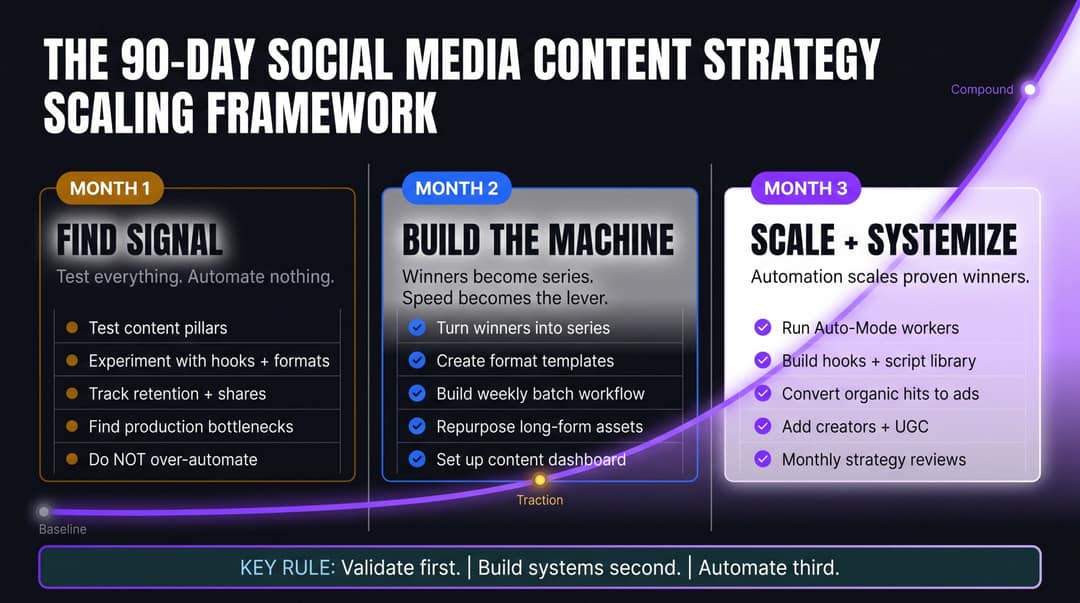
Month 1: find signal. Test pillars, hooks, formats, platforms and CTAs. Find where production gets stuck. Don't automate yet.
Month 2: build the machine. Turn winners into series. Template the formats that performed, run the weekly batch, start repurposing long-form assets, and set up a QA checklist and dashboard.
Month 3: scale. Automate proven content loops, build a library of winning hooks and scripts, and turn your best organic videos into ads. Add creators or customer UGC, and hold a monthly strategy review.
7 mistakes that stall a video-first strategy
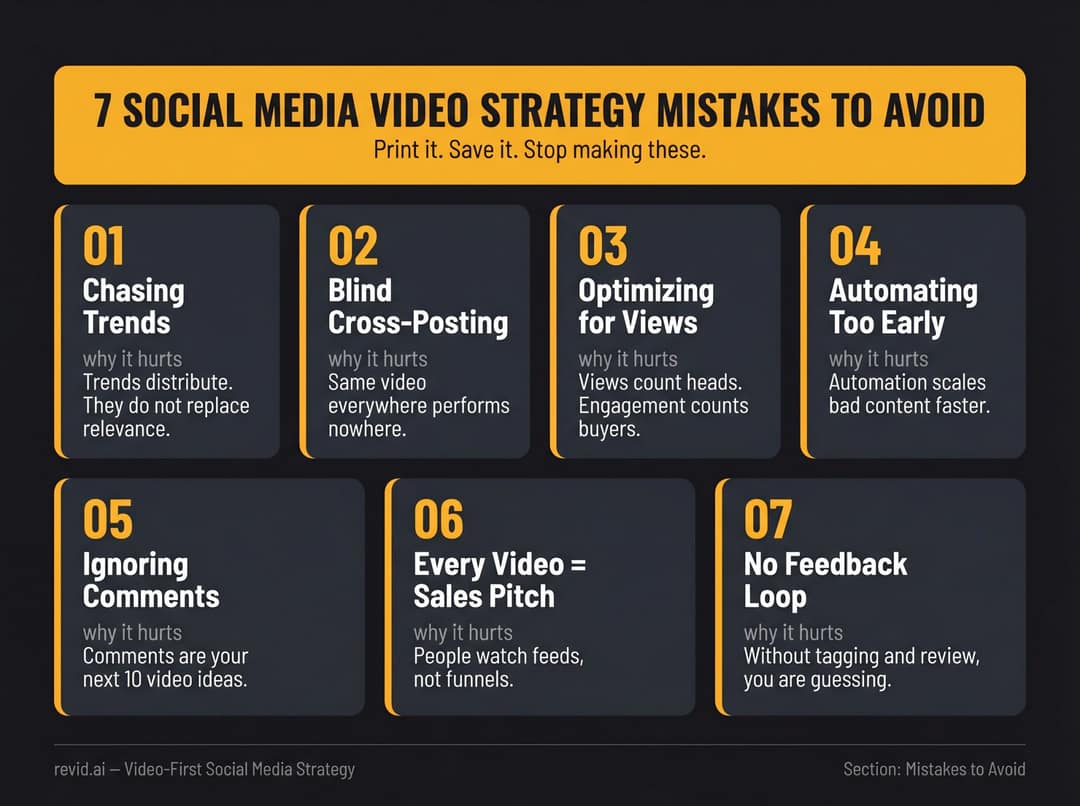
- Chasing trends before knowing your audience. Use a trend only when it makes your customer's problem easier to understand.
- Posting the same file everywhere. Adapt the hook, caption, title, CTA, cover and length per platform, and remove other apps' watermarks. Instagram caps posts at 5 hashtags. Since March 2026, Facebook deprioritizes reposts changed only with borders, captions or speed edits.
- Optimizing for views. Ask whether the right people watched, stayed, saved, shared or clicked.
- Automating before validating. Automation multiplies whatever you feed it, including weak formats.
- Ignoring comments. They hold objections, customer language and your next reply videos.
- Turning every video into a pitch. Earn attention first, guide action second.
- Not tagging what you publish. Without tags for pillar, hook, format, platform and CTA, you are guessing. A basic spreadsheet is enough.
Score your content system every month
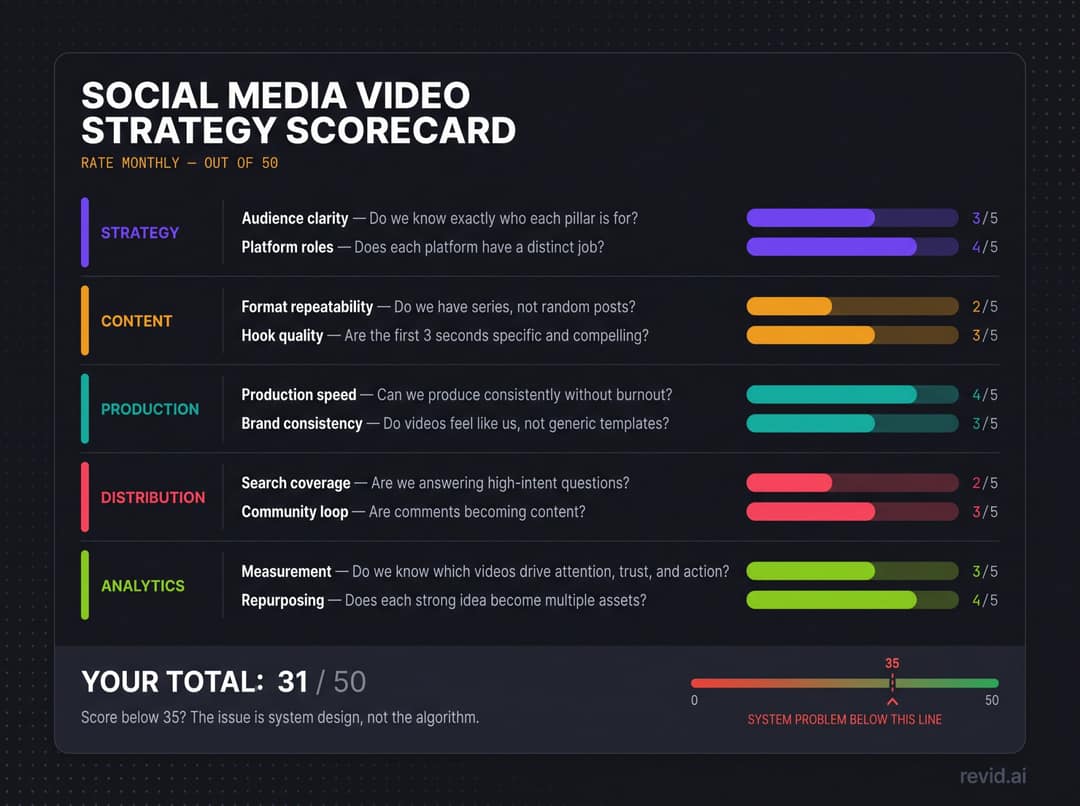
| Category | Question | Score |
|---|---|---|
| Audience clarity | Do we know exactly who each pillar is for? | /5 |
| Platform roles | Does each platform have a distinct job? | /5 |
| Format repeatability | Do we have series, not random posts? | /5 |
| Hook quality | Are the first 3 seconds specific and compelling? | /5 |
| Production speed | Can we produce consistently without burnout? | /5 |
| Brand consistency | Do videos feel like us, not generic templates? | /5 |
| Search coverage | Are we answering high-intent questions? | /5 |
| Community loop | Are comments becoming content? | /5 |
| Measurement | Do we know which videos drive attention, trust and action? | /5 |
| Repurposing | Does each strong idea become several assets? | /5 |
Below 35, the problem is probably not the algorithm. It's the system design.
FAQ
What is a social media content strategy?
A social media content strategy is a plan for what you publish, why you publish it, how you produce it consistently and how you measure whether it works. A strong one defines your audience, content pillars, platform roles, cadence and feedback loop, not just a list of post ideas.
How often should you post short-form videos?
There is no universal best frequency, so start with a cadence you can sustain without losing quality. For many small teams, 3 to 5 short videos a week on the main platform is realistic. Raise it once your formats are proven.
Do captions really matter on social media videos?
Yes. Captions make a video understandable with the sound off, improve accessibility and keep viewers oriented through fast cuts. Keep them large, high-contrast and inside the platform's safe zone.
Is a video-first strategy only for TikTok, Reels and Shorts?
No. The same ideas feed LinkedIn, Facebook, Pinterest, webinars, product pages, emails, ads and onboarding. Video-first means each idea is designed to work as video first, then repurposed everywhere it helps.
Can AI-generated videos be monetized?
On YouTube, yes, if the final video shows your creative vision and gives real educational or entertainment value. YouTube does not monetize mass-produced AI content made from generic templates, or incoherent AI clip compilations. You must disclose realistic AI-generated scenes.
Sources
- Revid analysis of 176,367 TikToks with 1,000+ likes posted between Oct 1, 2025 and Oct 16, 2026 (61,203 creators)
- Revid TikTok index: 2,377,477 TikToks with AI labels per video, snapshot of Sep 15, 2026. Median views estimated from view buckets.
- Wyzowl, Video Marketing Statistics 2026 (December 2025)
- Wyzowl, Video Marketing Statistics 2026 (December 2025)
Charts and figures checked on November 6, 2026.