
Social Media Content Strategy: 7 Steps to Authentic Engagement
A social media content strategy is a one-page plan: one goal, one audience problem, 3 to 5 content pillars, the right platforms, a flexible calendar and the metrics that decide what changes. Here is how to build it in 7 steps.

On this page
A social media content strategy is a written plan that answers six questions: which business goal your posts serve, who they are for, which 3 to 5 topics (content pillars) you cover, which platforms and formats you use, how often you publish, and which metrics decide what you change next. The 7 steps below build one.
The bar for "authentic" moved in 2026. In Sprout Social research published in March 2026, 50% of Gen Z said they had blocked, muted or unfollowed a brand or creator because its content felt like "AI slop", and 56% of consumers said they see slop often or very often. A strategy keeps your feed out of that pile: specific topics, a voice people recognize, and formats chosen on evidence instead of habit.
- Gen Z who blocked, muted or unfollowed a brand over content that felt like AI slop
- 50%
- Sprout Social, March 2026
- Marketers using short-form video, the most-used content format
- 60%
- HubSpot, September 2026
- Median views for TikTok challenges, the top format in Revid's data
- 182K
- Revid analysis of 176,367 TikToks
- Global shoppers who rely on UGC in their buying decisions
- 65%
- Bazaarvoice, November 2024
What a social media content strategy includes
| Component | The decision | Example (a small coffee roaster) |
|---|---|---|
| Goal | One business outcome | More online bean subscriptions |
| Audience | The problem they bring | Home brewers whose coffee tastes bitter |
| Content pillars | 3 to 5 recurring topics | Brewing fixes, behind the roast, customer setups, offers |
| Platforms and formats | Where you post, and in what shape | Reels and TikTok for tutorials, Shorts for repurposed clips |
| Calendar | What ships when | Planned posts plus open slots for trends |
| Voice and style guide | How you sound and look | Plain, slightly nerdy, no jargon |
| Metrics | What proves it works | Link clicks to the subscription page |
The parts work as a loop, not a checklist: what you measure at the end decides the goal and pillars for the next round.
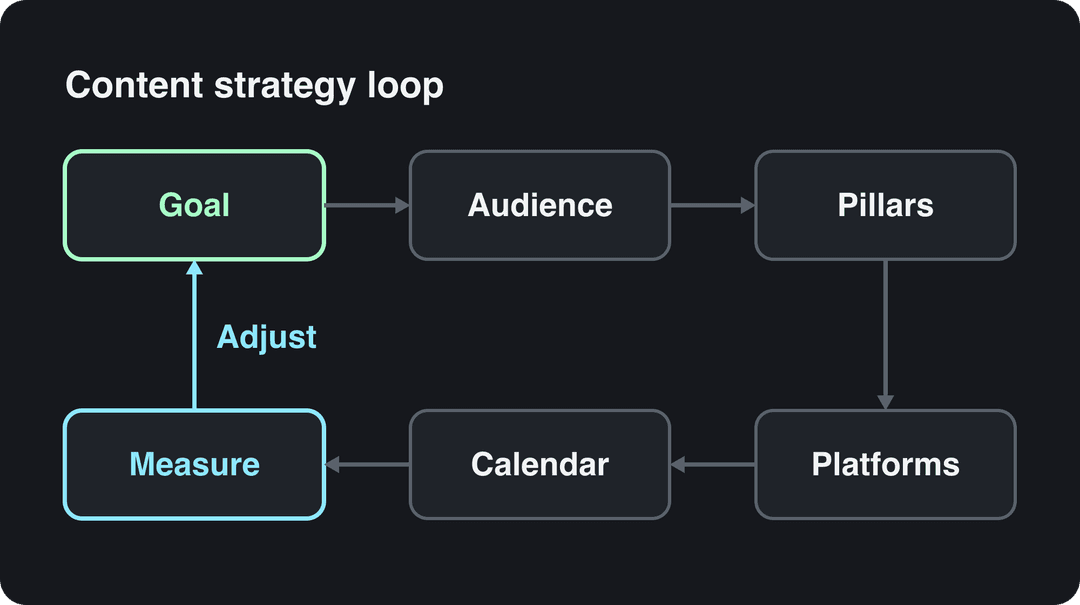
How to build a social media content strategy in 7 steps
1. Pick one goal and the metric that proves it
Most strategies fail here because the goal is "grow on social". Pick one outcome for the next quarter and write down the number that shows it moved.
- Awareness: views and reach from non-followers.
- Community: comments, shares and saves per post.
- Leads: link clicks and sign-ups from social.
- Sales: purchases or discount-code redemptions traced to social.
Decision rule: if you cannot name the metric, the goal is too vague to plan content around.
2. Describe your audience by the problem they bring
Demographics tell you who your audience is. Problems tell you what to post. "Home brewers whose coffee tastes bitter" hands you a list of video ideas. "Adults who like coffee" hands you nothing.
Where to find those problems:
- Comments on your posts and on competitors' posts (every question is a content idea).
- Search suggestions in TikTok, YouTube and Instagram when you type your topic.
- Customer support emails, sales calls and product reviews.
- Platform demographics, such as Sprout Social's running list of social media statistics, to check which networks your audience actually uses.
3. Choose 3 to 5 content pillars
A content pillar is a recurring topic with a job. With fewer than three, the feed gets repetitive. With more than five, nobody knows what you stand for. Give each pillar one job:
| Pillar job | Example pillar | Sample post |
|---|---|---|
| Educate | Brewing fixes | "Your pour-over tastes bitter because of your grind size" |
| Entertain | Behind the roast | POV: first crack at the roastery |
| Prove | Customer setups | A subscriber's morning routine, reposted with permission |
| Sell | Offers and launches | New single-origin drop, with the subscription link |
Most of your posts should come from the educate and entertain pillars. Sell posts work when the other pillars have already earned attention.
4. Match platforms and formats to your audience
Start where your audience already spends time, then expand. Short video is now the shared default: in HubSpot's 2026 State of Marketing data, 60% of marketers use short-form video, the most-used content format (more in our short-form video statistics). In Sprout Social's 2026 Content Strategy Report, 50% of social media users said they have a TikTok profile, rising to 72% among Gen Z.
Audiences overlap less than you might think. Google, citing GWI data from February 2025, said 45% of YouTube Shorts users are not on TikTok and 65% are not on Instagram Reels. Adapting one video for each platform reaches people the original never would.
Each platform has rules that change how you plan:
| Platform | Plan around | Rule to know (October 2026) |
|---|---|---|
| TikTok | Short video, trends, search | Uploads can be up to 60 minutes; TikTok Studio's Viewers tab shows when viewers were most active over the last 7 days |
| Reels, carousels, Stories | Reels over 3 minutes are not recommended to non-followers; up to 5 hashtags per post; trial reels show a reel to non-followers first (professional accounts need 200 followers) | |
| YouTube Shorts | Vertical video up to 3 minutes | A Short longer than one minute with an active Content ID claim is blocked globally |
| Reels (every new video is now a reel) | Since March 2026, reaction-only, clip-stitching and lightly edited reposts count as unoriginal and are deprioritized | |
| Professional video and text | Videos up to 15 minutes; the vertical video feed is mobile-only, and any video you post may appear there |
Decision rule: if you can only staff one or two platforms, choose the ones where your audience's problem gets searched and discussed, not the ones where you personally scroll.
Prompt to try
Create a 30-second faceless vertical video framed as a challenge: "Can I fix a bitter pour-over using only what's in this kitchen?" Open with the bitter first sip as the hook, then show three quick fixes (coarser grind, cooler water, shorter brew) as on-screen steps. Use upbeat stock footage of a home kitchen, bold captions and a curious, slightly nerdy voice.
5. Plan posts that teach and entertain
Brand content that teaches something in an entertaining shape ("edutainment") is the easiest kind to share. Sprout Social's 2024 content strategy report asked consumers what they want from brand content on social. In HubSpot's 2026 research, 48% of marketers said funny content yields the highest ROI among short-form content types.
Format choice also shows up in engagement data. In Revid's analysis of 176,367 TikToks with 1,000+ likes posted between October 2025 and October 2026, challenges had a median of 182K views and comedy 155K, while storytelling (66K) and tutorials (62K) trailed. The sample only holds videos that already did reasonably well, so it shows what top videos have in common, not a guarantee. The method is in our study of what makes a TikTok go viral.
Challenges and comedy passed 1M views about twice as often as tutorials and storytelling, which are the most common formats.
Source: Revid analysis of 176,367 TikToks with 1,000+ likes posted between Oct 1, 2025 and Oct 16, 2026 (61,203 creators)
Show the data
| Median views | Share that passed 1M views | |
|---|---|---|
| Challenge | 182.3K | 25.6% |
| Comedy | 154.8K | 22.1% |
| Reaction | 104.8K | 16% |
| Dance | 83.8K | 15.5% |
| Storytelling | 66.1K | 12.2% |
| Lip Sync | 61.7K | 12.3% |
| Tutorial | 61.9K | 12.1% |
The lesson is not to drop tutorials. Wrap them in a stronger format instead. In the same TikTok data, faceless tutorials had a 156K median, against 52K for on-camera tutorials. Turn each tip into a challenge, a reaction or a POV:
- Tutorial as challenge: "Can I fix a bitter pour-over using only what's in this kitchen?"
- Tutorial as reaction: react to a viral brewing hack and test whether it works.
- Tutorial as POV: "POV: you finally dial in your grinder", with the steps as on-screen text.
For animated how-tos that need no filming, an explainer video maker turns a script into a short video. The talk below is about presentations, but its audience engagement techniques (questions, stories, interaction) carry over to how you open a video.
The day matters far less than the hour: every weekday lands within a few percent of the others, and Saturday and Sunday posts pass 1M views slightly more often.
Source: Revid analysis of 123,704 English-language TikToks with 1,000+ likes posted between Oct 1, 2025 and Oct 16, 2026
Show the data
| Median views | Share that passed 1M views | |
|---|---|---|
| Monday | 63.5K | 12.5% |
| Tuesday | 63.5K | 12.4% |
| Wednesday | 62.7K | 12.5% |
| Thursday | 64.6K | 12.5% |
| Friday | 64.5K | 12.6% |
| Saturday | 70.2K | 13.4% |
| Sunday | 65.1K | 13.6% |
6. Build a calendar with room for trends
A content calendar turns pillars into dates. Plan the core posts ahead (tutorials, launches, recurring series) and leave open slots for trends and news. Those slots matter more than they used to: Meta said same-day posts made up more than 30% of recommended Reels on Instagram and Facebook in Q1 2026, more than double the level a year earlier.
- Give each pillar a recurring slot (for example, brewing fixes every Tuesday).
- Batch-produce planned posts so trend slots get your attention, not your leftover time.
- Keep a trend backlog of sounds, formats and topics you could adapt to a pillar.
- Schedule planned posts in advance so they go out even on busy days.
For templates, see how to create a social media content calendar.
Add a pause rule. Write down who can stop scheduled posts and when: a product problem, a public complaint, sensitive news. A cheerful scheduled post during a crisis does more damage than silence.
7. Measure, then change one thing at a time
| Goal | Primary metric | Supporting signal | Where to find it |
|---|---|---|---|
| Awareness | Views and reach from non-followers | Follows per post | TikTok Studio, Instagram insights, YouTube Studio |
| Community | Comments and shares per view | Saves, replies | Post-level analytics |
| Leads | Link clicks | Sign-ups from tagged (UTM) links | Platform insights plus your web analytics |
| Sales | Purchases from social | Discount-code use | Store dashboard |
TikTok analytics live in TikTok Studio (profile > menu > TikTok Studio > Analytics), with date ranges of 7, 28, 60 or 365 days. Instagram insights now lead with Views, and follower activity insights need at least 100 followers. For definitions of each metric, see our guide to video engagement metrics.
Review on a fixed rhythm and keep whatever beats your own median. Change one variable per test (hook, format, length or posting time) so you know what caused the result.
Prompt to try
Make a 25-second POV video: "POV: you finally stop buying the trendy gadget and fix the real problem." Hook with an honest pros-and-cons line in the first two seconds, then give one plain tip from your niche with real-looking footage and simple captions. Keep the tone casual and direct, like a creator talking to a friend.
How to keep your content authentic
Authentic does not mean unpolished. It means recognizably yours and honest about what it is.
- Write a style guide. Set the tone (words you use and words you never use), the visual rules (fonts, colors, caption style) and how you reply to comments. Anyone posting for you should sound like you.
- Show real people and real opinions. In Clutch's October 2025 survey, 44% of US consumers said they prefer casual, authentic videos from independent creators over polished brand spots. Bazaarvoice found that 43% of shoppers trust creators who share both the pros and cons of a product.
- Post original work. On July 15, 2025, YouTube renamed its "repetitious content" monetization policy to "inauthentic content" to cover repetitive or mass-produced videos. Facebook deprioritizes reposts that only add borders, captions or speed changes.
- Label realistic AI. TikTok, YouTube and Meta all ask you to disclose realistic AI-generated video or audio. TikTok and YouTube both say the label alone does not reduce distribution, so there is no reason to skip it.
How to use user-generated content (UGC)
In Bazaarvoice's Shopper Experience Index (November 2024), 65% of global shoppers said they rely on UGC such as ratings, reviews, photos and videos in their buying decisions. It is one of the sourced UGC statistics we track. For broader numbers on how social shapes buying, see Sprinklr's roundup of social media marketing statistics.
Run a UGC program in four steps:
- Ask on purpose. Put a branded hashtag on packaging, add a prompt to your order email ("show us your setup") or run a recurring customer feature.
- Curate. Pick posts that show the product in real use and fit one of your pillars.
- Get permission and credit. Ask before you repost, keep a record of the yes, and tag the creator.
- Reuse it. Share it in your feed, Stories and ads. Meta reported that adding partnership ads (creator content run as ads) to regular campaigns delivered 19% lower CPAs and 13% higher click-through rates on average.
How to scale content without losing quality
Scale comes from reusing ideas, not from inventing more of them. Turn one strong idea into a blog post, a short video, a carousel and a newsletter section, and remake your best performers in new formats. Our guide on how to repurpose video content covers the full workflow.
How to produce the videos with Revid
Revid handles the video side of your strategy, from finding a format to publishing:
- Start from a proven format. Search Revid's library of about 2.77 million short-form videos by topic, open a high-engagement one and choose "Make it about your topic". Revid applies its hook style, pacing and energy to your pillar (repurpose viral videos).
- Or start from what you have written. Article to video turns a blog post or link into a narrated vertical video with a script, AI voice-over, captions and visuals.
- Edit and schedule. Fix any scene in the timeline editor, then schedule to TikTok, Instagram and YouTube from one publishing queue.
- Automate a recurring pillar. An Auto-Mode worker creates a fresh video every day from a prompt or a content source. The Growth plan ($39/month) includes 3 workers.
Your one-page strategy template
Copy this and fill it in before you plan a single post:
- Goal this quarter:
- Metric that proves it:
- Audience problem:
- Pillars (3 to 5), each with its job:
- Platforms and main format on each:
- Recurring calendar slots plus trend slots:
- Who can pause posts, and when:
- Review rhythm and the one variable you will test next:
FAQ
How often should you post on social media?
Post as often as you can keep quality up, on a schedule you can sustain. No platform publishes an ideal number. Check when your audience is active in TikTok Studio's Viewers tab or Instagram's follower insights. In Revid's TikTok data (videos with 1,000+ likes), posts at 3 to 6 a.m. US Eastern had the highest median views, partly because those hours are daytime in Europe and Asia.
What is the difference between a content strategy and a content calendar?
The strategy decides why, for whom and what you post: goal, audience, pillars, platforms and metrics. The calendar decides when each post goes out. Build the strategy first, or the calendar just fills dates with random posts.
Should you post the same content on every platform?
Post the same idea, adapted to each platform. Change the crop, caption, hashtags and length: Instagram allows up to 5 hashtags per post, and Facebook deprioritizes reposts that only add borders, captions or speed changes.
How many hashtags should you use?
Use a few specific ones. In Revid's TikTok data, posts with 4 hashtags had the best median (77K views), while posts with 9 or more had only 16K. On Instagram, the limit is 5 per post.
Can AI-generated content be part of an authentic strategy?
Yes, as long as it carries your own ideas and you disclose realistic AI. YouTube allows AI-assisted videos that show the creator's creative vision but won't monetize mass-produced template content, and TikTok and Meta require labels on realistic AI video.
Sources
- Revid analysis of 176,367 TikToks with 1,000+ likes posted between Oct 1, 2025 and Oct 16, 2026 (61,203 creators)
- Revid analysis of 123,704 English-language TikToks with 1,000+ likes posted between Oct 1, 2025 and Oct 16, 2026
- Sprout Social, Social Media is Now the Top Source for Breaking News, New Sprout Social Research Finds (press release) (March 2026)
- HubSpot, The Future of Social Media [Research]: What Marketers Need to Know in 2026 (September 2026)
- Bazaarvoice, Shopper Experience Index Vol. 18 (press release) (November 2024)
Charts and figures checked on November 6, 2026.