Facebook Video Ads in 2026: Best Practices, Specs and 8 Examples
How to make Facebook video ads that work in 2026: placements, specs, seven best practices backed by Meta data, and 8 real ads broken down with what to copy.
On this page
Facebook video ads are video creatives you run through Meta Ads Manager in Feed, Reels, Stories, in-stream and Audience Network placements. The ones that work in 2026 hook viewers in the first 2 to 3 seconds, make sense with the sound off, start from a 9:16 master that crops cleanly to 4:5, and end on one clear call to action.
The format underneath has changed. Since a June 2025 change, every new Facebook video is shared as a reel. Meta says Facebook video time spent grew 9% globally year over year in Q2 2026 (more in our short-form video statistics). A widescreen brand film that opens on a logo was built for a screen your buyers no longer look at.
- Growth in Facebook video time spent globally, year over year in Q2 2026
- 9%
- Meta Platforms, July 2026
- Lower CPA when partnership ads are added to business-as-usual campaigns
- 19%
- Meta, December 2025
- Higher offsite conversion rate for partnership ads with a creator testimonial
- 7.5%
- Meta, December 2025
- Safest length for a first Facebook video ad cut in Feed and Stories
- 15s
Where do Facebook video ads appear?
When you run video ads on Facebook, you choose placements: the surfaces where the ad can show. The same campaign can also run on Instagram, because both use Meta Ads Manager.
| Placement | What the viewer sees | Shape to deliver |
|---|---|---|
| Facebook Feed | Your ad between posts in the main feed | 4:5 |
| Facebook Reels | A full-screen ad between reels | 9:16 |
| Facebook Stories | A full-screen ad between stories | 9:16 |
| In-stream | An ad that plays inside someone else's video | Check the Meta Ads Guide |
| Audience Network | Ads inside partner apps, including rewarded video | Check the Meta Ads Guide |
| Instagram Feed, Reels, Stories | The same ad, from the same campaign | 4:5 or 9:16 |
Advantage+ placements let Meta spread your budget across all of these and favor whichever delivers results at the lowest cost. Use manual placements only when you have a reason to exclude one, for example an in-app placement that sends clicks that never convert. For background on the platform itself, Facebook's Wikipedia entry covers its history and audience size.
Facebook video ad specs
Meta's recommendations for Facebook Reels are the safest baseline for any Facebook video ad, since Reels is now the default video surface.
| Setting | Recommended |
|---|---|
| File | .mp4 |
| Resolution | 1080p |
| Video codec | AVC or HEVC |
| Frame rate | 24 to 60 FPS |
| Audio | AAC stereo, 44.1 or 48 kHz |
| Aspect ratio | 9:16 master; 4:5 for Feed |
Maximum length and file size differ by placement and change often, so check the Meta Ads Guide before you export a long cut. For other platforms, see our social media video sizes guide.
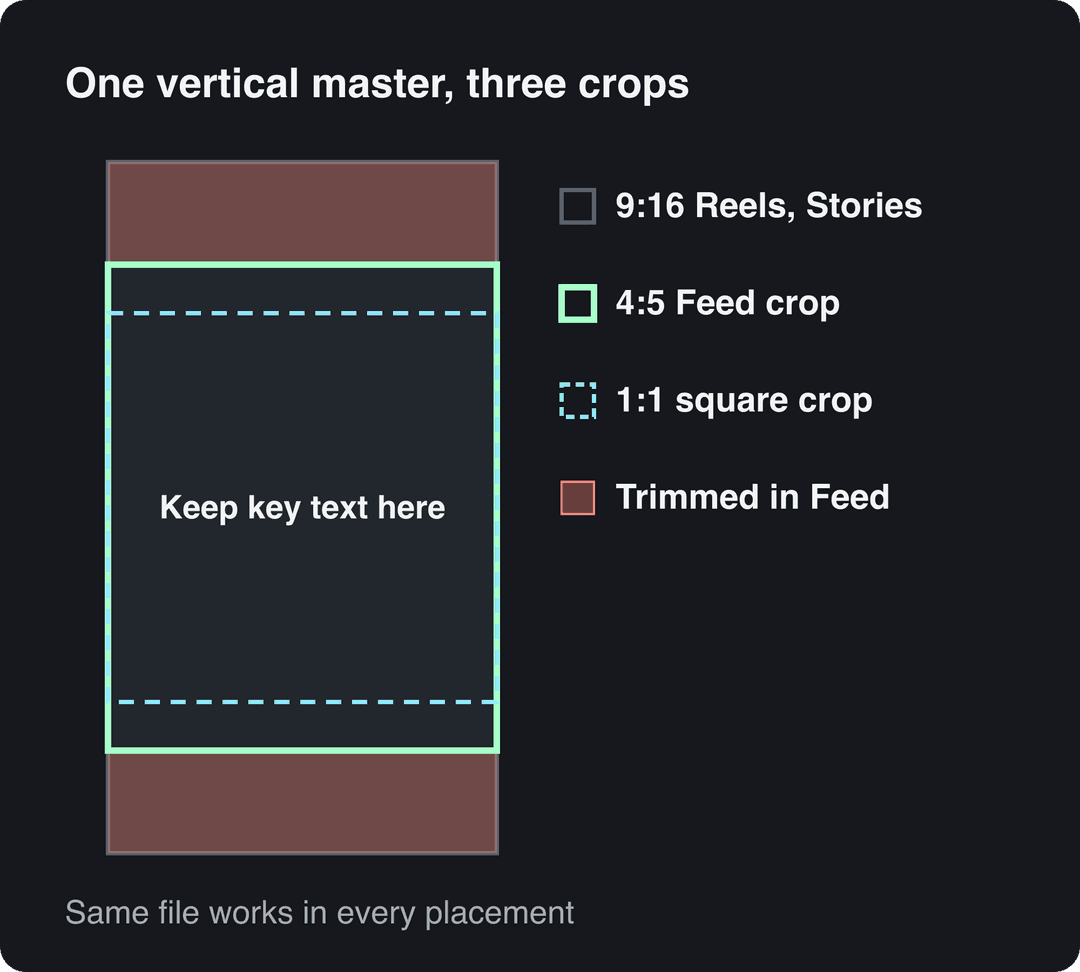
The practical rule: shoot or generate one 9:16 master and keep your product, faces and on-screen text inside the central square (1:1). That single file then runs full size in Reels and Stories and survives the trim to 4:5 in Feed.
Facebook video ad best practices
1. Hook in the first 2 to 3 seconds
People decide in the opening frames whether to stop scrolling. Put the most interesting thing first: the result, the product in use, or a line that names the viewer's problem. Cut the logo intro.
Hook lines that follow this pattern:
- "Your deodorant stops at your armpits. This one doesn't."
- "Here's how you send mass emails without copy-pasting a single address."
- "Why split the group across hotel rooms?"
- "Stop doing [annoying task] by hand."
- "This is what [product] looks like after 3 months of daily use."
2. Design for sound off
Many people scroll Facebook with the sound muted, so the ad has to work as pictures and text alone. Burn captions into the video instead of hoping viewers turn them on, put the offer in a one-line text overlay, and show the product doing its job rather than describing it. If your footage has speech, Revid's AI caption generator adds synced captions in 100+ languages.
The same pattern shows up in organic data. In Revid's analysis of 176,367 TikToks with 1,000+ likes posted between October 2025 and October 2026, videos with under 40 characters of speech had a median of 123K views and 20.2% passed 1M views, against 68K and 11.9% for videos that talked throughout. This is TikTok data on organic posts that already did reasonably well, not Facebook ad results, and it shows what strong videos have in common rather than causes. The lesson still carries over: let the visuals do most of the work. The method is in our study of what makes a TikTok go viral.
Videos with just a few spoken words (a line or two) beat both silent videos and videos that talk the whole way through, which were the most common and the weakest.
Source: Revid analysis of 176,367 TikToks analyzed by AI, with 1,000+ likes posted between Oct 1, 2025 and Oct 16, 2026 (61,203 creators)
Show the data
| Median views | Share that passed 1M views | |
|---|---|---|
| No speech | 73.3K | 14.3% |
| Under 40 | 122.7K | 20.2% |
| 40 to 120 | 97.2K | 17.6% |
| 120 to 300 | 91.6K | 16.8% |
| 300+ | 67.7K | 11.9% |
3. Frame for every crop
A vertical ad that looks fine in Reels can lose its headline when Feed trims it to 4:5, and the Reels interface covers the bottom of the frame with the caption and CTA button. Keep text away from the top, the bottom and the right edge. If you only have a widescreen or square video, resize it to 9:16 or 4:5 instead of padding it with black bars.
Prompt to try
A 15-second vertical 9:16 video ad for a reusable insulated water bottle. Open with the hook "Your coffee is cold by 10 a.m. This one stays hot till dinner" while the bottle is poured steaming hot. Show one benefit, then the offer "Free shipping this week" as a bold text overlay. Clean, bright product style with burned-in captions so it works on mute, ending on a Shop Now end card.
4. Keep the first cut at 15 seconds or less
For Facebook short video ads in Feed and Stories, a cut of 15 seconds or less is the safest starting point: product in the first seconds, one benefit, the offer, the CTA. Reels can carry a longer demo or testimonial once the short cut has proven the angle. If your source is a long recording, cut several short ads from it rather than running the whole thing.
5. One message, one call to action
Each ad should sell one benefit and ask for one action. Match the CTA button to the campaign goal, and repeat the action on an end card or text overlay so it registers on mute.
| Goal | CTA buttons used in the examples below |
|---|---|
| Online sales | Shop Now, Get Offer |
| Bookings | Book Now |
| App installs | Install Now |
| Sign-ups | Sign Up |
| Consideration | Learn More |
Posts promoting a brand
Source: Revid social index: 388,379 posts from X, Instagram, Threads, Reddit and LinkedIn with AI labels per post, snapshot of Sep 15, 2026.
Show the data
| Posts promoting a brand | |
|---|---|
| 26% | |
| X | 24.5% |
| Threads | 15.4% |
6. Use creator-style footage
A person on camera talking like a customer, filmed on a phone, reads as a recommendation rather than an ad. Meta has numbers on this. In December 2025 it reported that adding partnership ads (creator content run as ads) to business-as-usual campaigns delivered 19% lower CPAs and 13% higher click-through rates on average. Partnership ads featuring a creator testimonial drove a 7.5% higher offsite conversion rate and a 9.6% higher offsite click-through rate. More sourced figures are in our UGC statistics.
7. Test creatives, not only audiences
Run several videos with the same copy and audience so the creative is the only variable. Grammarly does exactly this below: one caption, three completely different videos. Give each variant at least 2 to 3 days, longer if the ad set is still in Meta's learning phase, then compare cost per result rather than views. Keep the winner, replace the losers with new angles, and repeat.
8 Facebook video ad examples and what to copy
The ads below were captured from Facebook in 2024. The brands have since moved on to new creatives, but the structures still apply. To see what any advertiser runs today, search its name in Meta's free Ad Library.
1. Sephora Middle East
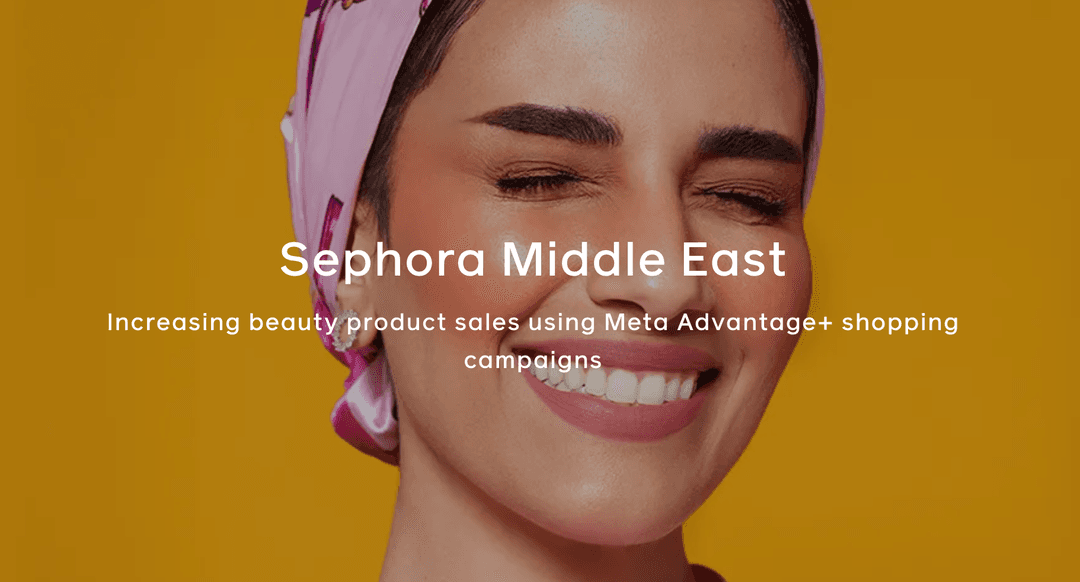
Meta's Sephora Middle East success story describes how the retailer used Advantage+ shopping campaigns to grow beauty product sales, letting Meta's automation handle audiences and placements. The takeaway for a smaller advertiser: give an automated campaign several strong creatives and let delivery find the winner, instead of betting on one ad.
2. Airbnb

Airbnb opens with a question that names the problem (staying apart in hotel rooms) and answers it with a single image of a house built for a group. One benefit, one picture, a Book Now button. If your product solves a shared problem, show the shared outcome, not the feature list.
3. Grammarly
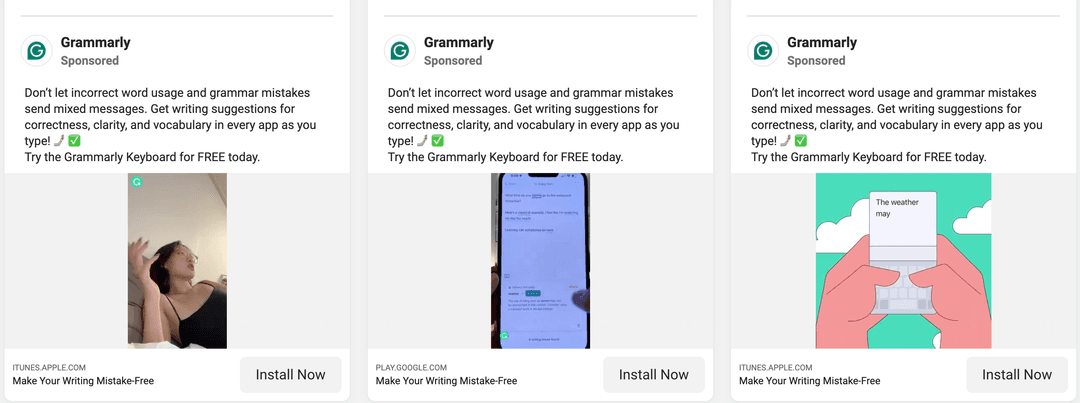
Grammarly ran the same caption and Install Now button over three different videos: a creator talking to camera, a screen recording of the keyboard in use, and a flat animation of hands typing. This is creative testing done cleanly. Write your caption once and test talking head, demo and animation against each other.
4. Oreo
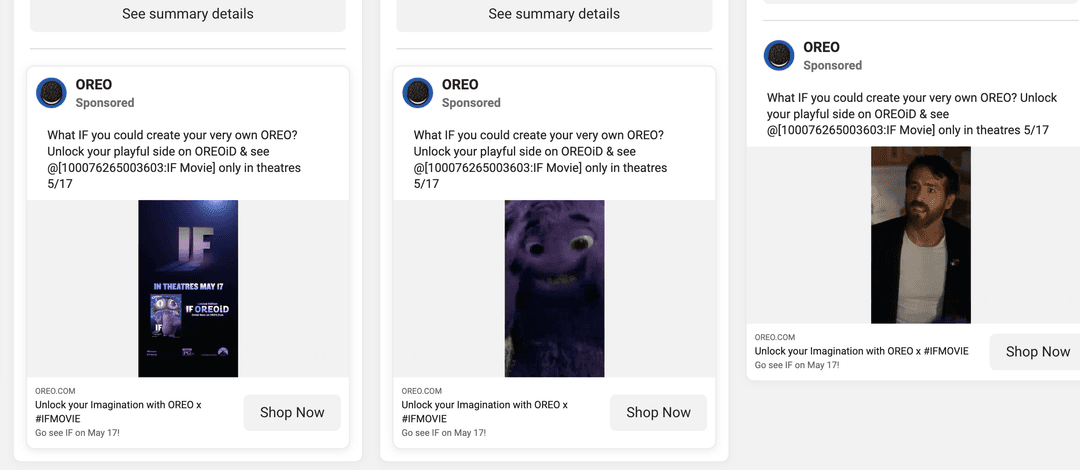
Oreo tied its ad to the release of the movie IF and rotated three vertical clips: the poster, the purple IF character and a scene with the film's star. A cultural moment gives the ad a reason to run this week. If you have a seasonal or event hook, build a short burst of ads around it and retire them when the moment passes.
5. Lume Deodorant
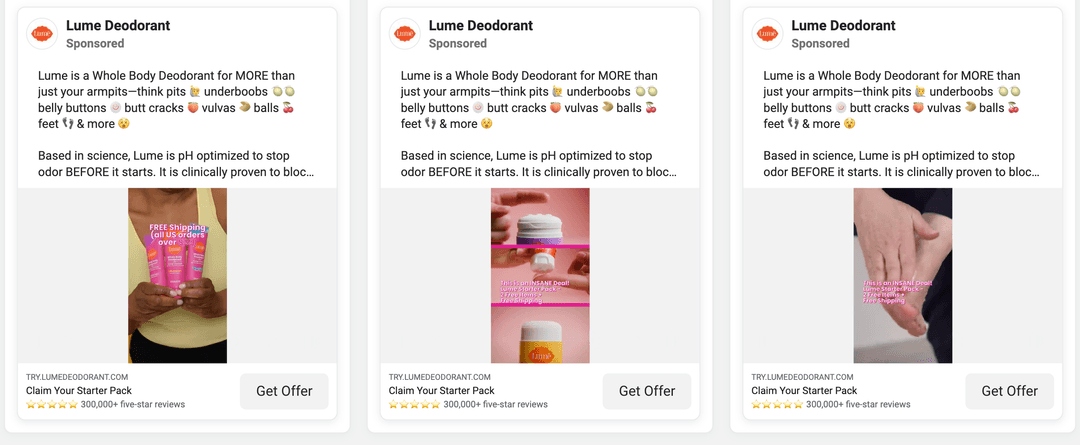
Lume's three variants all put the offer on screen as text (free shipping, a deal banner) over hands holding and applying the product. The ad works on mute, and the headline "Claim Your Starter Pack" matches the Get Offer button. Put the offer inside the video, not only in the caption.
Input
Create a short vertical product promotion video for InnerNote. Positioning: LinkedIn posts that actually sound like you, not a robot.
Output
6. monday.com

monday.com uses a presenter seated next to a laptop showing the product, with a burned-in how-to hook: "Here's how you send mass emails". It promises a useful lesson rather than a pitch, so the Sign Up button feels like the next step. Software sells well as a short tutorial.
7. Allbirds
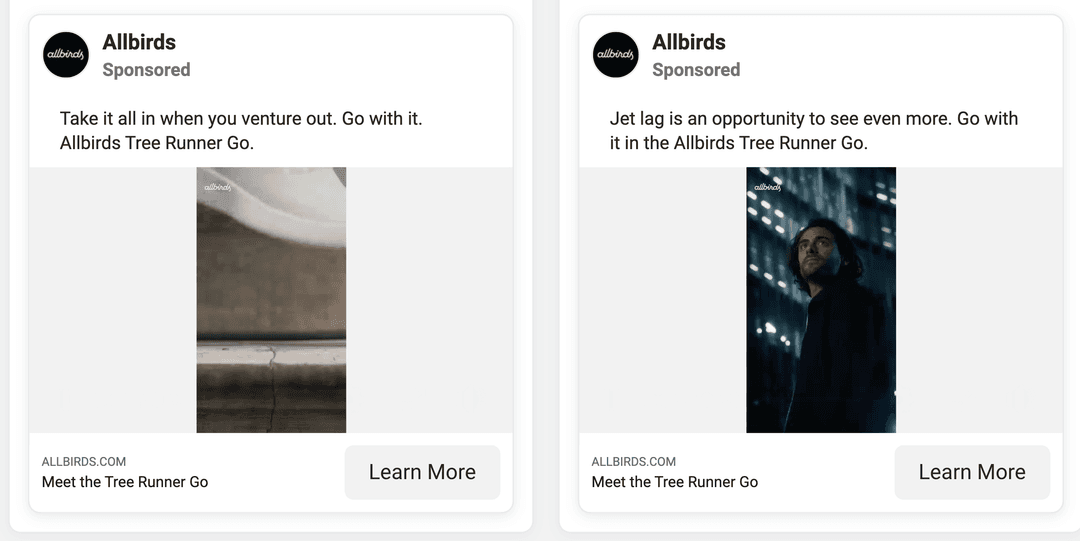
Allbirds runs two vertical, mostly wordless clips (a close-up of the shoe on pavement and a traveler in a city at night) with copy about travel and jet lag. It sells a mood rather than a feature, with Learn More as a low-pressure CTA. This works for premium products where the feeling is the reason to buy, as long as the brand stays visible in frame.
8. Mailchimp
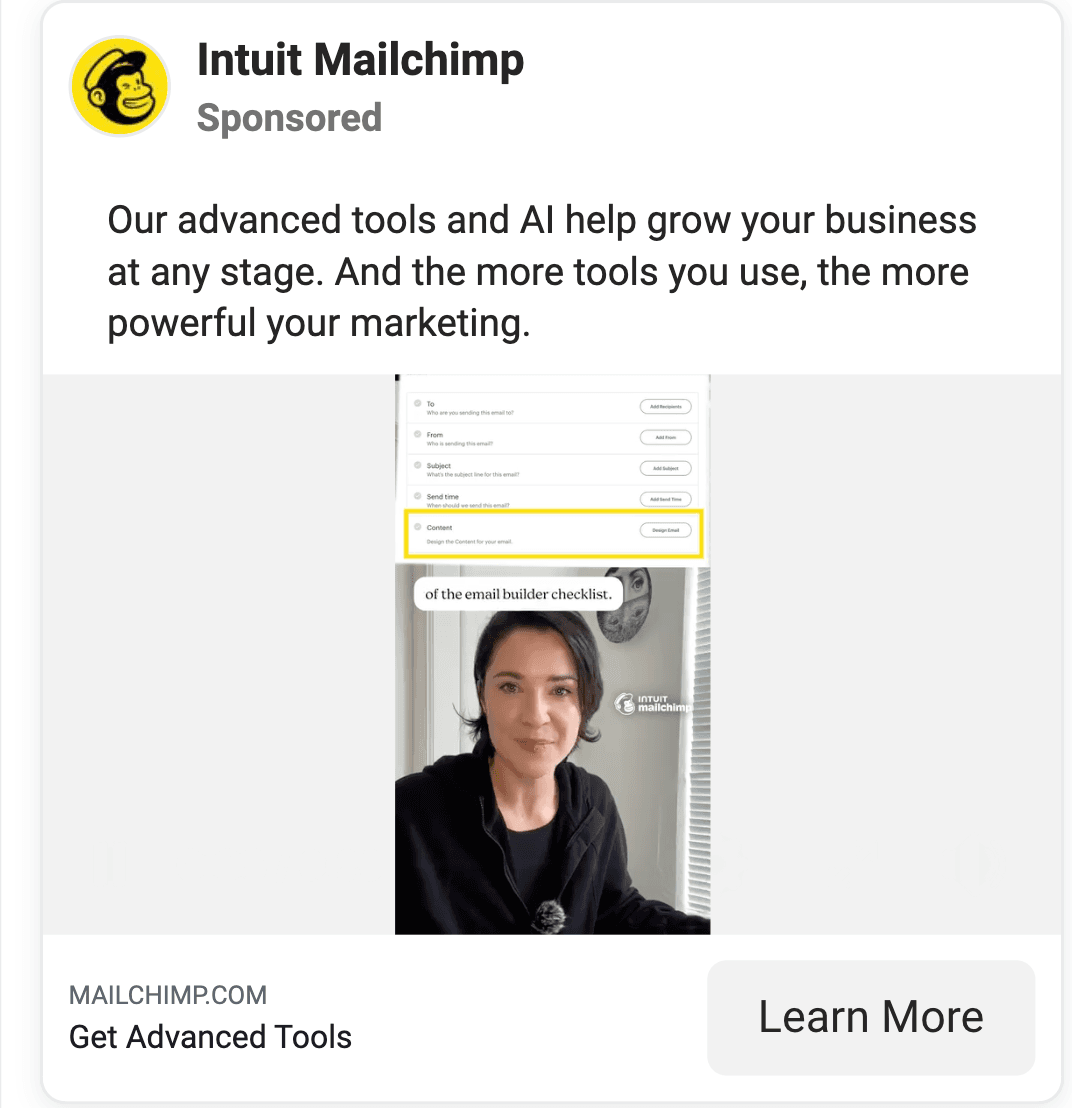
Mailchimp stacks a screen recording of its email builder above a presenter explaining it, with captions over the split. The viewer sees the product and the person at once, which is the fastest way to explain software on mute. If your product lives on a screen, try this split layout before paying for a polished demo.
How to launch a Facebook video ad in Ads Manager
- Choose the objective that matches the action you want: Sales, Leads, App promotion, Traffic, Engagement or Awareness.
- Set the audience and budget in the ad set. Broad audiences give Meta's delivery room to find buyers; narrow them only with a reason.
- Pick Advantage+ placements or select placements manually.
- In the ad, upload your 9:16 master (plus a 4:5 version if you want full control of Feed), then write the primary text and headline and pick the CTA button.
- Add two or three more videos as separate ads so you have something to compare.
- Publish, let it run, then read cost per result, click-through rate and conversion rate in reporting.
If you only want more reach for a video that already does well organically, boosting it from your Page is quicker, but you give up most of the testing and placement control.
What are rewarded video ads on Facebook?
Rewarded video is a format on Meta Audience Network, the network of partner apps (often mobile games) where people choose to watch a video ad in exchange for an in-app reward such as an extra life or coins. As an advertiser you don't build a special rewarded ad: your video can show there when Audience Network is included in your placements. Because viewers opt in for the reward rather than for your product, judge this placement on conversions, and exclude Audience Network if it brings views that never buy. App developers who want to earn from rewarded video set it up through Audience Network's SDK, a separate process from buying ads.
How to make Facebook video ads with Revid
If you have no footage and no one to film, Revid can generate the ad from what you already have:
- For a product ad, upload product images to the AI ad generator and Revid builds a video ad around them.
- For a creator-style ad like the monday.com or Grammarly examples, the UGC ad generator produces a UGC-style video with a natural-looking AI avatar.
- Adjust scenes in the timeline editor, keep captions on, and make one version per angle you want to test.
- Export in 1080p (or 4K) at 30 or 60 fps and upload the MP4 in Ads Manager.
For other options side by side, see our ranking of the best AI video editors for ads. To support your ads with organic posts, read how to create videos for Facebook that people actually watch.
FAQ
How much do Facebook video ads cost?
There is no fixed price. You set a daily or lifetime budget, and Meta's auction decides what each impression costs based on your audience, placement, objective and competition. Budget enough to run each variant for several days so the comparison means something.
Should I boost a video or use Ads Manager?
Boost when a post or reel already performs organically and you just want more reach. Use Ads Manager when you need a specific objective, placement control, several creative variants or conversion tracking.
Are all Facebook videos Reels now?
Yes, for organic posts: since a June 2025 change, every new Facebook video is shared as a reel and the Video tab was renamed Reels. Ads still let you choose placements, so the same file can run in Feed, Reels and Stories.
Can I use AI-generated video in Facebook ads?
Yes. Meta may show an "AI info" label when it detects industry-standard AI signals, and it requires disclosure of photorealistic video or realistic audio that was digitally created or altered. Never present an AI avatar as a real customer: in the US, the FTC's 2024 rule on fake reviews bans testimonials attributed to people who do not exist.
Sources
- Revid analysis of 176,367 TikToks analyzed by AI, with 1,000+ likes posted between Oct 1, 2025 and Oct 16, 2026 (61,203 creators)
- Revid social index: 388,379 posts from X, Instagram, Threads, Reddit and LinkedIn with AI labels per post, snapshot of Sep 15, 2026.
- Meta Platforms, Meta Q2 2026 Results Conference Call transcript (July 2026)
- Meta, New AI-powered tools to scale creator and brand partnerships (December 2025)
- Meta, New AI-powered tools to scale creator and brand partnerships (December 2025)
Charts and figures checked on November 6, 2026.