How to Increase Brand Awareness: A Step-by-Step Plan for 2026
A step-by-step plan to increase brand awareness: make your brand recognizable, choose the right channels, publish short-form video that doesn't look like an ad, and measure what matters.
On this page
To increase brand awareness, make your brand easy to recognize (the same name, look and voice everywhere), choose the one or two channels where your buyers spend time, and publish useful content there every week, with short-form video as the main format. Then borrow reach from customers, creators and local partners, and track branded search and direct traffic.
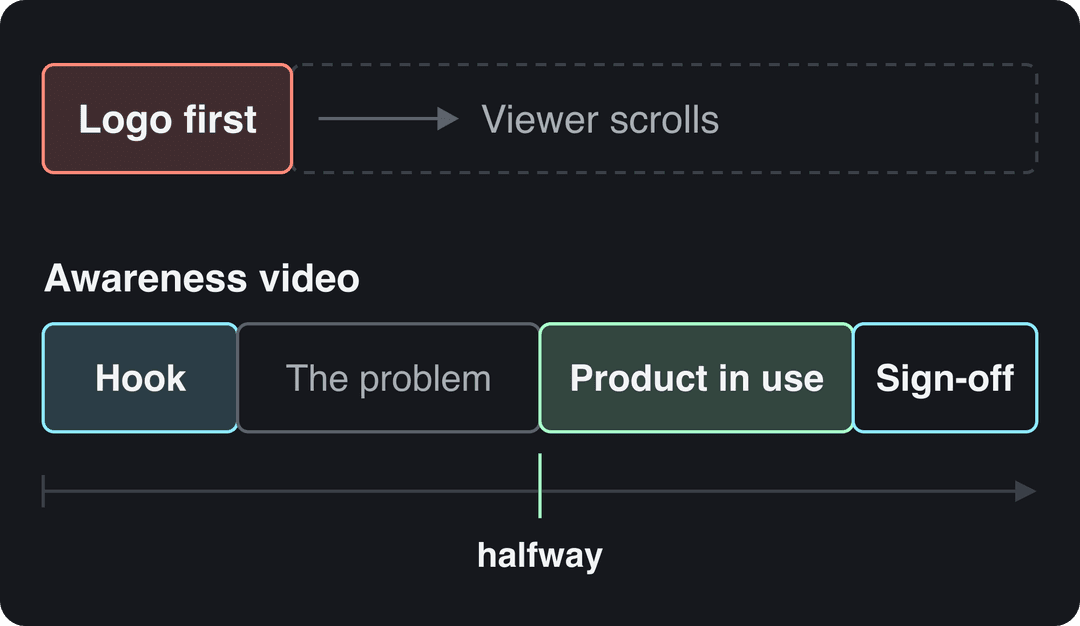
The most common mistake is making awareness content that looks like an ad. In Revid's analysis of 517,105 TikToks, posts promoting a brand had a median of about 57,000 views, 29% fewer than the 80,000 of non-branded posts. People share what helps or entertains them. A logo in the first second tells them to keep scrolling.
- Fewer median views for brand-promoting TikToks than non-branded posts
- 29%
- Revid analysis of 517,105 TikToks
- Marketers naming short-form video their top ROI content format
- 49%
- HubSpot, 2026
- U.S. adults under 30 who use TikTok
- 63%
- Pew Research Center, March 2026
- U.S. consumers who see creators they follow as trusted sources
- 83%
- Deloitte Digital, May 2025
Make your brand recognizable before you make it louder
Awareness only pays off if people remember whose post they just saw. That takes a brand that looks, sounds and acts the same way everywhere, built on a short set of values that decide what you publish and what you skip.
Decide what you stand for
Write down the values behind your decisions and the single promise you want customers to repeat about you. A sustainable fashion brand, for example, would build everything on ethical sourcing and transparency: product tags, captions and stories all show where materials come from and how items are made.
Use this rule: if a post would work just as well with a competitor's logo on it, it does nothing for your brand. Rewrite it until it could only come from you.
Stay consistent at every touchpoint
Consistency is what turns separate impressions into recognition. Put these in a short brand guide and share it with everyone who posts for you:
- Visuals: logo, colors, fonts, caption style and the way you frame products.
- Voice: the words you use and the ones you avoid, so emails, captions and support replies sound like the same person.
- Experience: what a customer gets at every step, from the first click to a support ticket.
Nike is the textbook case: the swoosh, "Just Do It" and the same motivational voice appear on its site, in its ads and on its packaging, so any single touchpoint reminds you of all the others.
What makes a brand trusted
| Pillar | Why it matters | What to do |
|---|---|---|
| Authenticity | People connect with brands that show how they work | Share behind-the-scenes content and state your values in plain words |
| Consistency | Repetition builds recognition | Write guidelines for visuals and voice and apply them on every channel |
| Reliability | Proof that you keep your promises | Deliver the same quality every time and answer support predictably |
| Transparency | Confidence when something goes wrong | Be open about pricing, processes and mistakes, and say what you are fixing |
Choose one audience and the channels it already uses
Posting everywhere is the fastest way to publish a lot and be remembered by nobody. Pick the audience you most want to reach, then go where it already spends time.
| If you sell to... | Start with | Why |
|---|---|---|
| Businesses (B2B software, services) | Buyers go there for industry insight and professional contacts | |
| Gen Z and young adults | TikTok | Short video and trends are how they discover brands |
| Visual products (fashion, food, interiors, beauty) | Reels and carousels show the product in use | |
| Buyers who research before purchasing | YouTube and Google search | People look for answers and watch longer explanations |
| A local area | Google Business Profile and local community groups | Nearby customers search and ask for recommendations there |
Age matters more than most brands assume: Pew Research Center found that 63% of U.S. adults under 30 use TikTok, compared with 12% of adults 65 and older.
Before you commit, check two more things: which format you can produce every week (short video, long articles, photos), and whether the platform's tone fits your brand's voice. Start with one or two channels and go deep. For platform-by-platform tactics, see our guide to brand awareness on social media.
Publish content people search for and share
Content is how an unknown brand earns attention without paying for every view. The goal is to solve a real problem so completely that people save it, share it and remember who made it.
Find topics in your customers' own words
The best topics come from questions customers already ask. Read Reddit threads, Quora answers and niche Facebook groups in your market, and note the questions that keep coming back.
Then check search demand with a keyword tool. Favor long-tail keywords of three or more words, because they show a precise need. A project management software company might find people searching "how to manage remote team deadlines": a complete guide to that problem helps the reader and presents the software as the obvious fix.
Formats that build authority
- Original research: survey your customers or your industry and publish the results. Other sites cite data, which earns you links and mentions.
- Complete how-to guides: walk through a hard process from start to finish. People bookmark them and come back.
- Case studies: show how a real customer solved a specific problem, with the before and after.
- Video: turn your best explanations into short clips. A clear video content strategy keeps the posting regular.
Make it easy to find
- Put the main keyword in the title, the first paragraph and a heading or two.
- Write short paragraphs with clear subheadings, lists and visuals so readers can scan.
- Promote every new piece on social, in your newsletter, and with links from related pages on your own site.
Prompt to try
Make a 30-second vertical TikTok for a reusable water bottle brand. Open with the hook "If you refill plastic bottles, stop doing it" and explain the problem in a funny, fast-paced style. Show the bottle in use as the fix only halfway through, use bold captions in the brand colors, and end on the same short sign-off line.
Make short-form video your main awareness format
Short video reaches people who have never heard of you, because TikTok, Reels and Shorts recommend content to non-followers. Marketers see the return: short-form video was the top ROI-driving content format in HubSpot's 2026 State of Marketing Report, cited by 49% of marketers, ahead of long-form video (29%).
What you post matters as much as how often. In Revid's analysis of 176,367 TikToks with 1,000+ likes posted between October 2025 and October 2026, challenges had the highest median views (182K, with 25.6% passing 1M), followed by comedy (155K) and reactions (105K), while tutorials sat at 62K.
Challenges and comedy passed 1M views about twice as often as tutorials and storytelling, which are the most common formats.
Source: Revid analysis of 176,367 TikToks with 1,000+ likes posted between Oct 1, 2025 and Oct 16, 2026 (61,203 creators)
Show the data
| Median views | Share that passed 1M views | |
|---|---|---|
| Challenge | 182.3K | 25.6% |
| Comedy | 154.8K | 22.1% |
| Reaction | 104.8K | 16% |
| Dance | 83.8K | 15.5% |
| Storytelling | 66.1K | 12.2% |
| Lip Sync | 61.7K | 12.3% |
| Tutorial | 61.9K | 12.1% |
Humor is a reasonable bet for brands: in HubSpot's 2026 research, 48% of marketers named funny content as the short-form type with the highest ROI. The same TikTok data found faceless videos ahead of one person on camera (114K median views vs 67K), so you do not need a founder willing to be on camera. These numbers describe TikToks that already cleared 1,000 likes and show what top videos have in common, not what causes views; the full TikTok virality study explains the method.
Rules for brand videos people actually watch:
- Open with the viewer's problem, a surprising fact or a joke, never your logo.
- Put the product inside the story (in use, solving the problem) instead of making it the subject.
- Repeat the same visual cues in every video (caption style, colors, sign-off) so separate views add up to recognition.
- Turn your best-performing video into a recurring series people learn to expect.
- Check the TikTok trends page for rising hashtags, sounds and videos before you plan the week.
Hook templates to adapt:
- "If you [do common task], stop doing [common mistake]."
- "Things nobody tells you before you [buy or start X]."
- "What [result] actually looks like after [time period]."
Faceless videos earned a median of 114K views, against 67K for videos with one person on camera, and passed 1M views 38% more often.
Source: Revid analysis of 176,367 TikToks with 1,000+ likes posted between Oct 1, 2025 and Oct 16, 2026 (61,203 creators)
Show the data
| Median views | Share that passed 1M views | |
|---|---|---|
| Animals | 147.4K | 24.1% |
| Faceless | 113.9K | 17.4% |
| Groups of people | 96.1K | 16% |
| Objects or products | 70.8K | 13.2% |
| One person on camera | 67.4K | 12.7% |
How to make brand videos with Revid
Revid turns content you already have into short videos and publishes them, which is the hard part of posting every week with a small team.
- Paste a blog post, article or product page into Revid's article to video tool. It writes the script, builds scene visuals, and adds a voice-over and synced captions.
- Have a webinar, podcast or long YouTube video? The long video to short video converter cuts it into vertical clips.
- To start from a proven format instead, search Revid's library of about 2.77 million real short-form videos with engagement data, open one from your niche, and choose "Make it about your topic" to apply its hook and pacing to your brand.
- Adjust colors, captions and scenes in the timeline editor, then publish and schedule to TikTok, Instagram and YouTube from one queue.
Turn customers and creators into your distribution
People trust other people more than brand accounts. In Deloitte Digital's 2025 State of Social research, 83% of US consumers said they see the influencers or creators they follow as trusted sources of information.
Get customers posting about you
Give customers a simple, repeatable reason to post. A pet food brand could run a weekly "Show us your pup" thread and repost the best entries: each one is free social proof, and every customer who joins shows your brand to their own followers.
Treat your comments as a conversation, not a broadcast. Ask open questions in captions, run polls on product ideas, and reply with something that continues the exchange rather than a generic thanks.
Input
Create an authentic UGC-style TikTok advertisement for the DJI Osmo Pocket 3 featuring a relatable young female content creator filming in her bright, modern apartment.
Output
Partner with creators who fit
Skip the biggest names. Micro-influencers in your niche often have smaller but more engaged audiences who see them as peers. Search your niche hashtags on Instagram and TikTok, then read the comments: real back-and-forth conversation matters more than follower count.
A short outreach message that shows you did the work:
Hi [name], your video on [specific topic] was the clearest take on [problem] I've seen, and the comments show your audience agrees. We make [product] for [audience]. Would you be open to a paid post showing how you'd actually use it? Happy to send it first so you can decide.
When a creator post performs, put ad money behind it. Meta reported in December 2025 that adding partnership ads (creator content run as ads) to regular campaigns delivered 19% lower CPAs and 13% higher click-through rates on average.
Win locally before you go national
Local identity is a real buying reason. In McKinsey's State of the Consumer research, 47% of consumers worldwide said local ownership is a key factor when they decide what to buy, mainly to support businesses from their own country (36%) and because they believe local brands understand them better (20%). In China, six of the top ten beauty brands gaining ground were Chinese.
Listen first
Follow local news, community Facebook groups and regional creators to learn the events, slang and running jokes people care about. A national retailer that notices a city obsessed with its high school football team can sponsor the team and run game-day offers instead of another generic ad.
Local video prompt
Create a 25-second vertical video for a neighborhood coffee shop in Austin. Hook: "Things nobody tells you about the best coffee on South Congress." Use warm, friendly narration with local landmarks in the background and a game-day offer at the end, with clean captions.
Make your marketing look local
- Film with recognizable local landmarks in the background.
- Use a few regional phrases in captions, where they sound natural.
- Run geo-targeted ads that reference a local event or season.
Show up in person
- Sponsor local events: a charity run, a music festival or a youth sports team.
- Partner with nearby businesses: a coffee shop and a bookstore can run a joint "book and a brew" offer.
- Host free workshops: a hardware store teaching basic home repairs becomes the local go-to for advice.
Use AI to keep up with a small team
The hardest part of awareness is volume: showing up every week on every channel you chose. AI takes over the repetitive work so your time goes to ideas and judgment.
| Task | Manual method | With AI | What you gain |
|---|---|---|---|
| Content repurposing | Editing clips and writing posts by hand from each blog post | AI turns long content into scripts, clips and captions | Hours to minutes |
| Trend spotting | Scrolling feeds and setting keyword alerts | AI scans large volumes of posts for rising topics and formats | Earlier, better-timed posts |
| SEO | Guessing from competitor pages | AI outlines based on what already ranks for a keyword | Better-structured pages, faster |
| Ad creative | One version per audience | AI generates variants to test | More tests for the same budget |
Keep the decisions about what your brand says with a person. For search, this guide on how to use AI for SEO covers AI-assisted outlines and keyword research.
How to measure brand awareness
You cannot measure awareness as precisely as a sale, but a few metrics read together show whether more people know and remember you. Ignore raw follower counts.
| Metric | What it tells you | Where to find it |
|---|---|---|
| Reach and impressions | How many people saw you, and how often | Native analytics on each platform |
| Engagement and shares | Whether people cared enough to react or pass it on | Native analytics |
| Branded search volume | How many people look you up by name | Google Trends, and Google Search Console queries containing your brand |
| Direct traffic | Visitors who type your URL or use a bookmark | Your web analytics |
| Share of voice | Your mentions compared with competitors' | Social listening tools and AI assistant tracking |
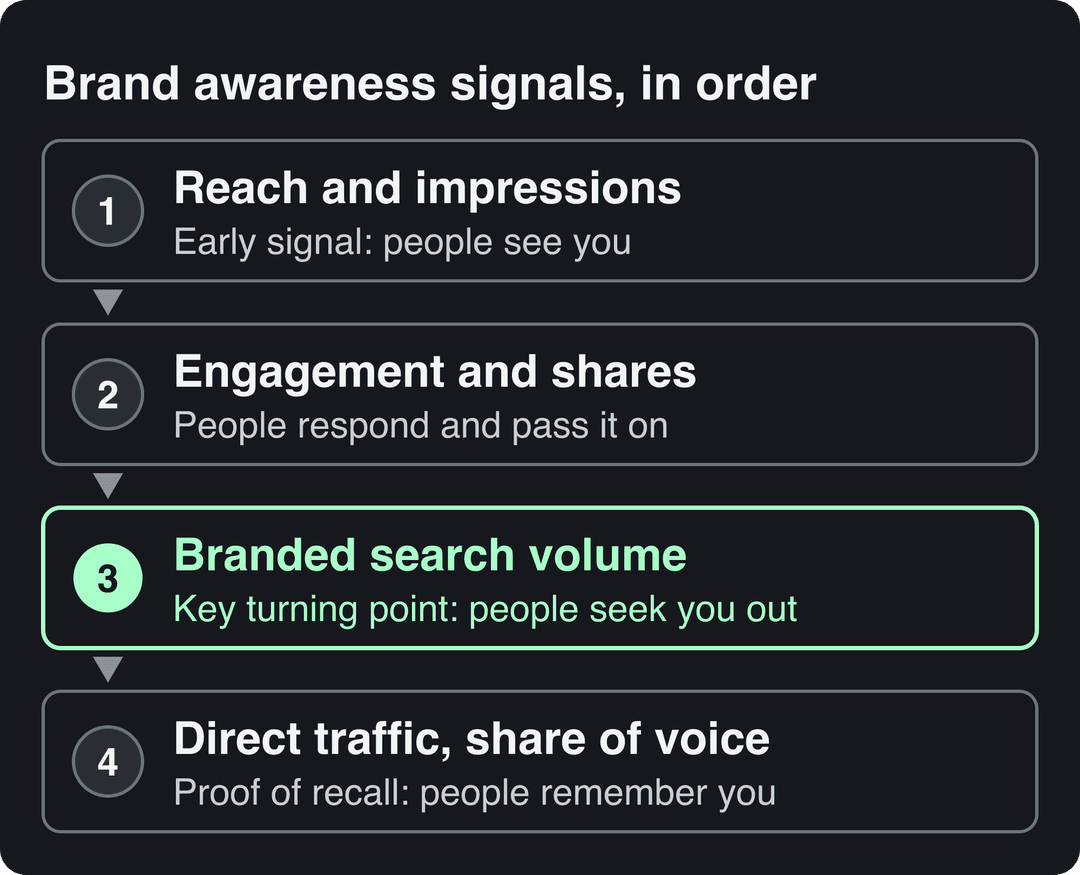
Reach and engagement move first and tell you whether your content travels. Branded search and direct traffic move later and tell you whether people remember you, so judge the program by those. To track how often you are mentioned against competitors, including in AI assistants' answers, this practical guide to share of voice measurement explains the methods.
FAQ
How long does it take to increase brand awareness?
Expect early signals, such as more direct traffic and more people tagging you, after 3 to 6 months of consistent publishing. Lasting recall and steady growth in branded search usually take 6 to 12 months of regular, multi-channel work.
How can a small business increase brand awareness on a small budget?
Narrow the focus: one niche, one or two channels, and short-form video plus helpful content every week. Add customer posts, local partnerships and events, which cost time more than money.
Does paid advertising increase brand awareness?
Yes, ads buy reach quickly, but recall fades when the spending stops. Paid works best when it amplifies posts that already performed organically, such as creator content run as partnership ads.
What is the difference between brand awareness and brand recognition?
Recognition means people identify your brand when they see it (name, logo, colors). Awareness is broader and includes recall: people think of you unprompted when they need what you sell, which is why branded search is the best proxy for it.
Which social media platform is best for brand awareness?
The one your buyers use most: LinkedIn for B2B, TikTok and Instagram for younger consumers, YouTube for research-heavy purchases. Pick one or two and post every week rather than spreading across all of them.
Sources
- Revid analysis of 176,367 TikToks with 1,000+ likes posted between Oct 1, 2025 and Oct 16, 2026 (61,203 creators)
- HubSpot, 2026 Marketing Statistics, Trends & Data (2026)
- Pew Research Center, 8 facts about Americans and TikTok (March 2026)
- Deloitte Digital, 2025 State of Social Research (May 2025)
Charts and figures checked on November 6, 2026.