Content Distribution Strategy: How to Build and Refine It in 2026
How to build a content distribution strategy across owned, earned and paid channels, refine it with the metrics that matter, and pick the channels that bring new audiences.
On this page
A content distribution strategy is the plan for where, when and in what format each piece of content is published and promoted across owned, earned and paid channels. Build it in this order: goal, audience, a short list of channels, a native version for each channel, a schedule, then a monthly review that cuts what underperforms.
Where you publish can matter more than what you publish. Socialinsider's 2026 study of 69 million short-form videos found that accounts with under 5,000 followers averaged 15,160 views per YouTube Short, against 625 per Instagram Reel and 350 per TikTok. Similar accounts and similar videos got dozens of times the reach depending on the feed. Most distribution plans never test that difference.
- Average views per YouTube Short for accounts under 5,000 followers (vs 350 on TikTok)
- 15,160
- Socialinsider, August 2026
- Share of YouTube Shorts users who are not on TikTok
- 45%
- Think with Google, April 2026
- Share of recommended Reels that were same-day posts in Q1 2026
- 30%+
- Meta Platforms, April 2026
- Lower CPA when partnership ads are added to regular campaigns
- 19%
- Meta, December 2025
What a content distribution strategy covers
Every piece of content can travel through three kinds of channels. A strategy decides which ones each piece uses, and in what order.
| Channel type | Examples | What it does best | Main limit |
|---|---|---|---|
| Owned | Website, blog, email list, your social accounts | Full control, compounding traffic | Slow to grow; social reach is set by algorithms |
| Earned | Shares, press, creator mentions, community posts, search rankings | Trust and new audiences | You can't control it directly |
| Paid | Social ads, boosted posts, creator partnership ads, sponsored newsletters | Speed and precise targeting | Reach stops when the budget stops |
The usual order is to publish on an owned channel, push for earned reach (shares, creators, communities, search), and put paid budget only behind pieces that have already proved themselves organically. For a longer primer on the three channel types, Contentoo's guide to content distribution strategy walks through each one with examples.
How to build a content distribution plan in 6 steps
- Give each piece one goal and one metric. For awareness, track views from non-followers or reach. For leads, track sign-ups or demo requests. For sales, track conversions from UTM-tagged links. If you can't name the metric, you can't refine the plan later.
- Go where your audience already is. Check your web analytics referrers, ask recent customers where they found you, and look at which accounts they follow. If you sell to B2B decision-makers, LinkedIn is the obvious first channel to test. If you sell an impulse-priced consumer product, short-form video feeds come first.
- Pick one primary channel and a few supporting ones. The primary channel gets native content on a fixed cadence. Supporting channels get adapted versions. Don't add a new channel until the primary one runs on schedule without heroics.
- Create once, adapt for each channel. One blog post can become a short vertical video, a LinkedIn text post, a carousel, a newsletter section and a reply in a community thread. Each version gets its own hook, length and format. Pasting the same file everywhere doesn't count as adapting.
- Put it on a calendar. A content deployment schedule lists what goes where and when, so the launch, the repurposed versions and the paid boosts happen in sequence instead of all on day one. Our social media content strategy guide covers planning the calendar itself.
- Amplify winners, not everything. Boost a post, or hand it to creators, only when it beats your organic average. Paid spend on a weak post just pays for more people to ignore it.
Template: a distribution plan for one blog post
| Channel | Format | When | Metric |
|---|---|---|---|
| Your blog | Full article | Launch day | Organic sessions, sign-ups |
| Email list | Short summary plus link | Launch day | Click-through rate |
| Text post with the key insight | Launch day | Comments, profile visits | |
| TikTok, Reels, Shorts | Vertical video of the main point | Same week | Views from non-followers |
| Communities (Slack groups, Reddit, forums) | Answer to a real question, linking the post | When a matching question comes up | Referral traffic |
| Paid social | Boost of the best-performing version | After the organic results are in | Cost per lead |
How can you refine your content distribution strategy?
Refine it in four moves: measure each channel against the goal metric you set, find where people drop off, change one variable at a time, and shift effort from losing channels to winning ones. Do it monthly on a fixed date so the review actually happens.
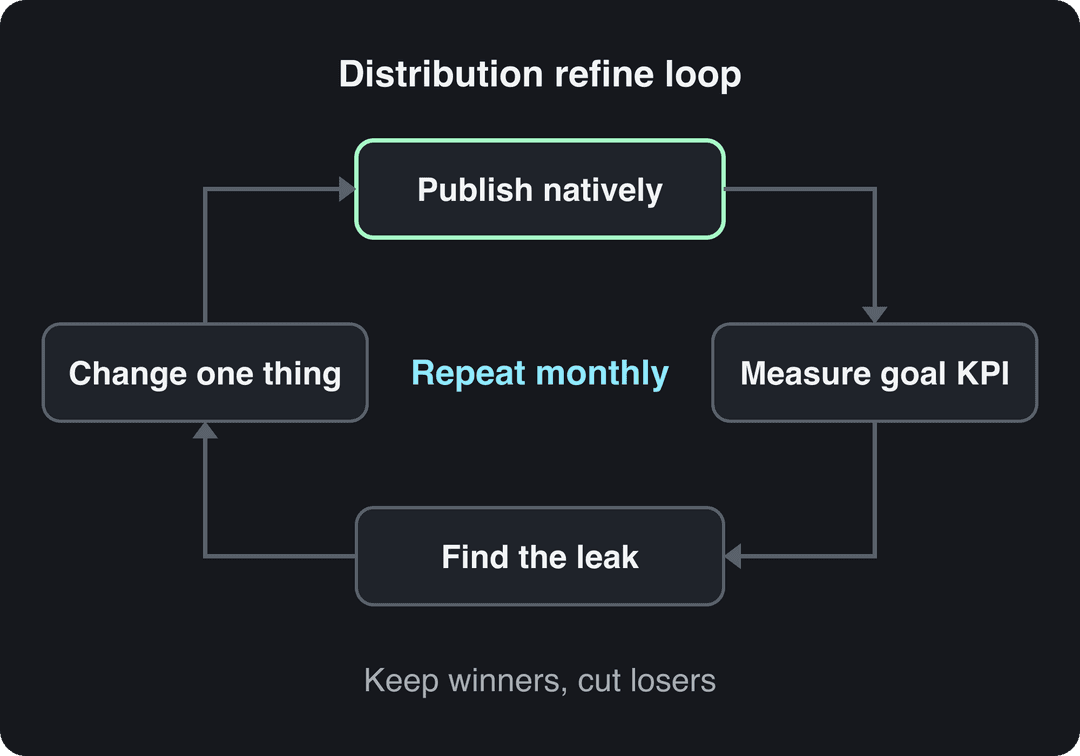
- Audit by goal, not by likes. List every channel with what it produced for the goal metric last month and the hours or budget it took. A channel with high engagement and zero sign-ups is a hobby, not a distribution channel.
- Find the leak. Use the table below to locate the problem.
- Change one variable at a time. Test the hook, the format, the posting time, the hashtags or the channel, one per round. If you change all of them at once, you learn nothing.
- Repurpose winners, retire losers. A post that beat your average on one channel is the first candidate for the next channel and for paid promotion. A channel that underperforms for several reviews in a row loses its slot.
- Recheck timing with your own data. TikTok Studio's Viewers tab shows when your viewers were most active over the last 7 days. Instagram's follower insights show the most-active times once you have at least 100 followers, over a window of up to 90 days.
| Symptom | Likely cause | What to change |
|---|---|---|
| Low impressions or views | Discovery: wrong channel, timing, format or tags | Test another channel or posting time, and use the platform's native format |
| Views, but people leave early | The opening: a weak hook or a slow start | Rewrite the first line or the first seconds |
| Watched, but few clicks | No reason to act | Add one clear next step and a link where the platform allows one |
| Clicks, but no conversions | The landing page | Make the page deliver what the post promised |
| Strong on one channel only | The format fits that audience | Adapt the format before moving it, instead of copying the file |
Which distribution channels help drive new audiences?
Recommendation feeds bring new audiences. Follower feeds and email mostly reach people who already know you. Put first the channels that show your content to non-followers by default.
- TikTok: the app opens on the personalized For You feed, so even a new account's video can reach people with no connection to it.
- Instagram Reels: reels up to 3 minutes can be recommended to non-followers; longer ones are not. Trial reels are shown first to non-followers, report insights within 24 hours and don't affect how your standard reels rank. They need a public account with at least 200 followers (professional accounts) or 1,000 (personal accounts).
- YouTube Shorts: apart from the reach gap above, Shorts reaches people the other apps miss. In April 2026, Google cited GWI data showing that 45% of YouTube Shorts users are not on TikTok and 65% are not on Instagram Reels (more on our YouTube Shorts statistics page).
- Search: blog posts, YouTube videos and answers that rank keep bringing in strangers for months after you publish them.
- Other people's audiences: creator collaborations, guest posts, podcast appearances and niche communities.
Content distribution tactics that work in 2026
Repurpose, then adapt to each platform
Repurposing is now standard practice. Wistia's 2026 State of Video Report found that over half of companies repurpose their videos into social clips. LinkedIn is the top destination (67% of teams post clips there), followed by Instagram (49%) and YouTube (41%), while about one in five teams share clips on TikTok. We collect these figures on our short-form video statistics page.
Adapting is where most teams cut corners. LinkedIn rewards a clear professional takeaway in the first lines. TikTok and Reels need a hook in the opening seconds and burned-in captions for viewers who watch with the sound off. YouTube Shorts can run up to 3 minutes and can send viewers on to your long videos. If video is your main format, our video distribution strategy guide goes through it channel by channel.
Use a handful of hashtags, not a wall
Hashtags help platforms categorize your post; they don't push it to everyone. Instagram now allows up to 5 hashtags per post, and a caption with more won't post. On TikTok, Revid's analysis of 176,367 TikToks with 1,000+ likes posted between October 2025 and October 2026 found that posts with 4 hashtags had the best median (77K views) and posts with 3 hashtags had 75K. Posts with no hashtags got 51K, and posts with 9 or more got only 16K. The sample only covers videos that had already passed 1,000 likes, so read these numbers as what strong posts have in common, not as proof that hashtags cause views.
Posts with 3 or 4 hashtags earned the most views. Captions stuffed with 9 or more hashtags did worst of all, with median views cut by about 80%.
Source: Revid analysis of 176,367 TikToks with 1,000+ likes posted between Oct 1, 2025 and Oct 16, 2026 (61,203 creators)
Show the data
| Median views | Share that passed 1M views | |
|---|---|---|
| None | 51.1K | 9.8% |
| 1 | 64K | 11.8% |
| 2 | 71.3K | 12.7% |
| 3 | 75.4K | 13.1% |
| 4 | 77.2K | 13.4% |
| 5 | 67.3K | 12.1% |
| 6 to 8 | 71.8K | 12.7% |
| 9+ | 15.6K | 7.8% |
Videos posted between 3 and 6 a.m. Eastern earned the most views and passed 1M views most often. The evening slot most guides recommend (5 to 9 p.m.) was the weakest of the day.
Source: Revid analysis of 123,704 English-language TikToks with 1,000+ likes posted between Oct 1, 2025 and Oct 16, 2026
Show the data
| Median views | Share that passed 1M views | |
|---|---|---|
| 12a | 67.3K | 14% |
| 1a | 79.4K | 15.1% |
| 2a | 79K | 14.2% |
| 3a | 90.8K | 16.1% |
| 4a | 120.4K | 19.9% |
| 5a | 93.5K | 16.7% |
| 6a | 97K | 17% |
| 7a | 75.8K | 13.1% |
| 8a | 83.9K | 14.3% |
| 9a | 70.5K | 13.1% |
| 10a | 65.5K | 13.6% |
| 11a | 65.7K | 13.1% |
| 12p | 60.4K | 11.9% |
| 1p | 60.9K | 11.8% |
| 2p | 53.7K | 11.2% |
| 3p | 63K | 11.9% |
| 4p | 63.8K | 11.5% |
| 5p | 55.6K | 11.1% |
| 6p | 55.3K | 11.5% |
| 7p | 50.4K | 11% |
| 8p | 60.5K | 12.3% |
| 9p | 62.2K | 13.1% |
| 10p | 62.3K | 12.6% |
| 11p | 67.2K | 13.3% |
Post when your audience is online
Generic "best time to post" charts describe someone else's audience, so start from your native analytics (see the refinement checklist above). For TikTok, the same Revid study found that posts at 3 to 6 a.m. US Eastern outperformed the 5 to 9 p.m. window, though those early hours are daytime for English-language viewers in Europe and Asia.
Publish while the topic is fresh (real-time content distribution)
Speed is a distribution advantage. Meta said same-day posts made up more than 30% of recommended Reels on Instagram and Facebook in Q1 2026, more than double the level a year earlier. When news or a trend breaks in your niche, a quick, decent post beats a polished one the following week. Watch TikTok trends today or each platform's trending tools, and keep a fast approval path for reactive posts.
Prompt to try
Create a 30-second vertical news video about Instagram's new limit of 5 hashtags per post. Open with the hook "Your hashtag wall just stopped working." Explain what changed and what creators should do instead, in a fast news style with bold burned-in captions.
Amplify user and creator content
Some of the best distribution runs on someone else's face and audience. Meta reported in December 2025 that adding partnership ads (creator content run as ads) to regular campaigns delivered 19% lower CPAs and 13% higher click-through rates on average. TikTok's Return on Influence report (January 2025) says Spark Ads built on user or creator content had a 30% higher completion rate and a 43% higher conversion rate than standard in-feed ads. Get written permission before you reuse anything: in MASV's 2024 survey, 47% of creators whose content had been used by brands said it was used without permission.
Add interactive formats
Polls, quizzes, questions in captions and "pick one" posts give people a reason to reply, and replies keep a post circulating. The video below covers the main types of interactive content.
How do you control content redistribution?
Content redistribution control means deciding who can republish, remix or embed your content, and on what terms. Set it at three levels:
- On your site: when partners syndicate your articles, ask them to add a canonical link to your original so search engines credit you. Publish clear reuse terms (all rights reserved, a Creative Commons license, or republishing allowed with attribution).
- On social platforms: TikTok's privacy settings let you allow or block downloads, Duets and Stitches. Instagram lets you turn remixing of your reels on or off. YouTube Studio lets you allow or block embedding on other sites. Menus move, so check each app's current settings.
- In syndication deals: media companies should write rights, territories and expiry dates into partner feeds and contracts, and track performance per partner to see which redistribution pays off.
When you are the one redistributing other people's content, the permission rule from the section on user and creator content applies.
AI content distribution: what to automate and what to keep human
An AI content distribution layer is the software between your content and your channels. It drafts platform versions, writes captions and translations, schedules posts and reports results. If you want the basics of the underlying technology, see IBM's overview of artificial intelligence.
- Automate: resizing and formatting, captions and subtitles, translations, first drafts of platform-specific copy, turning long content into short versions, scheduling and reporting.
- Keep human: the angle and the hook, the choice of channels, replies to comments, and anything that makes claims on behalf of your brand.
Two platform rules shape an AI video distribution strategy:
- Mass-produced AI content gets demoted or demonetized. On July 15, 2025, YouTube renamed its "repetitious content" policy to "inauthentic content", and AI videos made from generic templates that look mass-produced are not allowed to monetize. Facebook's 2026 originality rules push in the same direction.
- Labels don't cost reach. TikTok and YouTube both say that disclosing realistic AI content does not, by itself, reduce a video's distribution. Label it.
Results also vary by platform. Revid's study of AI videos vs real footage found that AI-generated TikToks averaged twice the views of real footage, while on X, Instagram and Threads, AI visuals clustered in the lowest engagement tier. Put AI video where it performs, and test before you assume.
Which solutions streamline content distribution across digital channels?
No single tool covers every channel. Match the tool type to the job:
| Job | Tool type | What to check before buying |
|---|---|---|
| Posting to many social accounts | Social media scheduler | Supported networks, approval workflow, per-post analytics |
| Feed management for media companies | Syndication or feed platform (RSS, MRSS, partner feeds) | Feed formats your partners accept, rights and expiry controls, per-partner analytics |
| Distribution analytics | Native analytics (TikTok Studio, Instagram insights, YouTube Studio) plus web analytics with UTM tags | Whether results tie back to your goal metric |
| Amplifying user and creator content | Creator ad formats such as Meta partnership ads and TikTok Spark Ads | Permissions and usage rights |
| Turning one piece into many videos | AI video creation with built-in publishing | Formats, languages, and which platforms it posts to |
| Fast delivery worldwide | Content delivery network (CDN) | Coverage in your audience's regions |
For media companies: feed management and distribution analytics
Media companies that send content to partner sites, apps and aggregators need two things. The first is feed management: one source of truth that outputs the right feed format for each partner. The second is distribution analytics that break results down by partner and by piece. Ask vendors to show per-partner reporting and rights controls in a live demo, not just on a feature list.
Automating multi-channel distribution while keeping the brand consistent
Automation keeps a brand consistent only when the inputs are fixed: one set of templates, fonts, colors, caption style and tone of voice per brand, an approval step before anything posts, and a short list of people who can publish. Automate the repetitive steps and keep a person on final approval for anything public.
How to distribute video across channels with Revid
Short-form video is usually the hardest format to produce for every channel, and it is the format Revid makes. To turn existing content into distributed video:
- Paste a blog post or article link into the article to video converter. Revid writes the script and generates the visuals, the voice-over and synced captions.
- Adjust scenes in the timeline editor, then export in 720p, 1080p or 4K.
- For other markets, use the AI video translator. Revid offers voices in 70+ languages and captions in 100+.
- Publish and schedule to TikTok, Instagram and YouTube from one queue with social media publishing. Each published post reports its views, likes and comments, and you can remix a post that did well in one click.
- To keep a channel supplied, set up Auto-Mode workers that create a fresh video every day from a prompt or a content source.
Revid publishes to TikTok, Instagram and YouTube only, so LinkedIn, X and email still need another tool. Plans start at $39/month.
FAQ
Which of the following is a key strategy for distributing your video content?
Adapt each video to the platform it runs on: vertical format, a hook in the opening seconds, captions for sound-off viewing, and a length and tone that fit that feed. Posting one unchanged file everywhere is the common mistake, and Facebook now deprioritizes lightly modified reposts.
What content delivery strategies improve global performance?
Serve media through a content delivery network close to your viewers, compress files, and use adaptive bitrate streaming so each viewer gets a version their connection can handle. To reach new language markets, localize as well: translated captions and voice-overs.
What is the difference between content marketing and content distribution?
Content marketing covers deciding what to make and making it. Content distribution is getting it in front of the right people through owned, earned and paid channels, and many teams treat it as an afterthought.
Do you need paid ads to distribute content?
No. Start with owned and earned channels, then use paid promotion to amplify posts that already beat your organic average. Paid budget behind an unproven post mostly buys impressions that don't convert.
How often should you review a content distribution plan?
Review channel results monthly, run a deeper audit each quarter, and do an extra review after any major platform change. Keep each review short: the goal metric per channel, one change to test, and one channel to cut or expand.
Sources
- Revid analysis of 176,367 TikToks with 1,000+ likes posted between Oct 1, 2025 and Oct 16, 2026 (61,203 creators)
- Revid analysis of 123,704 English-language TikToks with 1,000+ likes posted between Oct 1, 2025 and Oct 16, 2026
- Socialinsider, TikTok vs. Reels vs. Shorts: 2026 Engagement Data (August 2026)
- Think with Google, The YouTube Era's new marketing opportunities (April 2026)
- Meta Platforms, Meta Q1 2026 Results Conference Call transcript (April 2026)
- Meta, New AI-powered tools to scale creator and brand partnerships (December 2025)
Charts and figures checked on November 6, 2026.