Influencer Media Kit Examples: 6 Layouts to Copy (2026)
Six influencer media kit examples you can copy, from a one-page Instagram kit to an online kit, with sample copy, the metrics brands check and how to show rates.
On this page
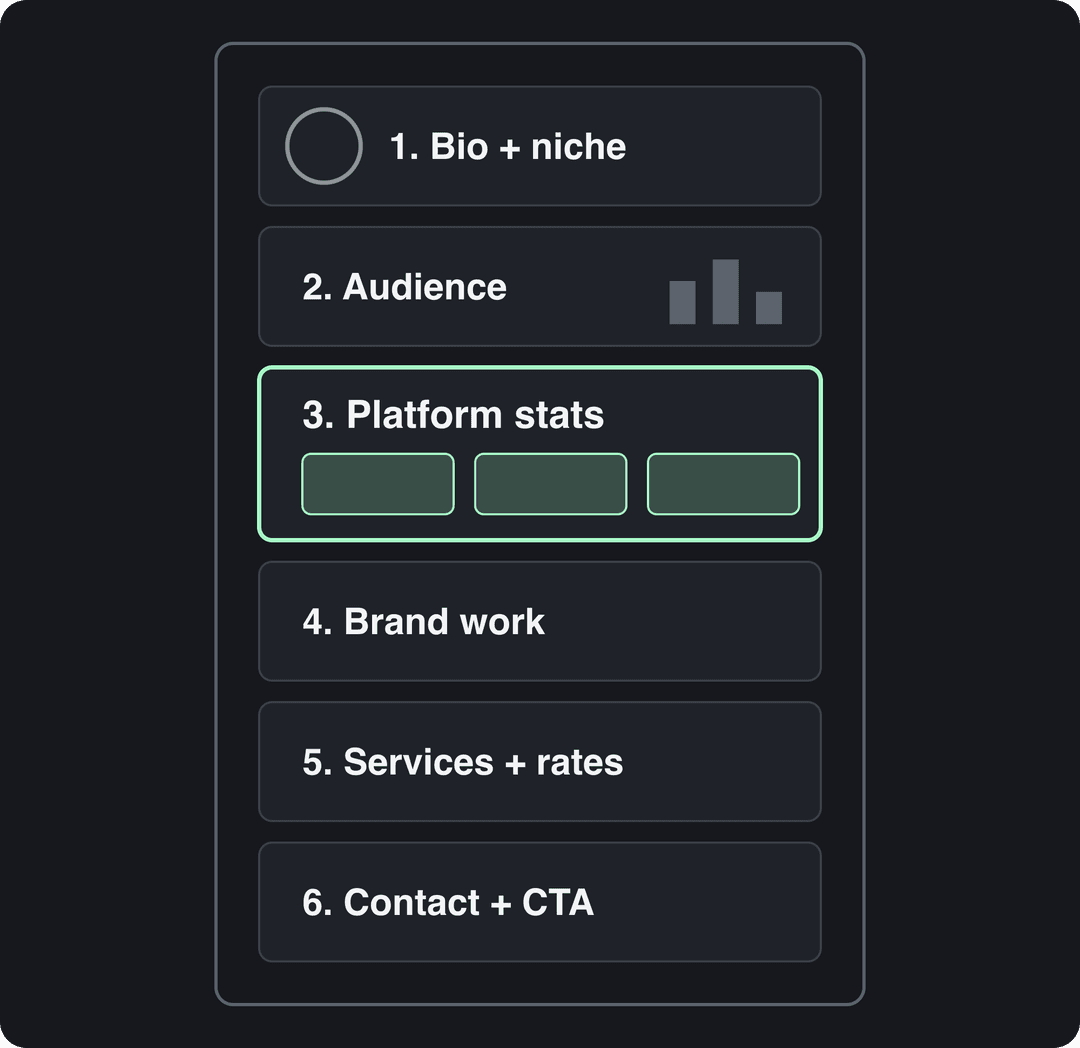
An influencer media kit is a one- or two-page PDF or web page that tells a brand who you are, who watches you and what working with you costs. The best examples share six sections: bio and niche, audience, platform stats, past brand work, services and rates, and contact details. Below are six example layouts you can copy.
Most kits fail on one line: the engagement rate, shown with no context. Socialinsider's 2026 study of 69 million short-form videos put the average engagement rate by followers at 2.60% on TikTok, 0.45% on Instagram Reels and 0.30% on YouTube Shorts. The same rate can be weak on TikTok and strong on Reels, so a kit that shows your rate next to the platform average answers the brand's first question before they ask it.
- Average TikTok engagement rate by followers, vs 0.45% on Reels and 0.30% on Shorts
- 2.60%
- Socialinsider, August 2026
- Share of base rate many creators charge for usage rights per 30 days
- 15-35%
- Aspire, February 2026
- Average cost of a UGC campaign on Collabstr's marketplace
- $197
- Collabstr, 2026
- Marketers planning to increase influencer marketing budgets in 2026
- 74%
- Aspire, 2026
What to include in an influencer media kit
Every strong media kit example below uses the same building blocks. Change the order and emphasis per platform, not the blocks themselves.
| Section | What to put | Example line |
|---|---|---|
| Bio and niche | Two or three sentences: who you are, what you post, for whom | "[Name] makes quick budget recipes for students living alone." |
| Audience | Age range, gender split, top countries and cities, taken from native insights | "Mostly women aged [range]. Top cities: [City], [City], [City]." |
| Platform stats | Followers, average views, engagement rate, per platform, with the date range | "TikTok: [followers] followers, [avg views] average views (last 28 days), [ER]% engagement" |
| Content pillars | The three themes or series you post most | "Weekly grocery hauls, 5-ingredient dinners, kitchen gadget tests" |
| Past brand work | Logos plus one to three short case studies with results | "[Brand] launch: [views] views, [clicks] link clicks, [uses] code redemptions" |
| Services and rates | Deliverables, starting prices or "from" prices, usage rights | "Dedicated TikTok video: from $[price], includes 30 days of organic usage" |
| Testimonials | One or two short quotes from brands you worked with | "Delivered ahead of schedule, top-performing creator in our campaign." ([Brand], [role]) |
| Contact | Email, handles, response time, one clear next step | "Email [address]. I reply within two business days." |
Put the stats in the top half of page one. A brand manager skims for niche, audience fit and average views first, and decides whether to read the rest.
6 influencer media kit examples to copy
The examples use placeholders in brackets. Replace each one with your real numbers from the platform's own analytics, and add the date you pulled them.
1. One-page Instagram media kit
Best for: lifestyle, beauty, food and travel creators whose feed is their portfolio.
Layout, top to bottom:
- Header: photo, name, handle, one-line niche ("Plant-based dinners for busy parents").
- Stats bar: followers, average Reel views, average Story views, engagement rate.
- Audience: age, gender, top three cities, as small bar charts.
- A grid of six of your best posts, two of them sponsored.
- Services: Reel, Story set, carousel, bundle.
- Contact and a call to action.
Which Instagram numbers to show: Instagram insights now lead with Views (how often content was played or displayed) and show Viewers (unique accounts) separately. Report average Reel views, saves and shares rather than likes alone, since saves and shares show purchase intent. Follower insights such as top locations and most active times need at least 100 followers, and the insights window covers up to the past 90 days, so pull your audience screenshot shortly before you send the kit.
Sample bio copy: "I post 3 plant-based dinners a week for parents who cook in under half an hour. My audience saves recipes to cook later, which is why grocery and kitchen brands get repeat exposure from one post."
The index leans toward videos that surface in hashtag and keyword searches, so its view counts run high: compare the groups, not the absolute numbers.
Source: Revid TikTok index: 2,377,477 TikToks with AI labels per video, snapshot of Sep 15, 2026. Median views estimated from view buckets.
Show the data
| Median views | Share past 1M views | |
|---|---|---|
| Challenge | 226.9K | 32% |
| Comedy | 194.6K | 29.9% |
| Dance | 121K | 23.4% |
| Reaction | 117.4K | 23.4% |
| Tutorial | 111.5K | 22.2% |
| Storytelling | 107.7K | 21.5% |
| Lip Sync | 90.7K | 21.4% |
2. TikTok media kit
Best for: creators whose reach comes from the For You feed rather than followers.
Layout, top to bottom:
- Header with niche and handle.
- Stats: followers, average views over the last 28 days, average shares, average watch time.
- Links to your three best videos, with a one-line note on why each worked.
- Formats you can deliver: talking head, voiceover, POV, tutorial, TikTok Shop affiliate video.
- Past brand work with results.
- Rates and contact.
Where to find the numbers: TikTok analytics live in TikTok Studio (profile, menu, TikTok Studio, Analytics), on Studio Web and in the TikTok Studio app, with date ranges of 7, 28, 60 or 365 days. Use 28 days for "recent performance" and say so on the kit. The Followers tab shows follower activity by hour and day, which is useful when a brand asks when a sponsored video should go live.
Before choosing which videos to feature, run a free TikTok account audit to see which of your formats consistently perform, not only which one went viral once. Brands care about repeatable results.
3. YouTube media kit
Best for: long-form creators, and channels that mix long-form videos with Shorts.
Layout, top to bottom:
- Channel banner, name, niche, subscriber count.
- Long-form stats: average views per video in the first 30 days, average view duration, total watch time.
- Shorts stats, listed separately from long-form.
- Audience: age, gender, top countries, from YouTube Studio.
- Integration options: dedicated video, integrated mention, Shorts, pinned comment and description link.
- Case studies, rates, contact.
Keep long-form and Shorts numbers apart. A brand buying a 60-second mention in a long video needs your long-form averages, and blending in Shorts views inflates them. Note the counting change too: since August 24, 2026, YouTube counts a view the moment a video starts to play on every format, so view counts can read higher than in older kits. Brands that know this may ask for average view duration as well, so include it.
4. Online media kit (web page or link in bio)
Best for: creators who pitch often or work across several platforms.
An online media kit is a single page on your website, a Notion page or a link-in-bio page. It has three advantages over a PDF: you can embed videos that play in place, you update the numbers in one spot, and the link never goes stale in a brand's inbox.
What good online media kit examples include:
- The same six sections as a PDF, in one scrolling page.
- Embedded top videos instead of screenshots.
- A "Last updated: [month, year]" line under the stats.
- A button to download a PDF version, because many brands attach kits to internal briefs.
- A contact form or mailto link at the top and bottom.
Open the page on your phone before you share it. Brand managers often review pitches from a phone, and a desktop-only layout with tiny stats looks careless.
5. Multi-platform social media kit
Best for: creators active on two or more platforms who want one document.
Replace the single stats bar with a table, one row per platform:
| Platform | Followers | Avg views (period) | Engagement rate | Best format |
|---|---|---|---|---|
| TikTok | [n] | [n] (last 28 days) | [x]% by views | Voiceover tutorials |
| [n] | [n] Reel views (last 90 days) | [x]% by followers | Carousels, Reels | |
| YouTube | [n] subscribers | [n] per long-form video | Avg view duration [m:ss] | Reviews |
Then add a line on how a campaign can run across all of them, for example one long-form review cut into a Reel and a TikTok. Keep branding identical across every platform section (same fonts, colors and photo) so the kit matches what brands find when they look you up; consistency is part of building a recognizable social media presence.
Prompt to try
Create a 20-second vertical UGC-style demo video for a reusable glass water bottle, filmed like a smartphone selfie in a bright kitchen. Open with the hook "I stopped buying plastic bottles after this", show the leak-proof lid and the fruit infuser, and end with a casual recommendation. Natural, friendly tone with on-screen captions.
6. Small creator or UGC creator kit
Best for: creators with a small audience, and UGC creators who make videos for brands to post on their own accounts.
When your follower count is not the selling point, lead with the work:
- Header: name, niche, "UGC creator" or "content creator".
- Portfolio: four to six sample videos by type (unboxing, testimonial, demo, hook variations).
- What you deliver: raw files, edited versions, hook variants, captions, turnaround time.
- Usage rights options and pricing.
- Contact.
Skip the audience section if it is thin, or keep it to one line. Brands buying UGC care about the video and the rights, not your followers.
How to present your metrics so brands trust them
Show engagement rate with its formula and period, because brands calculate it differently:
- Engagement rate by followers: (likes + comments + shares + saves) ÷ followers × 100. Common on Instagram.
- Engagement rate by views: (likes + comments + shares + saves) ÷ views × 100. Better on TikTok, where most views come from non-followers.
Then place your number next to a benchmark from the same platform:
| Platform | Average engagement rate by followers (Socialinsider, 2026) |
|---|---|
| TikTok | 2.60% |
| Instagram Reels | 0.45% |
| YouTube Shorts | 0.30% |
These come from Socialinsider's 2026 study of 69 million short-form videos, which we summarize with other sourced short-form benchmarks.
For TikTok, Revid's own data gives a per-view yardstick. In Revid's analysis of 176,367 TikToks with 1,000+ likes posted between October 2025 and October 2026, likes equaled 7.1% of views, shares 0.88% and comments 0.08%. The sample only includes videos that already earned 1,000+ likes, so treat these as a strong-performance bar, not an average. The full method is in our study of what makes a TikTok go viral.
Three rules that make the numbers credible:
- Use averages over a stated period, not your best video. Put the viral one in the portfolio instead.
- Add a screenshot of the analytics page, or offer one on request.
- Turn numbers into an outcome for the brand: "My audience saves recipes, so one post keeps getting views for weeks" says more than a bare rate. This guide to influencer press kit metrics has more ways to frame engagement for brands.
How to show rates and partnership options
You can publish exact prices, "from" prices, or write "rates on request". "From" prices work best for most creators: they filter out brands with no budget without locking you into a number.
A simple rate card lists:
- Deliverables: one video, a Story set, a carousel, a bundle across platforms.
- What each includes: number of revisions, script approval, posting window.
- Usage rights: how long the brand can repost or run your content as ads, and what extra usage costs.
- Add-ons: link in bio, raw footage, whitelisting.
Usage rights deserve their own line. In Aspire's 2026 survey of nearly 900 marketers and creators, 67% of brands said they include paid usage rights in the creator's initial contract or rate, and many creators price usage at 15% to 35% of their base rate per 30 days.
For UGC pricing, Influencer Marketing Hub's 2026 benchmark found roughly 80% of responses put UGC creator costs under $500, with most of the rest between $500 and $2,000. On Collabstr's marketplace, the average UGC campaign cost $197 in its 2026 report. More context is on our UGC and creator marketing statistics page.
The budget is there to ask for: Aspire's State of Influencer Marketing 2026 found that 74% of marketers plan to increase their influencer marketing budgets in 2026. If brand deals are one income stream among several, compare them with the other ways to monetize a TikTok account.
Posts promoting a brand
Source: Revid social index: 388,379 posts from X, Instagram, Threads, Reddit and LinkedIn with AI labels per post, snapshot of Sep 15, 2026.
Show the data
| Posts promoting a brand | |
|---|---|
| 26% | |
| X | 24.5% |
| Threads | 15.4% |
Media kit design: format, length and tools
- Length: one page; two if you have case studies. Anything longer does not get read.
- Format: PDF named "[Name]-Media-Kit-[Month-Year].pdf", plus an online version if you pitch often.
- Type: one heading font, one body font, big numbers for stats.
- Color: your brand colors from your profile, with plenty of white space around the stats.
- Tools: Canva's free templates are enough for most creators; Google Slides exported to PDF works too.
Buffer's guide to building an influencer media kit walks through more template options if you want a second set of layouts to compare.
Add a highlight reel with Revid
A 30-second highlight reel linked at the top of your kit shows your style faster than a grid of screenshots. With Revid's story-from-video tool, you upload your best clips and photos and Revid assembles them into one short video, with automatic captions and music you can adjust in the timeline editor. Export in 720p, 1080p or 4K, then use the video resizer to make 9:16, 4:5, 16:9 or 1:1 versions so the same reel fits your TikTok, Instagram and YouTube sections. Sign-up is free and new accounts get free credits to try it, no credit card needed; regular creation then uses a paid plan's monthly credits, from $39/month.
Media kit mistakes that cost brand deals
| Mistake | Fix |
|---|---|
| Stats from six months ago | Update before every pitch and add a "last updated" date |
| Follower count with no views or engagement | Lead with average views and engagement rate, with the period |
| One generic kit for every brand | Swap the featured posts and case study to match the brand's category |
| Only glowing, scripted sponsored posts | Show honest reviews: in Bazaarvoice's 2025 report, 43% of shoppers said they trust creators who share both pros and cons |
| Cluttered pages and walls of text | Keep it to one page, bullets and tables |
| Contact details buried on page two | Put email and handles in the header and the footer |
| No next step | End with one action, such as "Reply with your campaign dates and I'll send a proposal within two days" |
That last line matters more than it looks: a specific ask gets more replies than "let's work together". See these call to action examples for wording you can adapt.
FAQ
Is a media kit the same as an influencer PR kit?
No. A media kit is the document you send brands to pitch yourself; a PR kit (sometimes called a demo kit or influencer kit) is the product package a brand sends to creators hoping they will post about it.
How long should an influencer media kit be?
One page is ideal and two pages is the maximum. Put niche, audience and average views on the first screen, and move anything else to an online version.
Should I put my rates in my media kit?
Use "from" prices for your main deliverables, or write "rates on request" if your prices change often. Either way, state what usage rights each price includes.
Do I need a media kit with a small following?
Yes. A small creator kit that leads with sample videos, deliverables and turnaround time is how UGC creators and micro creators get paid work before their audience grows.
How often should I update my media kit?
Update the stats before each pitch and do a full refresh every few months or after any big campaign. An online kit makes this a quick edit instead of a new PDF.
How do I make a media kit for free?
Start from a free Canva template or a Google Slides page, fill in the six sections above, and export a PDF. Pull every number from the platform's own analytics so it matches what brands see.
Sources
- Revid TikTok index: 2,377,477 TikToks with AI labels per video, snapshot of Sep 15, 2026. Median views estimated from view buckets.
- Revid social index: 388,379 posts from X, Instagram, Threads, Reddit and LinkedIn with AI labels per post, snapshot of Sep 15, 2026.
- Socialinsider, TikTok vs. Reels vs. Shorts: 2026 Engagement Data (August 2026)
- Aspire, How brands and creators are navigating content usage rights in 2026 (February 2026)
- Collabstr, 2026 Influencer Marketing Report (2026)
- Aspire, The State of Influencer Marketing 2026 (2026)
Charts and figures checked on November 6, 2026.